Food safety guide
Food Safety Management System (FSMS): What It Is and Why You Need One
A comprehensive guide to building a compliant Food Safety Management System under UK law. Learn what EHOs look for, the core components of an FSMS, and how to implement one step by step.
1 February 2026
If you run a food business in the United Kingdom, you are legally required to have a food safety management system in place. That much is straightforward. What is less clear for many operators is what an FSMS actually looks like in practice, how it differs from a HACCP plan, and what level of documentation is appropriate for your size and type of business.
This guide breaks down the FSMS from its legal foundations through to practical implementation. Whether you are running a single-site cafe or managing a multi-site manufacturing operation, the principles are the same, even if the scale differs considerably.
What Is a Food Safety Management System?
A Food Safety Management System is the structured framework your business uses to identify, prevent, and control food safety hazards. It is the overarching system that brings together every policy, procedure, record, and practice related to producing safe food.
The legal basis sits in Regulation (EC) No 852/2004 on the hygiene of foodstuffs, which was retained in UK law after Brexit. Article 5 of that regulation requires food business operators to put in place, implement, and maintain a permanent procedure based on HACCP principles. But the regulation also requires compliance with general hygiene requirements set out in its annexes, covering everything from premises layout to personal hygiene.
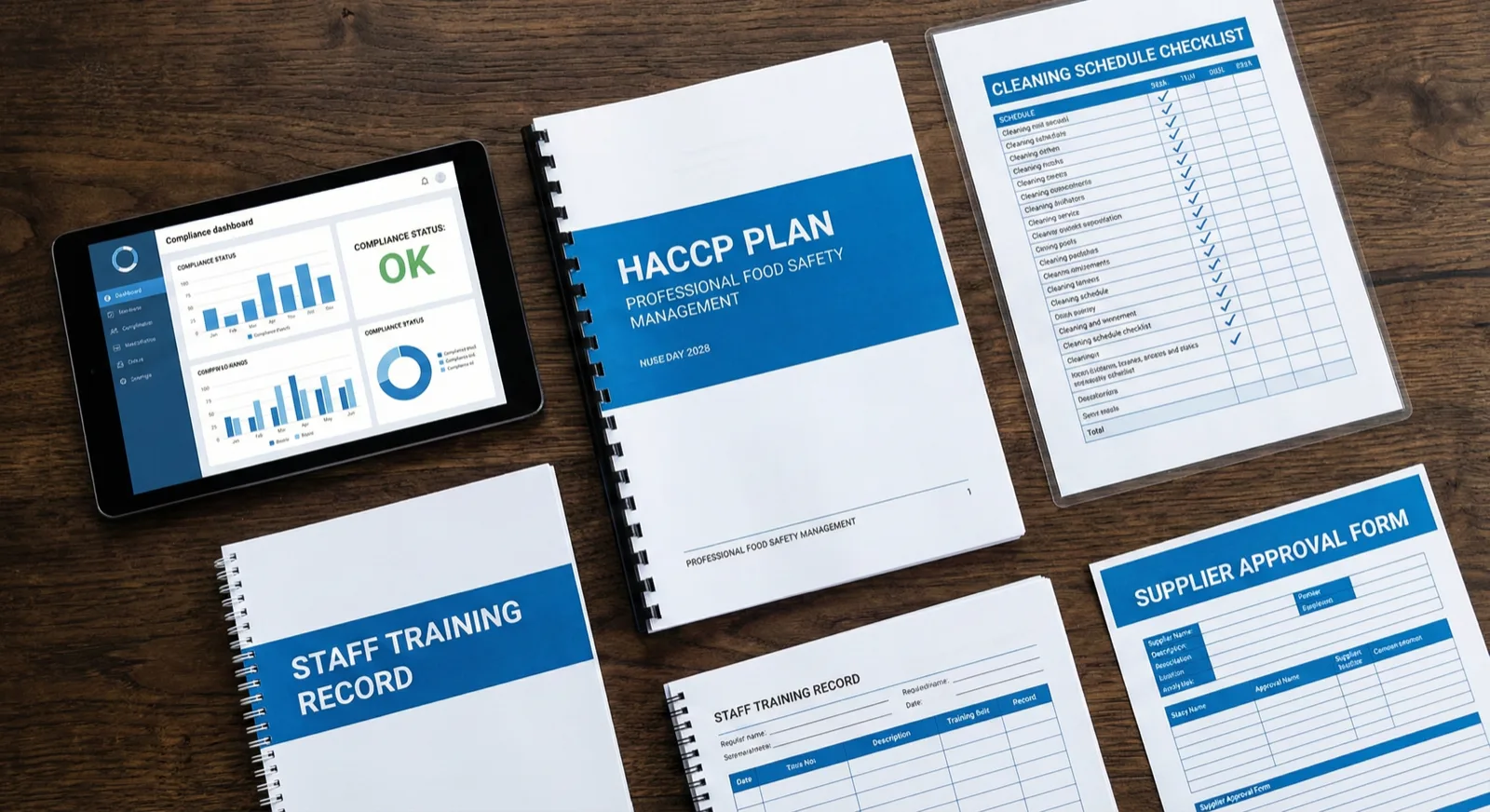
This is where a common misunderstanding arises. Many food business operators equate their FSMS with their HACCP plan. In reality, the HACCP plan is one component of the broader system. Think of the FSMS as an umbrella: underneath it sit your prerequisite programmes (cleaning schedules, pest control, maintenance), your HACCP plan, your training records, your traceability procedures, and every other documented process that contributes to food safety.
An FSMS is not a single document. It is the totality of how your business manages food safety, from the moment raw materials arrive to the point a finished product reaches the consumer.
Why Every UK Food Business Needs an FSMS
The requirement is not optional. Under the Food Safety Act 1990 and the supporting regulations, every food business registered with its local authority must operate a food safety management system based on HACCP principles. Failure to do so is a criminal offence that can result in prosecution, improvement notices, or closure.
Beyond the legal baseline, there are several practical reasons to take your FSMS seriously:
-
Food Hygiene Rating Scheme (FHRS) scores. Environmental Health Officers assess your food safety management system as one of three scoring areas during inspections. The “Confidence in Management” element directly evaluates whether you have a documented, functioning FSMS. A weak system will drag your rating down regardless of how clean your kitchen looks on the day.
-
Protection against enforcement action. If a food safety incident occurs, having a robust, well-documented FSMS demonstrates due diligence. This is your primary legal defence under the Food Safety Act 1990. Without it, you have very little to fall back on.
-
Customer and supplier expectations. Retailers, hospitality groups, and contract caterers increasingly require their suppliers to demonstrate formal food safety management. A documented FSMS is often a prerequisite for winning or retaining commercial contracts.
-
Insurance requirements. Many product liability and public liability insurers expect food businesses to maintain a documented FSMS. Some will not provide cover, or will limit cover, without evidence that one is in place.
-
Operational consistency. Beyond compliance, an FSMS helps your business deliver consistent food safety standards regardless of who is on shift. It reduces reliance on individual knowledge and makes your operation more resilient to staff turnover.
Core Components of an FSMS
A comprehensive FSMS is built from several interconnected components. The exact structure will vary by business, but most systems include the following nine elements:
-
Prerequisite programmes. These are the foundational controls that must be in place before your HACCP plan can function effectively. They include cleaning and disinfection schedules, pest control arrangements, equipment maintenance programmes, waste management procedures, water supply verification, and personal hygiene rules. Without solid prerequisite programmes, your HACCP plan is built on unstable ground.
-
HACCP plan. Your hazard analysis and critical control point plan is the systematic process of identifying biological, chemical, physical, and allergen hazards, then establishing controls at critical points. This is the regulatory centrepiece of your FSMS, but it does not stand alone.
-
Supplier approval. You need a documented process for approving and monitoring your suppliers. This typically includes checking supplier certifications, conducting questionnaires or audits, monitoring delivery quality, and maintaining an approved supplier list. Traceability starts with knowing where your ingredients come from.
-
Staff training records. Every member of staff who handles food must receive adequate training in food hygiene appropriate to their role. Your FSMS should include a training matrix, records of completed training, and a schedule for refresher training. Environmental Health Officers will check that training is not just delivered but documented.
-
Allergen management. Your system must include procedures for managing allergens throughout your operation, from ingredient specifications through to communication with customers. This includes allergen information for every dish or product, procedures to prevent cross-contamination, and staff training on allergen awareness.
-
Traceability system. Under UK food law, you must be able to trace ingredients one step back to your supplier and finished products one step forward to your customer. Your traceability system should enable you to do this quickly and accurately. The FSA expects you to be able to provide this information within a reasonable timeframe.
-
Complaint handling. You need a documented process for receiving, investigating, and responding to food safety complaints. This should include a log of complaints, investigation records, corrective actions taken, and trend analysis to identify recurring issues.
-
Recall and withdrawal procedures. If a food safety issue requires you to remove a product from sale or recall it from consumers, you need a pre-planned procedure. This should include contact lists, communication templates, and a clear process for managing the recall. Hoping you never need it is not a strategy.
-
Document control and review. Your FSMS must include a system for managing documents, ensuring current versions are in use, archiving superseded documents, and reviewing the entire system at planned intervals. A system that is written once and never updated is not a functioning FSMS.
FSMS for Small Businesses vs Large Operations
One of the most common concerns from small food business operators is that an FSMS sounds like an enormous bureaucratic undertaking. The good news is that the law requires a system proportionate to your business.
Small businesses (cafes, takeaways, small restaurants). For many small food businesses, the FSA’s Safer Food, Better Business (SFBB) pack provides a ready-made framework that satisfies the legal requirement for an FSMS. It includes prerequisite programmes, a simplified HACCP-based approach, and diary pages for ongoing records. If you are a single-site operation with a straightforward menu, SFBB may be entirely sufficient. EHOs are familiar with it and accept it as a valid system.
Medium businesses (multi-site restaurants, catering companies, mid-size producers). As your operation grows in complexity, SFBB may no longer provide enough structure. You will likely need a more formal, bespoke FSMS with detailed HACCP plans for different product groups, documented supplier approval processes, and more rigorous record-keeping. This is where many businesses find the transition challenging, as the step up from SFBB to a bespoke system requires food safety expertise.
Large operations and manufacturers. At this scale, your FSMS will typically be aligned with a recognised food safety standard such as ISO 22000, BRCGS (British Retail Consortium Global Standards), or SQF (Safe Quality Food). These standards provide a comprehensive framework for your FSMS and are often required by major retail customers. Certification involves third-party auditing and ongoing surveillance.
The key principle is proportionality. Your system should be as simple as possible while still being adequate for the hazards and complexity of your operation. An over-engineered system is as problematic as an inadequate one, because staff will not follow it.
How to Build an FSMS Step by Step
If you are building an FSMS from scratch or overhauling an existing system, the following steps provide a structured approach:
-
Assess your current position. Before building anything new, audit what you already have. Many businesses have informal food safety practices that simply need documenting and formalising. Identify gaps against the core components listed above and prioritise the areas of highest risk.
-
Establish prerequisite programmes. Get your foundations right first. Document your cleaning schedules, pest control arrangements, maintenance procedures, personal hygiene rules, and waste management. These need to be in place and functioning before your HACCP plan can be effective.
-
Conduct a thorough hazard analysis. Work through your processes from goods receipt to service or dispatch. Identify the biological, chemical, physical, and allergen hazards at each step. Be honest about the risks rather than aspirational.
-
Develop your HACCP plan. Based on your hazard analysis, identify your critical control points, set critical limits, establish monitoring procedures, define corrective actions, and plan verification activities. If you need a detailed walkthrough of this process, see our complete guide to HACCP.
-
Create standard operating procedures (SOPs). For each key process, write clear, concise procedures that staff can follow. These should be practical rather than theoretical. Include who is responsible, what they need to do, how often, and what to do if something goes wrong.
-
Implement a training programme. Develop a training plan that covers induction training for new starters, role-specific food safety training, and regular refresher sessions. Record all training and ensure staff sign to confirm their understanding.
-
Set up your record-keeping system. Decide how you will capture and store records, whether on paper or digitally. At a minimum, you need records for temperature monitoring, cleaning checks, deliveries, staff training, and corrective actions. Whatever system you choose, it must be easy for staff to use consistently.
-
Establish a review schedule. Your FSMS is not a static document. Plan formal reviews at least annually, or more frequently if your business changes. Reviews should also be triggered by food safety incidents, customer complaints, changes to products or processes, and legislative updates.
What EHOs Look for in Your FSMS
Understanding what Environmental Health Officers evaluate during inspections helps you build a system that meets their expectations. EHOs are not looking for perfection. They are looking for a system that is genuine, functional, and proportionate.
A documented system that reflects actual practice. The single biggest issue EHOs encounter is a gap between what is written down and what actually happens in the kitchen or factory. Your documented procedures must match your actual operations. If your cleaning schedule says the extraction canopy is cleaned weekly but it clearly has not been touched in months, the system loses all credibility.
Evidence of ongoing monitoring. EHOs want to see completed monitoring records: temperature logs, cleaning checklists, delivery checks. Gaps in records raise immediate concerns. Consistent, up-to-date records demonstrate that your system is active rather than decorative.
Corrective actions. When monitoring reveals a problem, such as a fridge temperature above the critical limit, EHOs want to see what you did about it. Documented corrective actions show that your system functions as intended. A perfect set of records with no corrective actions is actually less credible than records showing occasional problems that were identified and resolved.
Staff awareness. Officers will often ask staff questions about food safety procedures, allergen management, or what they would do in a specific scenario. If your team cannot answer basic questions about the system, it suggests the FSMS exists on paper only.
Review history. Evidence that the system has been reviewed and updated demonstrates management commitment. Dated review records, updated documents, and evidence of changes made following reviews all contribute positively to the Confidence in Management score.
The Confidence in Management score is arguably the most important element of your FHRS rating, because it reflects how likely you are to maintain standards in the future. A strong FSMS, consistently followed and regularly reviewed, is the foundation of a high score.
Common FSMS Pitfalls
Many food businesses invest time and money into building an FSMS only to see it fail in practice. Understanding why food safety systems fail helps you avoid the most common mistakes:
-
Over-complicated systems. A 200-page FSMS manual that nobody reads is worse than useless. It creates a false sense of security while staff continue to rely on habit and guesswork. Keep your documentation as simple and practical as possible.
-
No staff buy-in. If your team views the FSMS as a paperwork exercise imposed by management, compliance will be poor. Involve staff in developing procedures, explain the reasoning behind controls, and make it clear that food safety is a shared responsibility.
-
Outdated documentation. Menus change, suppliers change, staff change, and regulations change. If your FSMS does not keep pace, it becomes increasingly disconnected from reality. Schedule regular reviews and update documents promptly when changes occur.
-
Poor record-keeping. Records completed in bulk at the end of the week, identical entries day after day, or significant gaps all undermine your system. If record-keeping is burdensome, simplify the forms or consider moving to a digital system that makes daily compliance quicker.
-
No management review. An FSMS without regular management oversight drifts. Senior management must actively engage with the system, review its effectiveness, and allocate resources for improvements. The review process should be documented and result in tangible actions.
Paper vs Digital FSMS
Traditionally, food safety management systems have been paper-based: folders of procedures, printed checklists, handwritten temperature logs. This approach is still legally acceptable, but it comes with well-known limitations.
Paper-based systems are familiar and require no technology investment. However, they are vulnerable to damage, difficult to analyse for trends, time-consuming to maintain, and almost impossible to monitor across multiple sites. Retrieving specific records during an inspection or audit can be slow, and there is no way to verify when a record was actually completed.
Digital systems address many of these shortcomings. They offer real-time visibility of compliance across your operation, automated alerts when monitoring tasks are overdue, timestamped records that cannot be backdated, easier trend analysis and reporting, and reduced administrative burden on staff. A digital approach also makes it simpler to manage document control, ensuring that everyone is working from the current version of a procedure.
For businesses managing food safety across multiple sites or with large teams, a platform like Forkto can consolidate your daily monitoring, temperature checks, audits, and corrective actions into a single system, giving you real-time oversight of monitoring tasks, automated reminders, and audit-ready records without the filing cabinets.
The transition from paper to digital does require planning. Staff need training on the new system, and you need to ensure that the digital platform you choose is accessible and reliable in your working environment. A system that requires five minutes of loading time on a tablet in a busy kitchen will not get used.
Whichever approach you take, the principle remains the same: your record-keeping system must be practical enough that staff use it consistently and accurate enough that it provides genuine evidence of compliance.
FSMS and Food Safety Standards
For some food businesses, meeting the baseline legal requirement is sufficient. For others, particularly those supplying major retailers or exporting products, third-party certification against a recognised food safety standard becomes necessary.
The most commonly encountered standards in the UK are:
-
ISO 22000. An international standard for food safety management systems that integrates HACCP principles with a management system approach similar to ISO 9001. It is suitable for any organisation in the food chain and is widely recognised globally. ISO 22000 provides a framework but allows flexibility in how you implement it.
-
BRCGS Global Standard for Food Safety. Originally developed by the British Retail Consortium, this is the dominant standard in UK food manufacturing. Most major UK retailers require their suppliers to hold BRCGS certification. It is prescriptive, with detailed requirements covering everything from site standards to product control. Certification involves an annual audit by an accredited certification body.
-
SQF (Safe Quality Food). More commonly required by North American retailers, SQF may be relevant if you export to the US or Canada. It is benchmarked against the Global Food Safety Initiative (GFSI), as is BRCGS, so the two are broadly equivalent in scope.
Pursuing certification is a significant commitment. It requires investment in your FSMS, staff training, and annual audit fees. However, it can open commercial doors that would otherwise remain closed, and the discipline of working to a standard often raises the overall quality of your food safety management.
If you are considering certification, it is worth noting the relationship between these standards and HACCP and HARPC, particularly if you are exporting to markets with different regulatory frameworks.
For most small to medium food businesses, however, the priority should be building a solid FSMS that meets UK legal requirements and achieves a good FHRS score. Certification can be pursued later if commercial needs require it.
Getting Started
Building or improving your FSMS does not need to happen overnight. Start by honestly assessing where you are today, identify the gaps that carry the greatest risk, and work through them systematically. A simple, well-implemented system that your team actually follows will always outperform an elaborate one that exists only on paper.
If you are looking for a practical way to bring your food safety management system together, Forkto helps food businesses manage their daily food safety tasks digitally, with tools designed to make routine compliance straightforward for teams of any size. You can explore how it works and whether it suits your operation at forkto.com.
Whatever approach you take, the goal is the same: a food safety management system that protects your customers, satisfies your legal obligations, and gives you confidence that your business is doing things properly, every day.
Related Forkto software
Safe hands, clear records
Stop running food safety on paper
Forkto turns daily checks, temperature logs, HACCP and audits into a few taps on a phone. Your team stays consistent and you're always ready for the EHO.
14-day free trial · No card required