Food safety guide
Goods-In Checks: The Food Safety Step Most UK Kitchens Are Getting Wrong
Delivery checks are a critical control point in your HACCP plan — but most kitchens accept stock without properly checking it. This guide covers exactly what to check on delivery, what to reject, and how to document it for EHO compliance.
24 February 2026
Every piece of food in your kitchen arrived on a delivery. And every delivery is a potential entry point for food safety risk — contaminated product, cold chain failures, damaged packaging, incorrectly labelled goods. The moment stock crosses your threshold is one of the most important control points in your entire food safety system.
Most kitchens know this in theory. In practice, deliveries often go like this: the delivery driver arrives, the kitchen porter or chef checks the delivery note against the boxes, everything gets moved into storage, and the delivery note gets filed. Temperature? Not checked. Packaging condition? Glanced at. Use-by dates? Assumed to be fine.
This is a genuine HACCP failure. Goods-in is a critical control point in almost every food safety management system — which means that if you are not checking it properly and recording what you find, you have a documented gap in your compliance.
Here is what a proper goods-in process looks like, and why it matters more than most operators realise.
Why Goods-In Is a Critical Control Point
Your HACCP plan identifies hazards and the controls that prevent them from causing harm. For incoming deliveries, the relevant hazards are:
- Microbial contamination — product that has been in the temperature danger zone (8°C–63°C) for too long, or that has been cross-contaminated during transport
- Physical contamination — damaged packaging that has allowed foreign objects, pests, or environmental contamination to reach the food
- Chemical contamination — cleaning products or other chemicals stored or transported alongside food
- Allergen contamination — product that does not match its specification, has been reformulated without notice, or is incorrectly labelled
At the point of delivery, you have your last and best opportunity to catch these issues before the product enters your kitchen and your food production process. Once a contaminated product is in your walk-in fridge, mixed with your other stock, and eventually used in food preparation, the risk has already materialised.
An EHO reviewing your HACCP plan will look for evidence that your goods-in critical control point has defined monitoring procedures, defined critical limits, and a corrective action for when limits are not met. They will also look for records showing that monitoring actually happens.
What to Check on Every Delivery
Temperature
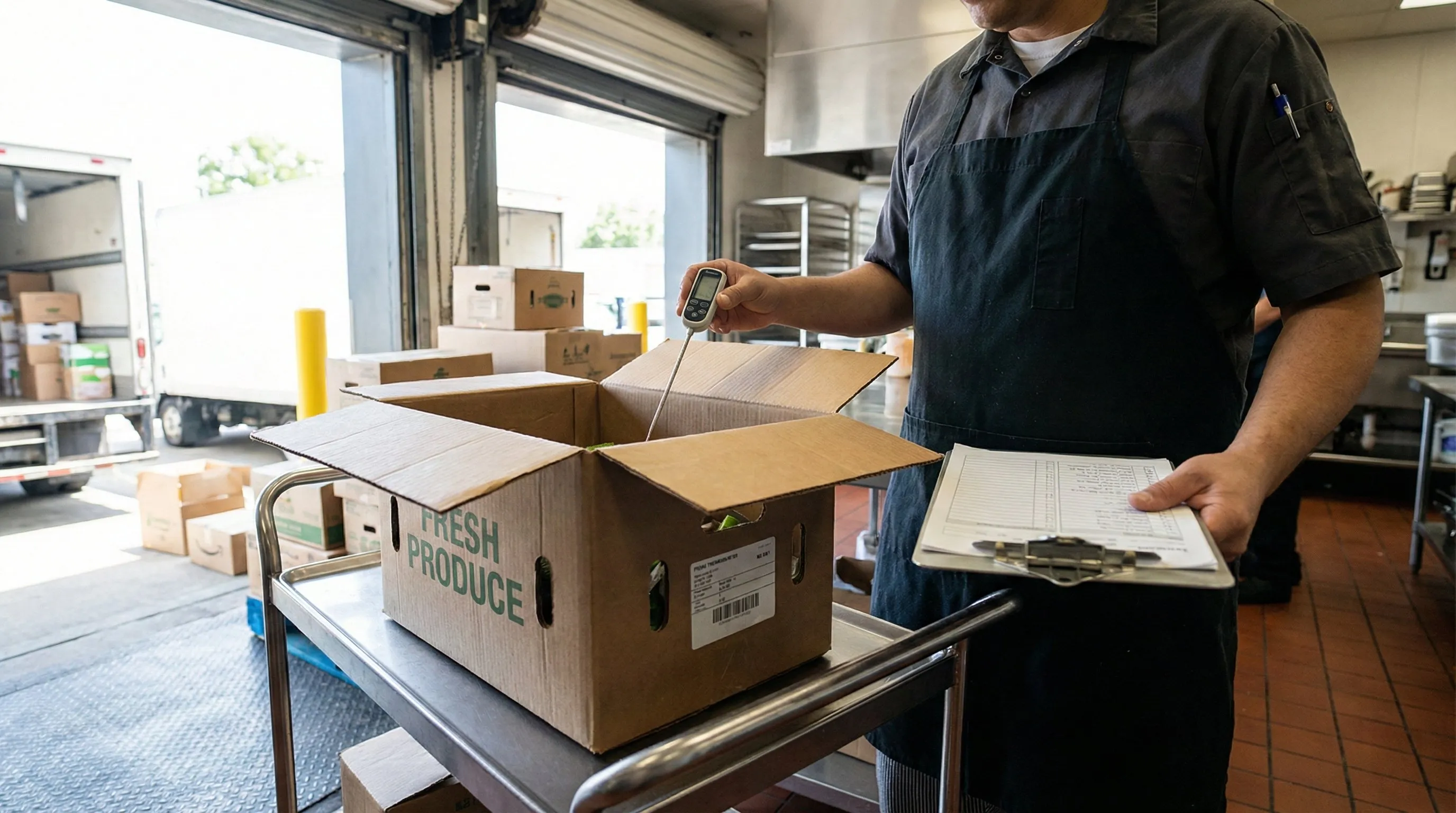
For chilled deliveries, the accepted threshold is 8°C or below at the point of delivery. For frozen deliveries, product should arrive at -18°C or below, with no evidence of thawing and refreezing (ice crystals on the outside of packaging, product that has clumped together, soft texture in what should be solid-frozen items).
Use a calibrated probe thermometer. Either probe the product directly (using a clean, sanitised probe and probing to the centre of the product) or use an infra-red thermometer to take a surface reading. If you are probing directly, note that surface temperatures will typically be warmer than the core — if the surface is already at the limit, the core temperature needs to be checked.
Record the actual temperature for every chilled and frozen delivery. “Okay” is not a temperature reading. 4°C is a temperature reading.
If a chilled delivery arrives above 8°C, it should be rejected. If you choose to accept a borderline delivery — for example, a delivery that arrives at 8°C exactly and goes straight into the fridge — record your decision and your reasoning. A product arriving at 9°C with no corrective action and no record is a compliance failure. A product arriving at 8°C with a record of the temperature and the decision to accept is a managed situation.
Packaging condition
Check all packaging before accepting the delivery:
- Damaged packaging — torn bags, cracked containers, broken seals. Damaged packaging exposes food to environmental contamination and potential pest access. Reject damaged items or, if the damage is minor and the food is clearly unaffected, document it.
- Blown or damaged tins — tins that are swollen, dented at the seam, or showing any sign of damage to the seal should always be rejected. A blown tin can indicate Clostridium botulinum contamination, which is invisible and extremely dangerous.
- Vacuum pack failures — vacuum-packed products where the seal has failed or the pack is no longer under vacuum should be treated with caution and, in most cases, rejected.
- Evidence of pest damage — gnaw marks, droppings, or contamination inside or on the outside of packaging. Reject and notify your supplier.
Date labels
Check the use-by or best before dates on all delivered items. You should not accept product that is already close to its use-by date unless you can guarantee using it in time. More importantly, check that the date labels on the delivery match what you ordered — a substituted product may have different allergen content and a different shelf life.
For products with use-by dates rather than best before dates, there is a legal obligation not to use or sell product past the date. Check dates on arrival so you know exactly what you have accepted.
Quantity and specification
Check the delivery against your order — right products, right quantities, right specifications. A substitution by a supplier (a different brand, a different cut, a different formulation) may affect your allergen matrix, your recipe costings, and your portion calculations. It is better to catch it at the door than after the product has been used in service.
If a supplier regularly substitutes products without notice, that is a supplier relationship issue worth addressing — not just for convenience but because specification changes can have allergen implications.
Temperature of the delivery vehicle
If the driver leaves the vehicle door open for an extended period during unloading, or if you notice that the vehicle refrigeration does not appear to be operating, make a note. A delivery that was within temperature on arrival may have been borderline throughout a poorly refrigerated journey, and that context is useful if you have any concerns about product quality.
What to Do When Something Is Wrong
Define your rejection criteria in advance — do not make the decision at the door under pressure. Your HACCP plan should specify:
- Temperatures above which chilled or frozen goods are rejected
- Packaging conditions that result in rejection
- The process for recording a rejected delivery
- Who has authority to reject a delivery
When you reject a product, you do not need to accept an argument from the delivery driver. The decision is yours, based on your food safety standards. Record what you rejected, why, the quantity, and the supplier. Notify the supplier and, if relevant, request a credit or replacement.
If you accept product that is borderline — slightly above temperature but within a range you are comfortable with given the context — record your reasoning. This is what due diligence looks like: a documented, conscious decision rather than an unchecked acceptance.
Storing Deliveries Correctly After Acceptance
Checking the delivery is only half the goods-in process. What you do with product after it passes your checks matters too:
Refrigerated and frozen items first. Ambient products can wait. Chilled and frozen products go into temperature-controlled storage immediately after checking — every minute at room temperature is time in the danger zone.
Apply your own date labels. Once you open or decant a product, apply a date label showing when it was opened and your internal use-by date. Do not rely solely on the manufacturer’s label once the original packaging has been breached.
FIFO — first in, first out. New stock goes behind existing stock. This principle is only effective if it is actively practised at every delivery, every time.
Separate raw and ready-to-eat. Raw meat, poultry, and fish should go directly into dedicated, covered storage, below ready-to-eat foods. Never place raw protein deliveries on a shelf above ready-to-eat items, even temporarily.
Check your fridge temperatures after a large delivery. A significant volume of ambient-temperature products entering a fridge can raise the temperature meaningfully. Check that the unit recovers to its normal operating temperature before the end of the next monitoring window.
Recording Goods-In Checks
Your goods-in records should include:
- Date and time of delivery
- Supplier name
- Products received (or reference to delivery note)
- Chilled and frozen temperatures (actual readings)
- Packaging condition (pass / any issues noted)
- Date labels checked (pass / any items flagged)
- Any rejections — product, quantity, reason
- Name of person completing the check
These records serve two purposes: they demonstrate that your HACCP critical control point is being actively monitored, and they give you a searchable history if a food safety issue is ever traced back to a specific delivery.
How Forkto Helps
Forkto’s delivery logging feature lets your team record goods-in checks on any device at the point of delivery. Temperature readings, packaging condition, and any rejections are logged with a timestamp and the name of the person completing the check.
Because deliveries are recorded in the same system as your temperature logs, cleaning records, and daily opening and closing checks, you have a single, coherent compliance record rather than a delivery log that lives separately from everything else. When an EHO asks to see your goods-in records, they are available immediately — searchable by date, supplier, or product.
See how Forkto’s delivery logging works
Goods-In Check Quick Reference
For every chilled or frozen delivery:
- Temperature checked with a calibrated thermometer — actual reading recorded
- Chilled goods at 8°C or below; frozen goods at -18°C or below
- Packaging checked — no damage, blown tins, broken seals, or pest evidence
- Date labels checked — nothing accepted past or close to use-by date
- Delivery checked against order — correct products, quantities, and specifications
- Any rejections recorded — product, quantity, reason
- Chilled and frozen products moved to temperature-controlled storage immediately
- FIFO applied — new stock placed behind existing stock
- Own date labels applied to opened or decanted products
- Fridge temperature checked after large deliveries
Further reading
- Goods-In Delivery Record (free printable PDF) — a one-page delivery check sheet covering temperatures, vehicle, packaging, date codes and accept/reject decisions
- How to Choose Food Suppliers in the UK — the selection framework that decides what lands at your back door in the first place
- Allergen Matrix: The UK Food Business Guide — how to process supplier allergen specifications at goods-in
- UK Food Recalls & Fines 2026 Report — supplier-chain prosecutions where goods-in checks failed
Related Forkto software
Safe hands, clear records
Stop running food safety on paper
Forkto turns daily checks, temperature logs, HACCP and audits into a few taps on a phone. Your team stays consistent and you're always ready for the EHO.
14-day free trial · No card required