Food safety guide
HACCP vs HARPC: What's the Difference?
HACCP and HARPC are both food safety systems, but they serve different regulations. Learn the key differences and what UK businesses exporting to the US need to know about HARPC compliance.
1 February 2026
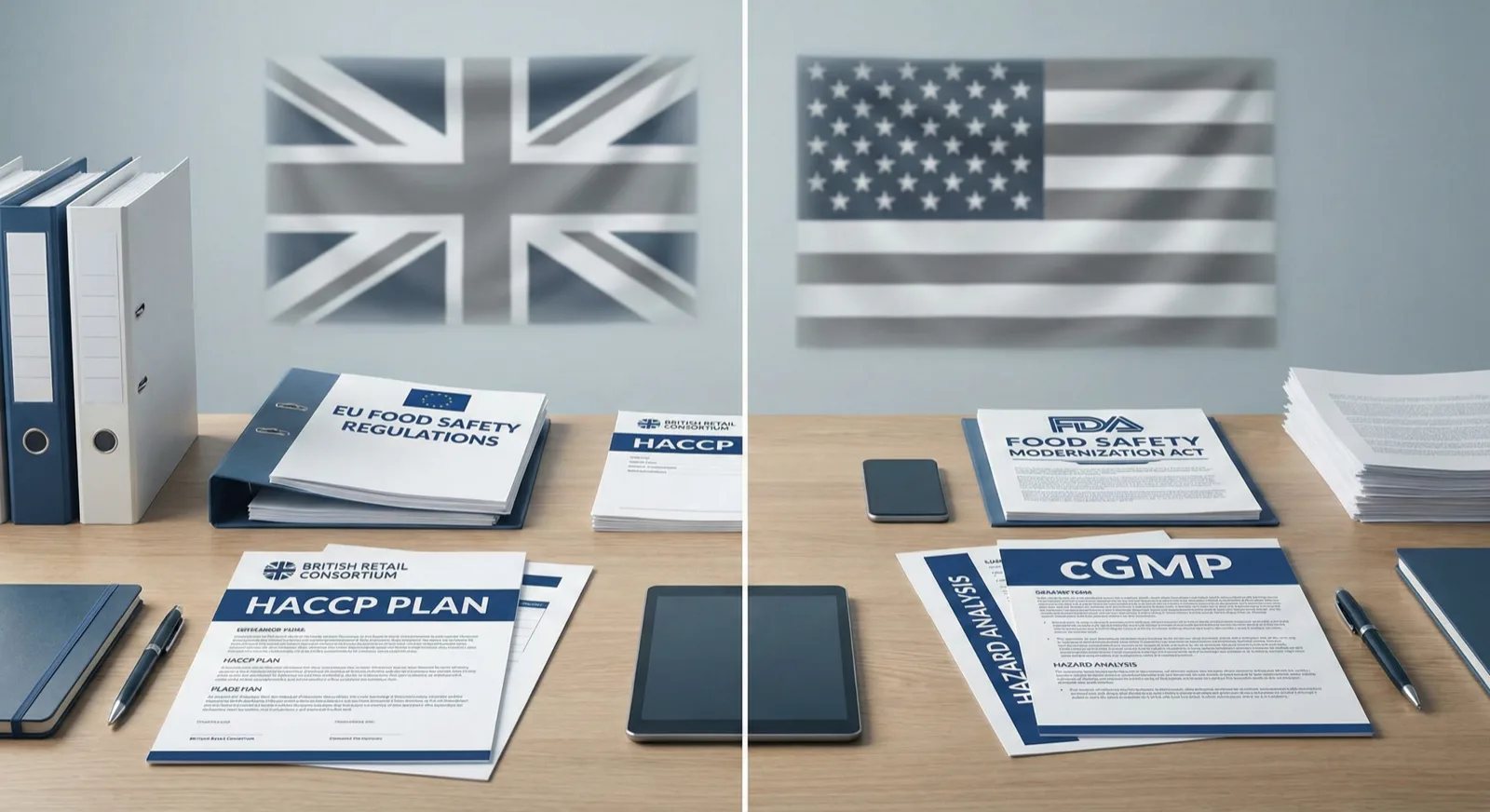
If your food business operates solely within the UK, you are likely familiar with HACCP — the hazard analysis framework required under European and domestic food safety law. But if you export to the United States, or manufacture products for US-based clients, you will encounter a different acronym: HARPC.
Both systems share the goal of preventing foodborne illness, and there is considerable overlap between them. However, HARPC introduces several requirements that go beyond what a traditional HACCP plan covers. Understanding these differences is essential for any UK food business looking to trade across the Atlantic.
This article breaks down both systems, highlights the key differences, and offers practical guidance on bridging the gap between your existing HACCP plan and US HARPC requirements.
Quick Comparison Table
| Feature | HACCP | HARPC |
|---|---|---|
| Origin / Legislation | Codex Alimentarius (international); mandated in the UK under EC Regulation 852/2004 | US Food Safety Modernization Act (FSMA), 2011 |
| Scope | Primarily biological, chemical, and physical hazards | Biological, chemical, physical hazards plus intentional adulteration and radiological hazards |
| Core Framework | 7 principles with Critical Control Points (CCPs) | Risk-based preventive controls (broader than CCPs) |
| Supply Chain Requirements | Not explicitly required | Mandatory supply chain programme with supplier verification |
| Recall Plan | Not mandated | Written recall plan required |
| Qualified Personnel | Trained individuals (no formal title required) | Preventive Controls Qualified Individual (PCQI) required |
| Record-Keeping | Required at CCPs | Comprehensive records across all preventive controls |
| Reanalysis | Periodic review recommended | Mandatory reanalysis at defined triggers (minimum every 3 years) |
| Regulatory Body | FSA (UK), with reference to Codex standards | US FDA |
| Who Needs It | All UK food businesses handling, processing, or distributing food | Food facilities registered with the US FDA |
What Is HACCP?
HACCP stands for Hazard Analysis and Critical Control Points. Developed from the Codex Alimentarius Commission’s guidelines, it is the internationally recognised framework for managing food safety hazards during production and handling.
In the UK, HACCP-based procedures are a legal requirement under EC Regulation 852/2004 (retained in UK law post-Brexit) and are enforced through the Food Safety Act 1990. Environmental Health Officers (EHOs) assess HACCP compliance as part of routine inspections, and your Food Hygiene Rating Scheme (FHRS) score depends in part on having documented HACCP procedures in place.
The system is built on seven principles:
- Conduct a hazard analysis
- Determine Critical Control Points (CCPs)
- Establish critical limits for each CCP
- Set up monitoring procedures
- Define corrective actions
- Implement verification procedures
- Maintain documentation and records
HACCP focuses on identifying specific points in your process where hazards can be controlled or eliminated. It is well established, widely understood, and forms the backbone of food safety management across Europe, Australasia, and much of the global food industry.
For a more detailed walkthrough of each principle and how to build your HACCP plan, see our complete guide to HACCP for UK businesses.
What Is HARPC?
HARPC stands for Hazard Analysis and Risk-Based Preventive Controls. It was introduced as part of the US Food Safety Modernization Act (FSMA), signed into law in 2011 and phased in through subsequent FDA rules.
FSMA represented a fundamental shift in American food safety regulation — moving from a reactive model (responding to outbreaks) to a preventive one (stopping problems before they occur). HARPC is the centrepiece of that shift.
Under HARPC, any food facility that is required to register with the US FDA must develop and implement a written food safety plan that includes:
- A hazard analysis covering all known or reasonably foreseeable hazards
- Preventive controls to address identified hazards
- A supply chain programme to verify that suppliers are managing hazards effectively
- A recall plan describing procedures for recalling products if needed
- Monitoring, corrective action, and verification procedures
- A reanalysis schedule, triggered by specific events or at minimum every three years
Critically, HARPC expands the categories of hazard beyond what traditional HACCP addresses. In addition to biological, chemical, and physical hazards, HARPC requires businesses to consider radiological hazards and intentional adulteration (such as economically motivated tampering or acts of deliberate contamination).
The food safety plan must be prepared or overseen by a Preventive Controls Qualified Individual (PCQI) — a person who has completed standardised training recognised by the FDA.
Key Differences Between HACCP and HARPC
While both systems begin with hazard analysis, the way they approach prevention, documentation, and oversight differs in several important ways.
1. Scope of Hazards
HACCP addresses biological, chemical, and physical hazards — the three categories most commonly encountered in food production. HARPC retains all three but adds two more: radiological hazards and intentional adulteration. The inclusion of intentional adulteration reflects growing concern about food fraud, economically motivated tampering, and deliberate contamination of the food supply.
For UK businesses, this means that your existing hazard analysis may not cover the full range of threats that HARPC requires you to assess.
2. Preventive Controls vs Critical Control Points
HACCP is structured around Critical Control Points — specific steps in your process where a hazard can be prevented, eliminated, or reduced to an acceptable level. The emphasis is on identifying a limited number of critical points and monitoring them closely.
HARPC uses the broader concept of “preventive controls,” which can include:
- Process controls (similar to CCPs)
- Allergen controls
- Sanitation controls
- Supply chain controls
- A recall plan
This broader framing means that HARPC does not limit risk management to discrete points in the production process. Instead, it encourages a more holistic view of the controls needed across your entire operation, including areas that HACCP typically addresses outside the formal CCP structure.
3. Supply Chain Programme
One of the most significant additions in HARPC is the requirement for a documented supply chain programme. If a hazard in your product is controlled by your supplier rather than by your own process, HARPC requires you to verify that the supplier is managing that hazard adequately.
This may involve:
- Approved supplier lists
- Supplier audits or certifications
- Incoming goods verification activities
- Written procedures for how you evaluate and monitor suppliers
HACCP does not include an equivalent formal requirement, although many UK businesses already carry out some level of supplier assurance as part of their broader food safety management system.
4. Recall Plan
HARPC mandates that every covered facility maintains a written recall plan. This plan must describe the procedures you would follow to notify customers, retrieve affected products, and communicate with the FDA in the event of a recall.
Traditional HACCP does not require a recall plan as part of the core framework. In the UK, recall and withdrawal procedures are typically managed through separate guidance issued by the FSA, but they are not embedded in the HACCP principles themselves.
5. Preventive Controls Qualified Individual (PCQI)
HARPC requires that your food safety plan is prepared, or its preparation overseen, by a PCQI. This is a person who has successfully completed a standardised curriculum recognised by the FDA — typically the FSPCA (Food Safety Preventive Controls Alliance) course.
HACCP requires that your team includes trained individuals, but there is no equivalent formal qualification or title. In the UK, competence is assessed by EHOs during inspections, and training expectations vary depending on the nature and scale of your business.
6. Reanalysis Triggers
Both systems expect you to review and update your food safety plan over time. However, HARPC is more prescriptive about when reanalysis must occur. Under FSMA, reanalysis is required:
- At least once every three years
- When a significant change occurs in your operations
- When you become aware of new hazard information
- When a preventive control is found to be ineffective
- After an unanticipated food safety problem
HACCP recommends periodic review but does not impose the same structured triggers, which means reanalysis can sometimes be overlooked — one of the reasons food safety systems fail in practice.
When UK Businesses Need to Know About HARPC
If your business operates entirely within the UK and does not export, HACCP under EC 852/2004 remains your primary obligation. However, HARPC becomes relevant in several scenarios:
- Exporting food products to the US. If your products enter the American market, the importing US facility is subject to FSMA. The FDA may also conduct inspections of foreign suppliers, meaning your operations could come under direct scrutiny.
- Manufacturing for US-based clients. Even if you do not export directly, a US client may require HARPC-compliant documentation from their supply chain partners as part of their own supplier verification programme.
- UK businesses with US operations. If your organisation has facilities or subsidiaries in the United States, those sites must comply with FSMA directly.
- Preparing for global food safety standards. Understanding HARPC positions your business to meet the expectations of international markets and global standards such as ISO 22000 and BRCGS.
Can Your HACCP Plan Satisfy HARPC Requirements?
The good news is that if you have a well-documented HACCP plan, you already have a strong foundation. The hazard analysis, monitoring procedures, corrective actions, and record-keeping that HACCP requires overlap significantly with HARPC.
However, gaps will exist. To bridge them, you will typically need to:
- Expand your hazard analysis to include intentional adulteration and radiological hazards. This may require a separate vulnerability assessment.
- Document a supply chain programme that describes how you verify your suppliers’ controls for hazards they manage on your behalf.
- Create a written recall plan with clear procedures, responsibilities, and communication protocols.
- Appoint or train a PCQI. At least one person in your organisation should complete the FSPCA Preventive Controls for Human Food course (or the equivalent for animal food, if applicable).
- Formalise your reanalysis schedule with defined triggers, not just an annual review date.
- Review your record-keeping to ensure it covers all preventive controls, not only CCPs.
For businesses managing both HACCP and HARPC documentation, keeping everything aligned and up to date can be a significant administrative burden — which is where dedicated HACCP software earns its place. Forkto helps UK food businesses maintain their HACCP plans digitally — with temperature monitoring, daily checks, corrective action tracking, and audit-ready records — within a single platform, reducing duplication and making audit preparation more straightforward.
Which Standard Should Your Business Follow?
The answer depends on where your products are sold and what your growth plans look like.
If your business operates only in the UK: HACCP-based procedures under EC 852/2004 are sufficient to meet your legal obligations. Focus on building a robust plan that satisfies EHO inspections and supports your FHRS rating. If you are using the FSA’s Safer Food, Better Business pack, you are already working within a HACCP-based framework.
If you export or plan to export to the US: You will need to ensure your food safety plan meets HARPC requirements under FSMA. Start with your existing HACCP plan and address the gaps outlined above. Engaging with the FSPCA training programme early will help your team understand the specific expectations of the FDA.
If you are pursuing global market access: Consider aligning your food safety management system with ISO 22000 or FSSC 22000, which harmonise HACCP principles with broader management system requirements. These standards incorporate many of the elements that HARPC adds — including supply chain management, prerequisite programmes, and structured review cycles — and are recognised by regulators and retailers worldwide.
A practical decision framework:
- Do you sell food products in the US market? If yes, you need HARPC compliance.
- Do you supply US-based food businesses? If yes, check whether they require HARPC-aligned documentation from suppliers.
- Do you operate only in the UK with no US trade? If yes, HACCP under EC 852/2004 meets your obligations.
- Are you seeking internationally recognised certification? If yes, explore ISO 22000 or FSSC 22000 as a route that satisfies both HACCP and HARPC expectations.
Moving Forward
HACCP and HARPC are not competing systems — they are complementary approaches shaped by different regulatory environments. For UK food businesses, HACCP remains the legal baseline. HARPC becomes relevant the moment your products or your supply chain crosses into the US market.
The most practical approach is to treat your HACCP plan as the foundation and build outward. Address the specific HARPC requirements — supply chain verification, recall planning, PCQI training, expanded hazard analysis — as additions rather than replacements.
If you are looking to bring your HACCP documentation into a single system that can adapt as your compliance requirements grow, Forkto offers a straightforward way to manage food safety records, track corrective actions, and maintain the documentation your business needs for UK compliance.
Further reading
- What is HACCP? The Complete UK Guide — the full UK HACCP framework, 4-nation differences and named prosecutions
- Safer Food Better Business (SFBB): The Complete Guide — the FSA simplified HACCP-based pack for small UK caterers
- How to Get a 5-Star Food Hygiene Rating — how your HACCP system feeds the FHRS scoring
Related Forkto software
Safe hands, clear records
Stop running food safety on paper
Forkto turns daily checks, temperature logs, HACCP and audits into a few taps on a phone. Your team stays consistent and you're always ready for the EHO.
14-day free trial · No card required