Food safety guide
Natasha's Law: The Definitive Guide for UK Food Businesses (2026)
Everything UK food businesses need to know about Natasha's Law — what PPDS means, labelling requirements, the 14 allergens, real prosecution cases, sector-specific guidance, and what's coming next with Owen's Law.
5 February 2026
On 17 July 2016, a fifteen-year-old named Natasha Ednan-Laperouse bought an artichoke, olive and tapenade baguette from Pret a Manger at Heathrow Airport Terminal 5. She told her father she had found a baguette that contained all the ingredients she loved and could eat. She checked the wrapper. Her father checked it too. Neither saw any mention of sesame.
Sesame seeds had been baked into the dough at a ratio of 2.41%, expressly commissioned by Pret. The seeds were not visible. No allergen or ingredient information appeared anywhere on the packaging.
Twenty minutes after boarding her flight to Nice, Natasha’s throat became itchy. Red hives spread across her body. Her father administered two EpiPen injections — neither halted the reaction. The coroner later raised concerns that the EpiPen’s 16mm needle was too short for reliable intramuscular delivery and the 300mcg dose was below the recommended 500mcg emergency dose.
Natasha’s final words were: “Daddy, help me, I can’t breathe.”
She suffered cardiac arrest on the plane. French paramedics continued CPR when the flight landed. She was pronounced dead at the University Hospital of Nice the same day.
Natasha had lived with allergies her entire life — three anaphylactic reactions before starting school. But she had not had a severe reaction in nine years. She was careful. She checked labels. The system failed her because there was nothing to check.
The Legal Loophole That Killed Her
Under UK law at the time, food that was prepared and packaged on the same premises where it was sold did not need to carry ingredient or allergen labelling. This category of food — known as Prepacked for Direct Sale (PPDS) — fell into a regulatory gap between factory-sealed supermarket products (which required full labelling) and loose food made to order (where allergens could be communicated verbally).
Pret a Manger was technically compliant with the law. The baguette packaging was legal. That was the problem.
The inquest, held in September 2018 at West London Coroner’s Court, revealed the scale of the issue. Pret sold over 200 million items annually but had no coherent system for monitoring allergic reactions. In the year before Natasha’s death, there had been 21 recorded allergic reactions at Pret — 9 involving sesame, and 6 relating to artisan baguettes.
The coroner, Dr Sean Cummings, concluded that Natasha died of anaphylaxis after eating food manufactured to Pret’s specifications with no allergen information on the packaging. He issued a formal Regulation 28 Report to Prevent Future Deaths, writing that he was “left with the impression that the ‘local kitchens’ were in fact a device to evade the spirit of the regulation.”
Not an Isolated Tragedy
Natasha’s death was not a one-off. Within eighteen months, three more people died from allergic reactions to food they believed was safe:
Megan Lee, age 15 — died 1 January 2017 after ordering food from Royal Spice takeaway in Lancashire via Just Eat. She noted her peanut and prawn allergies on the order. The meal had widespread presence of peanut protein. She suffered anaphylaxis, irreversible brain damage, and died in hospital. The restaurant owner and manager were convicted of manslaughter.
Owen Carey, age 18 — died 22 April 2017, on his birthday. He ordered a grilled chicken burger at Byron Burgers in London and told staff about his dairy allergy. The menu described the chicken as “plain grilled” with no mention of marinade. The chicken was marinated in buttermilk. Owen collapsed near the London Eye an hour later and was pronounced dead at St Thomas’ Hospital. He had forgotten his EpiPen at home that day.
Celia Marsh, age 42 — died 27 December 2017. A dental nurse and mother of five, she bought a “super-veg rainbow flatbread” from Pret a Manger in Bath, trusting its dairy-free labelling. The wrap contained a coconut yoghurt contaminated with milk protein from a starch ingredient processed alongside dairy. She collapsed within fifteen minutes and died at the Royal United Hospital.
Four deaths in eighteen months. The inquests and trials ran through 2018 and 2019, generating sustained media coverage and political pressure that made law reform unavoidable.
What Changed: Natasha’s Law
Natasha’s parents, Nadim and Tanya Ednan-Laperouse, founded the Natasha Allergy Research Foundation and launched a public campaign for law change. In January 2019, the government opened a consultation — over 70% of respondents backed mandatory full ingredient labelling for PPDS food.
The Food Information (Amendment) (England) Regulations 2019 was laid before Parliament in September 2019. Equivalent legislation followed in Scotland, Wales, and Northern Ireland. The law came into force across the UK on 1 October 2021.
Nadim’s words captured it simply: “If Pret a Manger were following the law, then the law was playing Russian Roulette with our daughter’s life.”
Both parents were awarded OBEs for services to people with allergies. The Natasha Allergy Research Foundation has since launched a £2.2 million clinical trial for oral immunotherapy and created Allergy School, an educational programme for children.
What the Law Requires
What Is PPDS Food?
PPDS — Prepacked for Direct Sale — is food that meets all three of these criteria:
- It is in packaging (fully or partly enclosed, contents cannot be altered without opening)
- It is packaged before the customer selects or orders it
- It is packaged at the same place it is offered or sold to consumers
Common PPDS examples:
- Sandwiches and wraps made in the morning and placed in a display fridge
- Bakery items sealed in bags before customers arrive (pastries, sausage rolls, bread)
- Pre-portioned salads, soup pots, and deli tubs assembled ahead of service
- Hot food pre-cooked and wrapped before peak service (chicken pieces, pies)
- Sausages, burgers, and marinated meats pre-packed by a butcher on premises
- Grab-and-go meals in school canteens, hospitals, and care homes
- Food samples pre-packed before being handed out — even free samples count
- Food prepared at a central kitchen and sold by the same operator at a market stall
What is NOT PPDS:
- Food made to a customer’s order (a sandwich assembled when you ask for it)
- Food plated or wrapped after the customer selects it
- Items given to customers as “doggy bags”
- Products packaged by one business and supplied to a different business for sale — that is pre-packed food, which already required full labelling before Natasha’s Law
The guiding question: was it packaged before the customer chose it, and did you make and sell it at the same place? If yes, Natasha’s Law applies.
What Must Be on the Label?
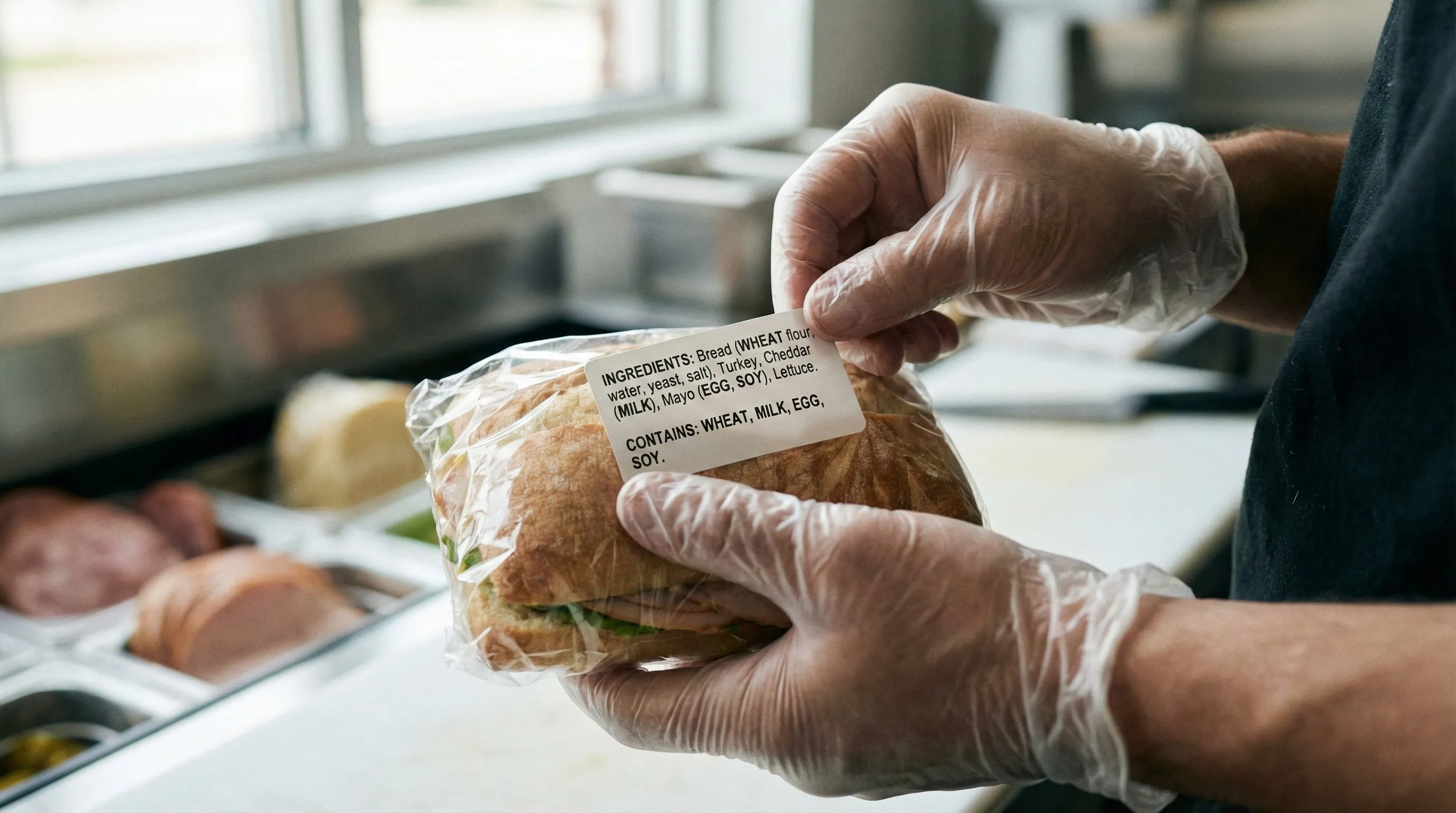
Every PPDS product must display three things directly on the packaging:
- The name of the food — a clear description of what it is
- A full ingredients list — all ingredients listed in descending order by weight, with compound ingredients broken down into their sub-ingredients
- All 14 allergens emphasised within the ingredients list — highlighted so they stand out clearly
Allergens must be emphasised through a typeset that clearly distinguishes them from the rest of the list. Acceptable methods include bold (most common and recommended), CAPITALS, contrasting colours, or underlining. The recommended practice is to include a statement: “For allergens, see ingredients in bold.”
Labels must be visible, legible, and durable enough to withstand handling. Minimum font size is 1.2mm x-height (0.9mm for packaging under 80cm²). Handwritten labels are legally acceptable if legible and allergens are properly emphasised — but they are not recommended by the FSA due to the higher risk of errors.
QR codes cannot replace a physical label. The information must be directly visible on the packaging.
What Is NOT Required for PPDS (Unlike Fully Pre-packed Food)
- Nutrition declaration
- Business name and address
- Best before or use by date (though separate food safety legislation may require date marking on perishable foods)
- “May contain” warnings — these are voluntary and should only be used after a genuine cross-contamination risk assessment
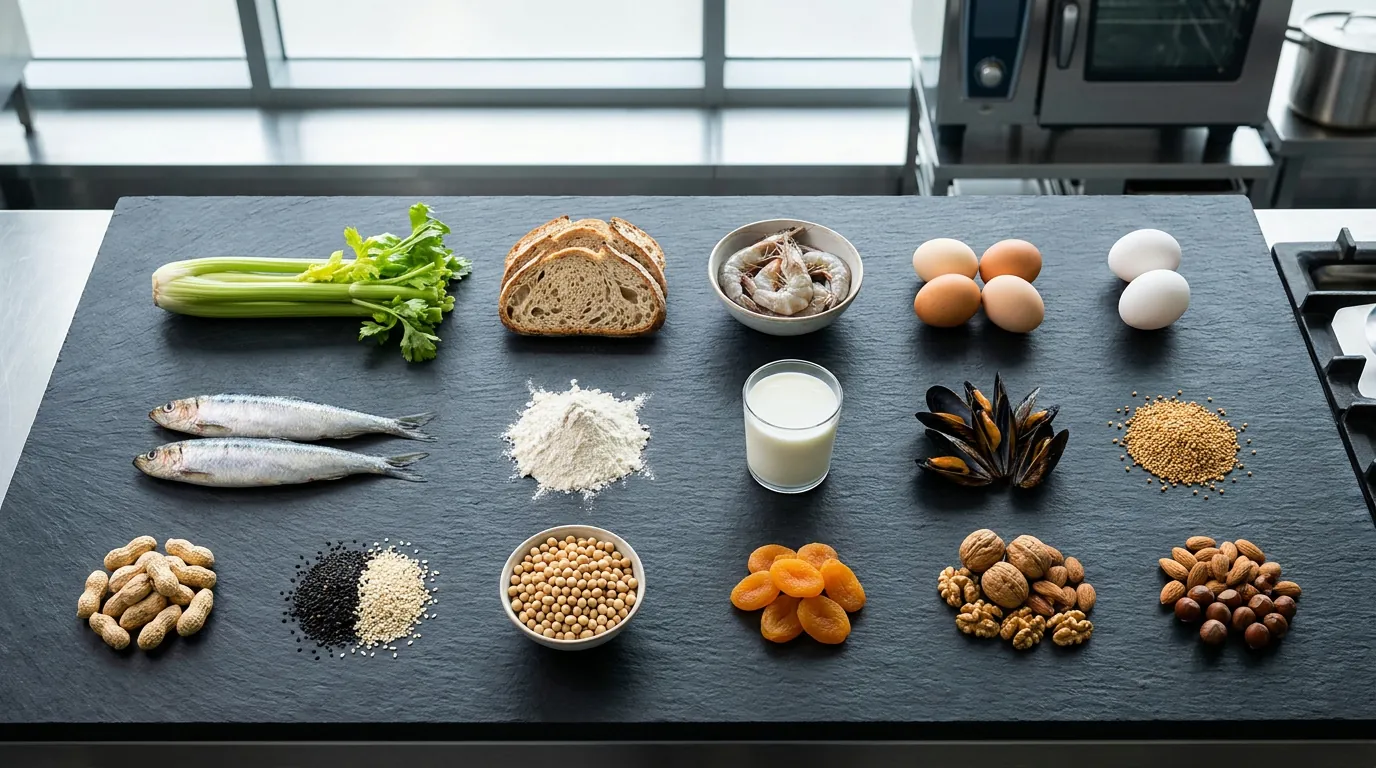
The 14 Allergens
These are the allergens that must be declared and emphasised whenever they appear in an ingredients list:
- Celery — including stalks, leaves, seeds, and celeriac
- Cereals containing gluten — wheat (including spelt and khorasan), rye, barley, oats
- Crustaceans — prawns, crabs, lobster, crayfish
- Eggs
- Fish
- Lupin
- Milk — including lactose and all dairy products
- Molluscs — mussels, oysters, squid, clams
- Mustard — including seeds and powder
- Nuts — almonds, hazelnuts, walnuts, cashews, pecans, Brazil nuts, pistachios, macadamia nuts
- Peanuts
- Sesame — sesame seeds
- Soybeans
- Sulphur dioxide and sulphites — at concentrations above 10mg/kg or 10mg/litre
Who Must Comply
Natasha’s Law applies to all food businesses regardless of size that produce and sell PPDS food. There is no exemption for small businesses, sole traders, or low-volume operations.
Bakeries
Pre-wrapped loaves, sealed pastries, boxed cakes on display — all PPDS. The particular risk for bakeries is hidden allergens in compound ingredients: sesame baked into dough (the exact issue that killed Natasha), milk powder in bread improvers, soya in margarines. Cross-contamination from shared ovens and work surfaces is also a significant concern.
Cafes and Coffee Shops
Pre-made sandwiches, wraps, and salad pots in display fridges are PPDS. Food made to order is not. Many cafes operate a hybrid model — some items are pre-packed, others are assembled fresh. Businesses must clearly distinguish between the two categories. A single chicken caesar wrap may contain twenty or more ingredients from multiple suppliers. All must be declared.
Butchers
Pre-packed sausages, burgers, marinated meats, and pies in sealed packaging all count as PPDS. Butchers also face a unique QUID requirement — meat products must show the percentage of meat content. Hidden allergens in marinades and seasonings are a particular risk: mustard, soya, celery, sulphites, and gluten are common ingredients in commercial rubs and seasonings that may not be obvious.
School and Hospital Catering
Grab-and-go sandwiches and boxed meals prepared in advance are PPDS. The stakes are especially high in these settings due to vulnerable populations — children and patients who may not be able to advocate for themselves. A 2025 poll found that nearly 70% of teachers have never received training in managing food allergies.
Caterers and Market Stalls
Food made at a central kitchen and sold by the same operator at a market stall, food fair, or mobile unit is PPDS. The same operator, different site — still counts. Environmental conditions (rain, heat, handling) can damage labels, so durability matters. Genuinely one-off events like a village fete cake sale by a private individual are generally exempt, but regular commercial operators are not.
Restaurants
Most restaurant food is made to order and is not PPDS. But any pre-packaged items — retail products sold at the counter, boxed meals in a display case, pre-wrapped desserts — fall under Natasha’s Law and require full labelling.
Common Mistakes Businesses Still Make
The FSA’s own compliance testing in 2023-24 found that 17 out of 47 PPDS food items tested had allergens without correct labelling — a non-compliance rate of roughly 36%. A separate survey found 24% of businesses selling PPDS admitted they were not fully compliant.
These are the errors that keep showing up:
“It Only Applies to Big Businesses”
It does not. Natasha’s Law applies to a single-person bakery stall with the same force as a supermarket chain.
Listing Allergens Separately Instead of Within the Ingredients
Allergens must be emphasised within the full ingredients list, not listed separately. A box that says “Contains: milk, wheat” without a full ingredients list does not comply. The complete list of ingredients must be provided with allergens highlighted inline.
Using “May Contain” as a Substitute
“May contain” statements are voluntary precautionary allergen labelling. They are not a substitute for declaring allergens as ingredients. PAL should only be used after a genuine cross-contamination risk assessment shows an unavoidable risk that cannot be managed. Blanket “may contain” statements covering every allergen are considered misleading and are increasingly scrutinised by enforcement officers.
Not Updating Labels When Recipes or Suppliers Change
Allergen labels are only as accurate as the day they were written. If a supplier reformulates a product, if you switch to a different brand of flour, if a sauce recipe changes — and your labels are not updated — you have an inaccurate label in front of customers. This is the most dangerous error and the one that carries the most serious consequences.
Removing Packaging to Avoid the Law
The FSA’s evaluation found that 17% of businesses reclassified food from PPDS to non-prepacked to avoid labelling requirements. This is technically legal — if food is genuinely sold loose, it falls under different (verbal) allergen communication rules. But EHOs know this tactic, and it trades one set of obligations for another. You must still make allergen information available for loose food.
Relying on a Single “Allergen Champion”
One trained staff member is not enough. If that person is on holiday, off sick, or leaves the business, your allergen system collapses. Every member of staff who handles food must understand the 14 allergens, know which allergens are in which products, and know the procedure when a customer asks.
What Happens When It Goes Wrong: Real Prosecution Cases
Allergen failures are not theoretical risks. People have gone to prison. Businesses have been fined tens of thousands of pounds. These are real cases:
Mohammed Zaman — 6 Years in Prison
The landmark case. Zaman owned the Indian Garden restaurant in Easingwold, North Yorkshire. On 30 January 2014, Paul Wilson, 38, ordered chicken tikka masala and specifically requested no nuts. Zaman had substituted cheaper groundnut powder (containing peanuts) for almond powder as a cost-cutting measure — he was £300,000 in debt.
A trading standards officer had found peanut traces in a “peanut-free” meal at another Zaman restaurant one week earlier. Three weeks before Wilson’s death, a 17-year-old had been hospitalised from a peanut reaction at a third Zaman restaurant.
Wilson died of anaphylaxis at home hours later. Zaman was convicted at Teesside Crown Court of manslaughter by gross negligence plus six food safety offences. He was sentenced to six years in prison. His appeal was dismissed. It was the first manslaughter conviction in the UK over the sale of food.
Javitri Restaurant — £43,816
In 2025, Javitri Restaurant in Uxbridge was fined after a customer with a nut allergy was hospitalised. Investigators found nuts stored incorrectly and confusing allergen information. The total penalty: £35,000 fine plus £5,000 surcharge plus £3,816 costs — £43,816 total.
Rusty Gun Pub — £27,803
In 2025, the Rusty Gun Pub in Hitchin was fined after a 9-year-old boy was given sausages containing wheat despite his mother repeatedly checking with staff. No allergen training was documented. The judge noted the company had “not learnt” from two previous allergen incidents. Total penalty: £19,000 fine plus £1,000 compensation plus £5,803 costs — £27,803.
Rasika Restaurant — Multiple Convictions
In 2025, two customers with peanut allergies suffered anaphylactic shock at Rasika Restaurant in Newcastle. The restaurant had labelled 100% peanut powder as “mixed nut powder.” Both the director and the company were convicted on seven counts each.
Royal Spice Takeaway — Manslaughter Convictions
Following Megan Lee’s death in 2017, the owner of Royal Spice was sentenced to three years and the manager to two years for manslaughter by gross negligence. The 15-year-old had noted her allergies on her Just Eat order. The meal contained peanut protein.
The Penalty Framework
Non-compliance with food allergen law is a criminal offence under the Food Safety Act 1990. Since 2015, there is no cap on fines — courts can impose unlimited financial penalties in both magistrates’ and Crown courts.
| Court | Maximum Fine | Maximum Imprisonment |
|---|---|---|
| Magistrates’ | Unlimited | 6 months |
| Crown Court | Unlimited | 2 years |
| Manslaughter (where death results) | Unlimited | Life imprisonment |
The Sentencing Council guidelines specify that large organisations with turnover above £50 million face starting-point fines of up to £3 million. Directors can be personally prosecuted and disqualified for up to 15 years.
Enforcement is carried out by local authority Environmental Health Officers and Trading Standards officers. The FSA provided £1.53 million in funding to councils specifically for Natasha’s Law enforcement.
What’s Coming Next
Owen’s Law
Owen’s Law — named after Owen Carey — would make it a legal requirement for restaurants to provide written allergen information on menus at the point of ordering. Currently, restaurants can communicate allergens verbally. Owen’s Law would eliminate that, requiring written allergen information for every dish without the customer having to ask.
Owen’s father Paul Carey launched the campaign in April 2021. It has cross-party Parliamentary support and the FSA Board “firmly agreed” in December 2023 that written allergen information should be a legal requirement.
In March 2025, the FSA published voluntary best practice guidance as an interim step. The government stated it would begin an evaluation in spring 2026 to assess uptake and decide whether to legislate. Legal analysts estimate Owen’s Law could take effect in late 2027 or 2028 at the earliest.
If your business already provides written allergen information on menus, you are ahead of the curve.
Benedict’s Law
Named after Benedict Blythe, age 5, who died from anaphylaxis at school in 2021. Benedict’s Law focuses on allergy safety in schools — requiring allergy management policies, spare adrenaline auto-injectors on site, and mandatory staff training.
In February 2026, the government committed to making Benedict’s Law statutory through mandatory guidance. It is expected to take effect in September 2026.
Precautionary Allergen Labelling (PAL) Reform
“May contain” labelling is currently voluntary and inconsistent in the UK. The EU is harmonising PAL rules via regulation expected in Q4 2027. The Netherlands became the first EU state to regulate PAL in January 2026. The FSA has been consulting on standardising “may contain” labelling to make it more consistent and trustworthy.
The direction of travel is clear: more transparency, more written information, more accountability. Businesses that build strong allergen management systems now will not be scrambling to catch up when the next law arrives.
Practical Compliance: What to Do Every Day
1. Identify Every PPDS Product You Sell
Audit everything. If it is packaged before the customer selects it and you made and sold it on the same premises, it is PPDS and needs a full label. This includes items you might not immediately think of — wrapped cookies given as free samples, pre-portioned deli tubs, boxed cakes on the counter.
2. Get Accurate Ingredient Information From Every Supplier
Request full ingredient breakdowns including sub-ingredients for every product you buy. Confirm allergen content with every new order — formulations change without notice. Maintain documentation of every supplier specification and review them at minimum annually.
3. Build and Maintain an Allergen Matrix
Document every recipe with its full ingredient list. Create a matrix showing which of the 14 allergens are present in each product. Update it immediately when recipes change or suppliers alter their ingredients. This matrix is the foundation of your labelling — if it is wrong, your labels are wrong.
4. Print Compliant Labels
Include the food name, full ingredients list in descending order by weight, and all 14 allergens emphasised in bold. Labels must be durable enough to withstand the conditions they face — refrigeration, heat lamps, customer handling. Consider using label printing software linked to your recipe database to reduce human error.
5. Train Every Member of Staff
Not just one allergen champion. Every person who handles food must understand the 14 allergens, know which products contain which allergens, and know what to do when a customer asks about allergens or reports a reaction. Training should be refreshed regularly and documented — EHOs will ask to see training records.
6. Have a Change Control Process
When a recipe changes, when a supplier reformulates a product, when you switch ingredients: document the change, update the allergen matrix, update the labels, and notify all staff before the new recipe enters production. This is where most businesses fail. The gap between an ingredient change and a label update is where the risk lives.
7. Audit Regularly
Periodically check your labels against your current recipes and supplier specifications. Verify that supplier information has not changed. Test staff knowledge. Keep records of every audit. An EHO does not just look at labels — they follow the thread from label, back to allergen matrix, back to supplier specifications, back to delivery records. If you cannot demonstrate that trail, you have a compliance gap even if the label itself looks correct.
A Quick Natasha’s Law Compliance Checklist
Use this to audit your own operation:
- Have I identified every product I sell that is PPDS?
- Does every PPDS product have a label with the product name, full ingredient list, and allergens emphasised?
- Is my allergen matrix up to date and does it match exactly what is currently being used in the kitchen?
- Do I have current supplier specifications confirming allergen content for every ingredient I use?
- Do I have a documented process to update labels and allergen records when ingredients change?
- Have all staff who handle food received allergen awareness training, and is it documented?
- If I sell food online or by phone for collection, am I providing allergen information before the order is placed and again at delivery?
- Can I trace the information on every label back through my records to a supplier specification?
- Am I using “may contain” statements only where a genuine cross-contamination risk assessment supports it?
- Do I have a process for catching when suppliers reformulate their products?
If you answered no to any of these, that is your starting point.
The Numbers
- 2.4 million UK adults live with a clinically confirmed food allergy — roughly 6% of the adult population
- Food allergy prevalence in the UK doubled between 2008 and 2018
- 4,323 hospital admissions for anaphylaxis in 2023/24 — a 17.8% increase year on year
- Hospital admissions for anaphylaxis have more than doubled since 2002/03
- 36% of PPDS items tested by the FSA had allergens without correct labelling
- 24% of businesses selling PPDS admitted they were not fully compliant
- 17% of businesses reclassified food from PPDS to non-prepacked to avoid labelling
- 51% of businesses reported increased costs from PPDS labelling requirements
- Allergen-related recalls are the leading cause of UK food alerts — 597 between 2016 and 2021, representing 57.6% of all food recalls
Managing Allergens Digitally
Paper-based allergen matrices create risk. They go out of date. They get lost. Staff refer to the wrong version. There is no audit trail. When an EHO asks to see your allergen records, scrambling through a folder of printouts is not a good look.
Forkto’s allergen management tools let you build and maintain your allergen records digitally — tracking each product, its ingredients, and which of the 14 allergens apply. When something changes, you update it in one place and it flows through to everything else. When an EHO visits, you have a clean, time-stamped record of exactly when information was reviewed and by whom.
The same records can face your customers too. Publish them as a QR allergen menu and anyone who scans the code sees a live menu they can filter by the allergens they need to avoid — no app, no account, and the printed QR code never goes out of date (see a live example).
Combined with digital checklists and delivery logging, Forkto gives you the traceability chain that EHOs want to see: from supplier delivery, through production, to the label on the product.
If you want to see how it works, start your free trial.
The Bottom Line
Natasha’s Law exists because a fifteen-year-old died eating food she had every reason to believe was safe. Owen Carey died on his eighteenth birthday because a menu did not mention buttermilk. Megan Lee died because a takeaway ignored her allergy note. Paul Wilson died because a restaurant owner cut costs with cheaper ingredients and did not care about the consequences.
The law is not complicated. Label your PPDS food accurately. Keep your allergen records up to date. Train your staff. Have a system for catching changes. That is it.
What trips businesses up is the consistency — keeping everything accurate as menus evolve, suppliers change, and staff turn over. That is an operational discipline, not a paperwork exercise. And it is the difference between a business that protects its customers and one that ends up in court.
Related Forkto software
Safe hands, clear records
Stop running food safety on paper
Forkto turns daily checks, temperature logs, HACCP and audits into a few taps on a phone. Your team stays consistent and you're always ready for the EHO.
14-day free trial · No card required