Food safety guide
Why Food Safety Systems Fail (and How to Fix Them)
Discover the seven most common reasons food safety systems fail in UK businesses, from forgotten SFBB diaries to staff turnover, and learn practical steps to fix them.
1 February 2026
Every food business in the UK is legally required to have a food safety management system based on HACCP principles. Most businesses have one. The problem is that having a system and having a system that actually works are two very different things.
Food safety failures rarely happen because a business set out to cut corners. They happen because systems degrade over time. Staff change. Menus evolve. The folder on the shelf gathers dust. And then one morning, an Environmental Health Officer walks through the door unannounced, and the gap between what your documentation says and what your team actually does becomes painfully visible.
This article examines the seven most common reasons food safety systems fail in UK food businesses, and what you can do to build something that genuinely protects your customers, your team, and your reputation.
The Real Cost of a Failed Food Safety System
Before looking at why systems fail, it is worth understanding what is at stake. The consequences of a food safety failure in the UK extend far beyond a slap on the wrist.
Under the Food Safety Act 1990, local authorities have a range of enforcement powers, including:
- Hygiene improvement notices requiring specific corrective actions within a set timeframe
- Hygiene emergency prohibition notices, which can close your business immediately where there is an imminent risk to health
- Criminal prosecution, which can result in unlimited fines and, in the most serious cases, imprisonment for up to two years
These are not theoretical risks. In recent years, UK courts have handed down significant penalties to food businesses. Prosecutions for food hygiene offences are a matter of public record, and local authorities regularly publish details of successful enforcement actions. A single serious incident can result in fines running into tens of thousands of pounds, plus legal costs.
Then there is the reputational damage. Your Food Hygiene Rating Scheme (FHRS) score is publicly visible on the FSA website and, in Wales and Northern Ireland, must be displayed at your premises. A score of 0, 1, or 2 does not just deter new customers; it can end relationships with delivery platforms, catering contracts, and supply agreements. Rebuilding a damaged FHRS score takes months, and the reputational stain can linger far longer.
The real cost of a failed food safety system is not a single fine. It is the slow erosion of trust, revenue, and operational stability that follows.
Reason 1: The System Lives in a Folder, Not in Practice
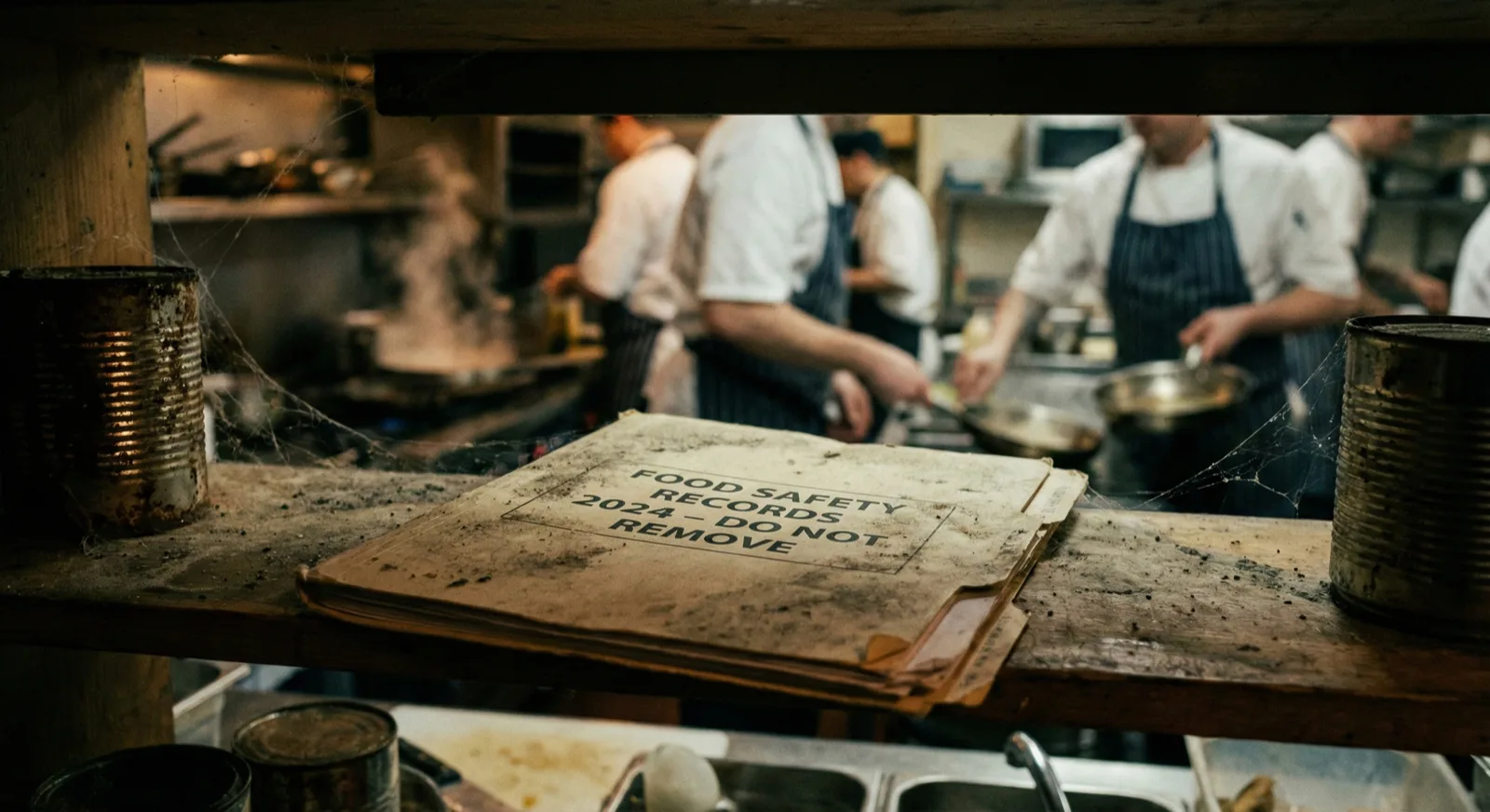
This is the most common failure mode, and it is deceptively simple. A business invests time and money in creating a food safety management system, complete with a HACCP plan, monitoring procedures, and corrective actions. The documentation is thorough, well-structured, and compliant. It goes into a folder. The folder goes onto a shelf. And that is the last time anyone looks at it.
The gap between documentation and daily practice is where food safety risk lives. Your HACCP plan might specify that fridge temperatures are checked twice daily, but if your team does not know where the monitoring sheet is, or what the critical limits are, or what to do when a reading is out of range, the plan is not protecting anyone.
Environmental Health Officers are trained to spot this gap. They will not just ask to see your paperwork; they will ask your staff questions. Can your kitchen porter explain the allergen procedure? Does your supervisor know the corrective action for a temperature deviation? If the answer is no, it does not matter how good your documentation looks.
The fix starts with making your system visible and accessible. Key procedures should be displayed where they are needed, not filed away in a back office. Daily checks should be built into the workflow, not treated as an afterthought.
Reason 2: Staff Don’t Understand Why
Most food safety training focuses on what to do. Wash your hands for twenty seconds. Check temperatures twice a day. Separate raw and cooked foods. These instructions are necessary, but they are not sufficient.
When staff understand the “what” but not the “why,” food safety becomes a set of arbitrary rules to be followed when someone is watching and ignored when they are not. If your team does not understand that inadequate cooking temperatures can allow harmful bacteria like Salmonella or E. coli O157 to survive, the instruction to “cook to 75 degrees” is just a number on a chart.
Effective food safety training connects actions to outcomes. It explains that the two-hour rule for food left at ambient temperature exists because the “danger zone” between 8°C and 63°C is where pathogenic bacteria multiply most rapidly. It makes clear that allergen cross-contamination is not a minor administrative issue but a potentially fatal one.
This does not mean every induction session needs to become a microbiology lecture. It means investing a few extra minutes in explaining the reasoning behind each procedure. Staff who understand the purpose of food safety controls are far more likely to follow them consistently, and far more likely to raise concerns when something does not look right.
Reason 3: High Staff Turnover Breaks Continuity
UK hospitality has one of the highest staff turnover rates of any sector, with estimates typically around 30% annually and significantly higher in some sub-sectors. This creates a persistent food safety challenge that many businesses underestimate.
Every time an experienced team member leaves, they take their knowledge of your specific procedures with them. Every time a new starter arrives, there is a window of vulnerability where they are learning your system, your menu, your suppliers, and your premises. If your induction process is informal or rushed, as it often is in a busy kitchen, that window stays open far longer than it should.
The risks compound when turnover is high enough that there is no stable core of experienced staff to maintain standards and mentor new arrivals. In the worst cases, you end up with a team where nobody has been in post long enough to fully understand the food safety system, and nobody feels confident enough to challenge poor practice.
To manage this, your induction process needs to be structured, documented, and non-negotiable. Key food safety competencies should be assessed, not just assumed. And your system should be designed so that critical knowledge is embedded in processes and prompts, not held in the heads of individual staff members.
Reason 4: No One Owns the System
Food safety is everyone’s responsibility. That statement is true in principle, but in practice it often means that no one takes specific accountability for maintaining the system.
Without a designated food safety lead, common problems include:
- Monitoring checks that are “someone else’s job” and do not get done
- Corrective actions that are identified but never followed through
- Supplier documentation that is not reviewed or updated
- Training records that are incomplete or missing
- SFBB diaries or equivalent records that fall weeks behind
The Food Standards Agency expects businesses to be able to demonstrate that their food safety management system is actively managed. This means someone in your organisation needs to have explicit responsibility for overseeing the system, ensuring checks are completed, reviewing records, and driving improvements.
This does not necessarily mean hiring a dedicated food safety manager. In smaller businesses, it might be the owner or a senior supervisor. The critical point is that the role is clearly defined, the person has the authority and time to fulfil it, and there is a clear escalation path when issues arise.
Reason 5: The System Wasn’t Built for Your Business
A surprising number of food businesses operate with food safety documentation that was downloaded from a generic template, copied from a previous employer, or produced by a consultant who never set foot in the kitchen.
Generic templates have their place as a starting point, but a HACCP plan that does not reflect your actual menu, your actual processes, your actual equipment, and your actual premises is not a HACCP plan. It is a piece of fiction.
EHOs recognise generic documentation immediately. If your hazard analysis lists risks associated with processes you do not carry out, or fails to address hazards specific to your operation, it signals that your system is a box-ticking exercise rather than a genuine risk management tool.
EC Regulation 852/2004 requires food safety procedures to be based on HACCP principles and to be specific to the food business in question. Your system needs to reflect:
- The specific foods you handle, prepare, cook, and serve
- The equipment and facilities available to you
- The skills and experience of your team
- Your supply chain and the controls your suppliers have in place
- Any specific risks associated with your customer base, such as vulnerable groups
If your system does not match your operation, it needs rebuilding from the ground up, starting with a proper hazard analysis that walks through every step of your actual process.
Reason 6: Records Are Retrospective, Not Real-Time
This is one of the most widespread and least discussed food safety failures. In theory, monitoring records demonstrate that critical control points are being checked at the required frequency. In practice, a significant proportion of food safety records are completed retrospectively.
Filling in temperature logs at the end of a shift from memory. Backdating SFBB diary entries to cover gaps. Signing off cleaning schedules for tasks that may or may not have been completed. These practices are so common that many businesses do not even recognise them as a problem.
But retrospective recording defeats the entire purpose of monitoring. The point of checking a fridge temperature is not to have a number written on a sheet of paper. It is to identify a temperature deviation at the time it occurs, so that corrective action can be taken before unsafe food reaches a customer. A temperature log filled in from memory at 10pm tells you nothing about what was actually happening at 7am.
The shift from retrospective to real-time recording is one of the most impactful changes a food business can make. It requires making monitoring quick and easy enough that it can be done in the moment, providing clear prompts so that staff know when checks are due, and creating accountability so that missed checks are visible immediately rather than buried in a backlog.
Reason 7: No Review or Update Process
Food businesses are not static. Menus change seasonally or more frequently. Suppliers are added or replaced. New equipment is installed. Staff join and leave. Regulations evolve.
Your food safety system needs to keep pace with all of these changes, and in many businesses, it simply does not. The HACCP plan was written when the business opened and has not been updated since. A new dish was added to the menu without a hazard analysis. A new supplier was approved informally without checking their food safety credentials. The deep fryer was replaced with a different model, but the safe operating procedures were not updated.
EC Regulation 852/2004 requires food business operators to review their food safety procedures regularly and whenever there is a significant change to the operation. Best practice is to conduct a formal review at least annually, with additional reviews triggered by:
- Menu or recipe changes
- New suppliers or ingredients
- Equipment changes
- Changes to premises layout
- Significant staff changes
- Customer complaints or near-misses
- Changes to legislation or guidance
Without a structured review process, your system drifts further from reality with every change you make to your operation. And the longer the drift continues, the harder it becomes to close the gap.
Building a Food Safety Culture That Sticks
Fixing the seven failures above requires more than better paperwork. It requires building a food safety culture, an environment where safe practices are the norm rather than the exception, and where every member of your team feels responsible for and engaged with food safety outcomes.
Food safety culture starts with leadership. If the owner, manager, or head chef treats food safety as a burden or a box-ticking exercise, the rest of the team will follow suit. Visible commitment from leadership, whether that means participating in training, conducting checks personally, or responding seriously to concerns raised by staff, sets the tone for the entire operation.
Practical steps to build a stronger food safety culture include:
- Making food safety a standing agenda item in team meetings and briefings
- Recognising and acknowledging good practice, not just identifying failures
- Involving staff in developing and reviewing procedures, so they have ownership
- Making compliance easy by designing workflows that naturally incorporate safety checks
- Responding constructively to mistakes, focusing on learning rather than blame
- Ensuring that new starters see food safety prioritised from their very first shift
Culture change does not happen overnight. It is built through consistent, repeated actions over time. But the businesses that invest in culture find that compliance becomes less effortful, staff engagement improves, and the gap between documentation and practice narrows significantly.
How Technology Helps (Without Adding Complexity)
One of the recurring themes in the failures described above is that traditional paper-based systems make it too easy for things to slip. Paper records can be backdated. Filed documents can be forgotten. Training records can go missing. And nobody knows a check has been missed until it is far too late.
Digital food safety tools, when designed well, address these problems not by adding complexity but by removing friction. The most effective systems work by prompting action at the right time rather than relying on staff to remember. They make real-time recording quicker than retrospective recording. They provide instant visibility of missed checks, overdue tasks, and emerging trends.
This is the approach Forkto takes: replacing the folder on the shelf with a system that actively supports your team in maintaining food safety standards day to day. Automated reminders ensure that checks happen on schedule. Digital records are timestamped and cannot be backdated, giving you and your EHO confidence that monitoring is genuine. And dashboards provide an at-a-glance view of your compliance status, so problems are identified before they escalate.
Technology is not a substitute for training, leadership, or a strong food safety culture. But it is a powerful enabler. The right digital tools make it easier for your team to do the right thing, and harder for the system to silently degrade in the ways described throughout this article.
Taking the Next Step
If you have recognised your business in any of the seven failure modes above, you are not alone. Most food businesses experience at least some of these challenges, particularly during periods of growth or high staff turnover.
The important thing is not to have a perfect system today, but to have a clear plan for closing the gaps. Start by honestly assessing where your current system falls short. Talk to your team about what they find difficult or unclear. Review your documentation against your actual daily practice. And consider whether the tools you are using, whether paper or digital, are genuinely supporting you or quietly holding you back.
If you would like to explore how Forkto can help you build a food safety system that works in practice and not just on paper, get in touch for a conversation about your specific needs. There is no obligation, and we are always happy to talk food safety.
For more on the fundamentals, see our guides to HACCP principles, Safer Food Better Business, and building a complete food safety management system.
Further reading
- Food Safety Culture: The UK Practitioner Guide — why the system survives on culture, not paperwork
- The Due Diligence Defence (s.21 Food Safety Act 1990) — how a properly-operating system protects you legally
- The Real Cost of Food Safety Non-Compliance — what happens when systems fail in practice
Related Forkto software
Safe hands, clear records
Stop running food safety on paper
Forkto turns daily checks, temperature logs, HACCP and audits into a few taps on a phone. Your team stays consistent and you're always ready for the EHO.
14-day free trial · No card required