Food safety guide
Date Labelling in Your Kitchen: The Food Safety Step EHOs Find Wrong Most Often
Incorrect date labelling is one of the most common EHO findings in UK food businesses. This guide explains the difference between use-by and best before, what your internal labels must include, and how to build a labelling system that holds up under inspection.
21 April 2026
Ask a kitchen team about date labelling and most will say they do it. Ask an Environmental Health Officer about the most common compliance gaps they find and date labelling comes up consistently — wrong labels, missing labels, labels that contradict each other, and food that cannot be traced to when it was prepared.
The gap between “we label our food” and “our labelling system is compliant and reliable” is where a lot of kitchen teams are sitting without realising it. Date labelling sounds simple. In practice, it involves several distinct types of labels, different rules for different categories of food, and a system that has to work consistently across every shift — not just when the head chef is in.
This guide clarifies exactly what is required, where kitchens most often go wrong, and how to build a labelling system that is simple enough to follow every time.
The Two Types of Date Labels — and Why They Are Not Interchangeable
Before anything else: the difference between use-by and best before is not a technicality. They are legally distinct and have different implications for how you handle food.
Use-by date
A use-by date indicates the point beyond which a food is not safe to eat, even if it looks and smells fine. Use-by dates appear on high-risk, perishable products — raw meat, fish, dairy, ready-to-eat chilled foods. Under the Food Safety Act 1990, it is a criminal offence to sell or use food past its use-by date. There are no exceptions for “it seems fine.”
When a use-by date passes, the food must be discarded. Full stop.
Best before date
A best before date indicates the point beyond which a food may deteriorate in quality — flavour, texture, appearance — but is not necessarily unsafe. Best before dates appear on lower-risk products: dried goods, canned foods, frozen items, some ambient products.
Food past its best before date is not automatically illegal to use. You are making a quality judgement, not a safety one. However, if a product past its best before date has deteriorated in a way that makes it unfit for consumption, using it would be a food safety issue regardless of the legal status of the label.
The key practical point: your high-risk products — anything raw, chilled, or ready-to-eat — will have use-by dates. These are non-negotiable. Treat them as hard limits.
Why External Labels Are Not Enough
Supplier and manufacturer date labels are the starting point, not the whole system. In a commercial kitchen, the external date label becomes insufficient or irrelevant in several common situations:
Once a product is opened. The manufacturer’s use-by date is based on the product being unopened. Once the packaging is breached, the shelf life changes — typically shortens significantly. A container of cream with a use-by date of Thursday does not remain safe until Thursday once it has been opened, portioned, and returned to the fridge.
Once a product is decanted. Ingredients transferred to kitchen containers lose their original labelling entirely. If the original packaging is discarded, there is no date information left.
Once a product is prepared or cooked. A batch of cooked rice, a tray of roasted vegetables, a portioned sauce — none of these carry any manufacturer date label. The only relevant date is when they were cooked or prepared, and the only label that can carry that information is the one you apply.
Once a product has been frozen. Freezing extends shelf life, but the clock does not stop entirely. Product frozen on a given date has a different safe use window than product frozen two months earlier. This information needs to be on the label.
In all of these cases, you need an internal date label — one your kitchen applies — to carry the safety-relevant date information.
What Your Internal Labels Need to Include
An internal kitchen label should always show:
- What the item is — specific enough to be unambiguous. “Sauce” is not sufficient. “Tomato sauce — cooked” is better.
- The date it was prepared, cooked, or opened — day and month at minimum
- The use-by date — the last date on which this item can safely be used
Some operations add the name of the person who prepared the item, which is useful for accountability and for training purposes but is not a legal requirement.
How long can prepped or cooked food be held? The safe holding periods depend on your specific products and your HACCP plan, but general guidance for chilled storage is:
- Cooked dishes: typically 2–3 days
- Opened raw ingredients: follow the manufacturer’s guidance once opened, usually 2–3 days for high-risk protein
- Prepared salad or vegetables: 1–2 days
- Cooked rice: 24 hours (high Bacillus cereus risk if held longer — spores survive cooking and multiply rapidly at room temperature)
- Opened dairy products: follow opened shelf life on packaging
Your HACCP plan should define the holding periods for the specific high-risk products in your kitchen. These periods become the basis for your use-by dates on internal labels.
Do not extend dates without a HACCP basis. A label showing a five-day holding period for a high-risk product needs a HACCP-assessed justification. You cannot simply decide to hold something longer because you want to avoid waste — you need evidence that your storage conditions and the specific product support that holding period safely.
Common Labelling Failures and What They Look Like to an EHO
Unlabelled containers
The most basic failure. Food in storage — prepped ingredients, cooked items, opened products — with no date label at all. An EHO finding unlabelled food cannot determine when it was prepared or whether it is within its safe holding period. They will document it as a compliance failure.
Vague or ambiguous labels
A label that says “Tuesday” is not useful if the inspection is happening on Friday and the label could refer to last Tuesday or the Tuesday before that. Labels need to be unambiguous — use dates (day and month), not day names.
Labels that have been altered or are illegible
Labels overwritten with a new date, dates that have faded, or labels that have peeled and been partially reapplied are all red flags for an EHO. They suggest that date labels are being managed to extend shelf life rather than to accurately represent when food was prepared.
Missing labels on frozen items
Frozen storage is often the worst for date labelling. Products go into the freezer in a rush, with no label. They stay there for weeks or months. Eventually, nobody knows what they are or when they were frozen. An EHO opening a freezer full of unlabelled vacuum packs and cling-wrapped trays will have serious questions.
Labels that contradict each other
A product with a manufacturer’s use-by date of Wednesday and an internal label saying Thursday. A batch of food with a preparation date label that is the same day as the container’s contents — which does not match a temperature log showing the batch was actually cooked two days earlier. Contradictions suggest that labels are being applied without care, which undermines confidence in the whole system.
No system for checking labels at the start of service
Even good labelling practices break down if nobody checks the labels before prep begins. Opening checks should include a sweep of all stored items to identify anything that has reached or passed its use-by date. This is the safety net — but if the opening check is not being done, food past its use-by date can stay in storage and eventually be used.
Building a Labelling System That Actually Works
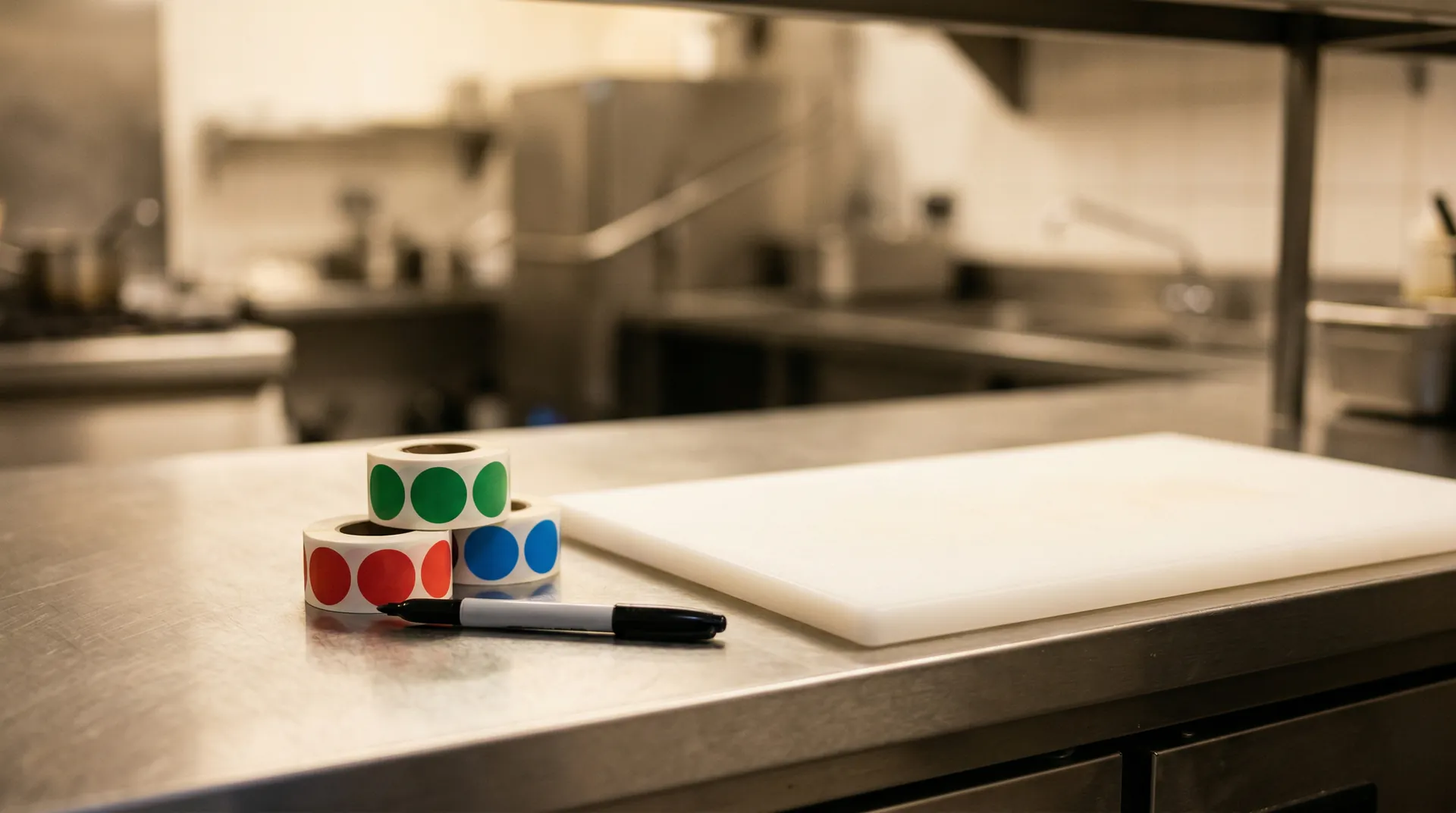
Make labels and equipment permanently available. Date labels, a marker or label printer, and a reference sheet showing your holding periods should be in the kitchen — not in a back office, not in a drawer that nobody uses. If applying a label requires more than ten seconds of effort, it will not happen consistently.
Define your holding periods and make them visible. A laminated reference card near the prep area — “cooked chicken: use within 2 days,” “opened cream: use within 3 days” — removes the need for staff to remember or guess. Clear, visible reference points reduce errors.
Label as you go, not at the end. The most reliable labelling happens at the point of preparation — as soon as the food is portioned or cooked, it gets a label. Labelling at the end of service, when staff are tired and in a hurry, results in missed items and rushed labels.
Include labelling in induction training. Every new team member should be specifically trained on your labelling system — what labels to use, what to include, where to find the materials, and what the holding periods are. Do not assume it is obvious.
Audit labels regularly. A manager sweep of the fridges and freezers once a week — checking that everything is labelled, labels are legible, and nothing is approaching or past its use-by date — catches system drift before it becomes a compliance problem.
Connecting Labels to Your Wider Food Safety System
Date labelling does not sit in isolation. It connects to:
- Stock rotation (FIFO): Labels only support FIFO if they are clear enough to allow staff to identify which items were prepared first. Vague labels undermine rotation.
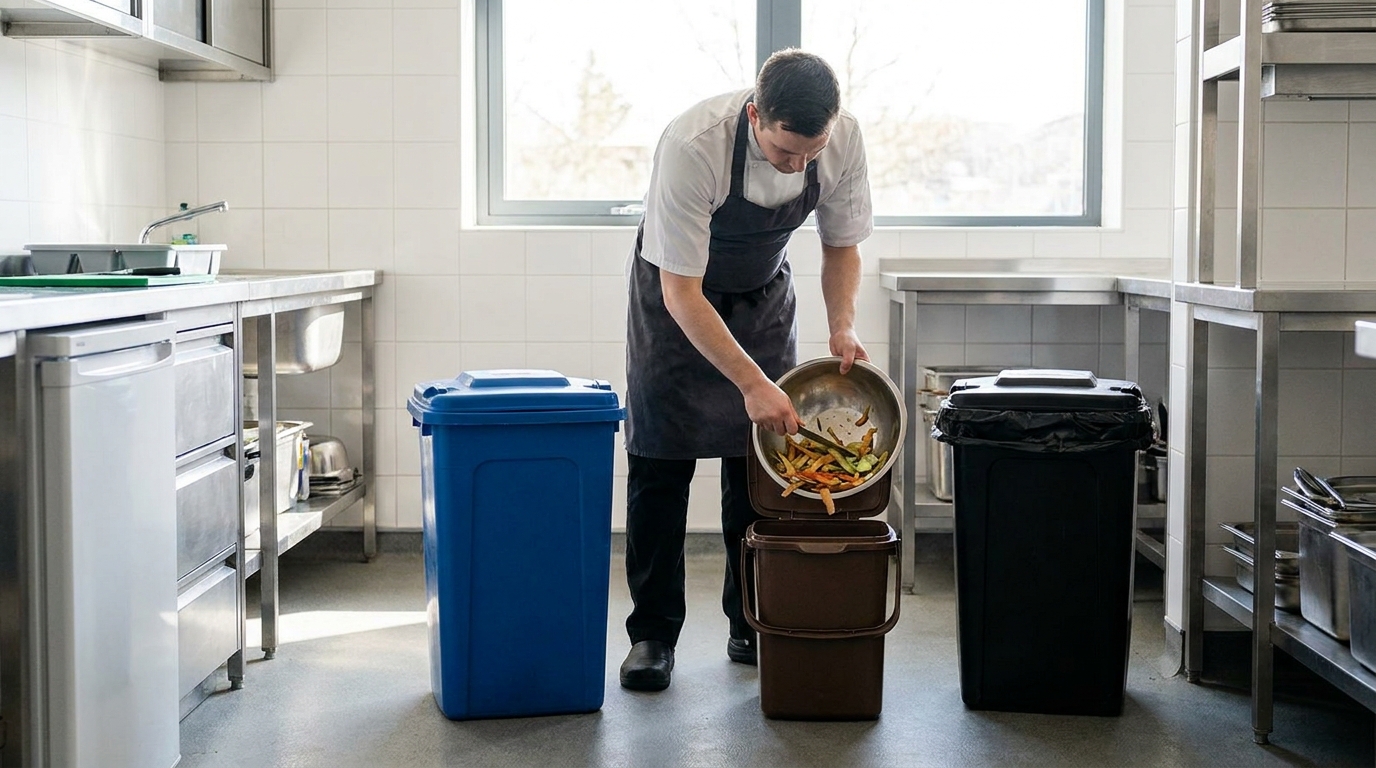
- Waste records: When a dated item is disposed of because it has reached its use-by date, that disposal should be recorded. This gives you data on how often products are reaching the end of their life — a signal about over-production or poor rotation.
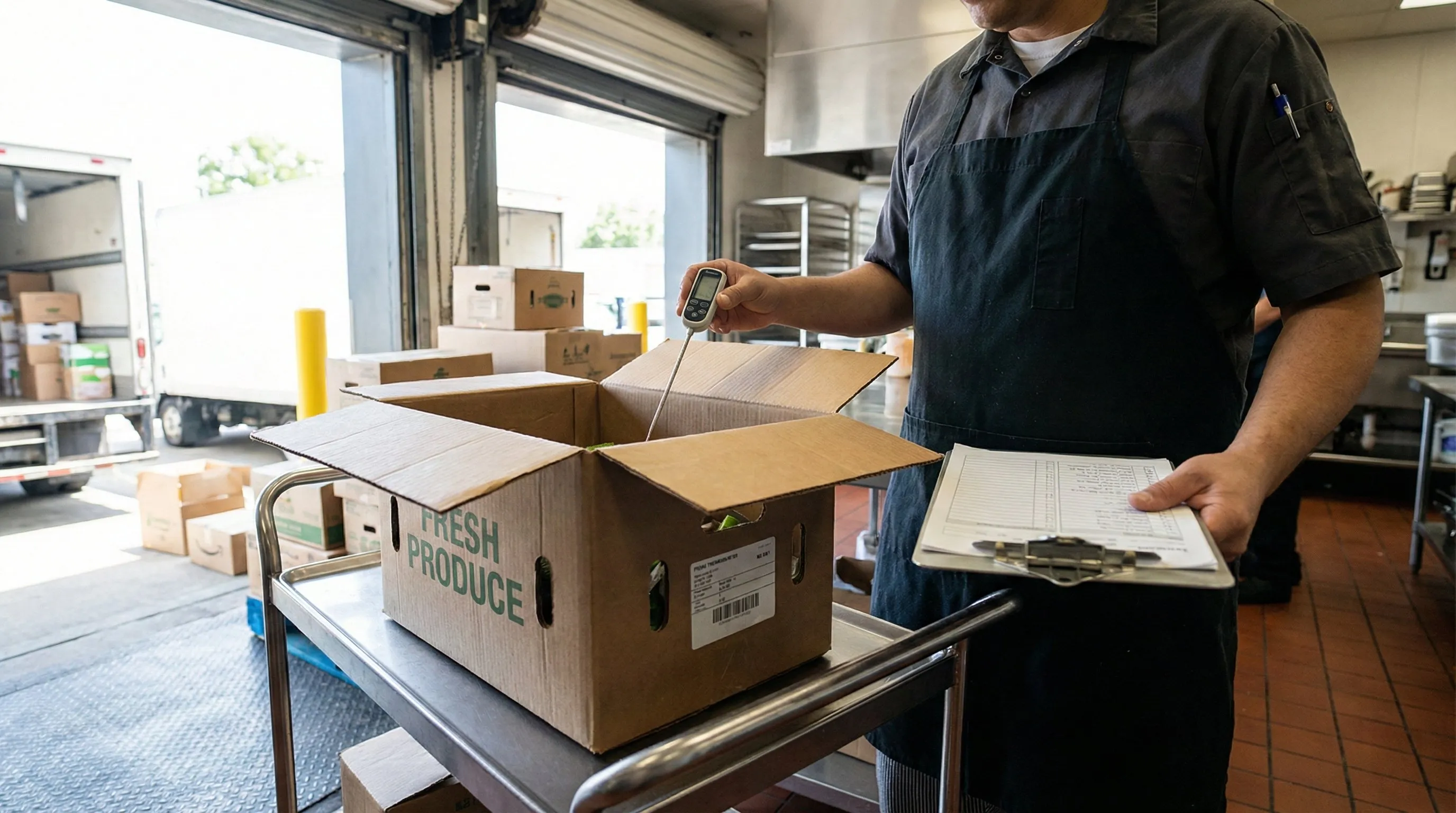
- Delivery checks: Use-by dates on incoming deliveries feed into your labelling system. If you accept a product with a short remaining shelf life, your internal holding period for that product may need to be shortened accordingly.
- Opening checks: The start-of-day review of fridge labels is the point where labelling failures are caught and corrected before they become service problems.
How Forkto Helps
Forkto’s digital checklists can include date label checks as a required step in opening procedures and food preparation workflows — not a separate process, but built into the checks your team is already doing. When a team member is prompted to confirm date labels have been applied to prepared items, it becomes part of the routine rather than an afterthought.
Combined with Forkto’s wastage tracking, you can record disposals of date-expired items and build up a picture of where waste is concentrated — useful both for reducing cost and for identifying where holding periods or production quantities need adjustment.
See how Forkto’s operational checklists work →
Quick Reference: Date Labelling Checklist
- Do all opened, decanted, prepped, and cooked items in storage carry an internal date label?
- Do internal labels show: what the item is, when it was prepared/opened, and a use-by date?
- Are holding periods defined in your HACCP plan and visible to kitchen staff?
- Are labels legible and unambiguous (date, not day name)?
- Are frozen items labelled with preparation/freezing date?
- Do opening checks include a sweep of fridge and freezer labels?
- Are expired items removed and disposal recorded?
- Are labelling materials (labels, pens or printer) available in the kitchen at all times?
- Is date labelling covered in your staff induction?
Related Forkto software
Safe hands, clear records
Stop running food safety on paper
Forkto turns daily checks, temperature logs, HACCP and audits into a few taps on a phone. Your team stays consistent and you're always ready for the EHO.
14-day free trial · No card required