Food safety guide
Owen's Law: What Every UK Restaurant Needs to Know (2026)
Owen's Law will require UK restaurants to display written allergen information on menus. Learn what it means, the full Owen Carey story, how to prepare now, and when it becomes law.
29 March 2026
On 22 April 2017, Owen Carey turned eighteen. His family took him to Byron Burgers at the O2 Arena in North Greenwich to celebrate. He ordered a grilled chicken burger. The menu described the option simply: “Chicken – choose yours grilled or fried.” No mention of a marinade. No mention of dairy. No mention of buttermilk.
Owen had a lifelong severe dairy allergy. He knew the risks and he managed them carefully. He had never had an anaphylactic reaction – not once in eighteen years – because he was vigilant about what he ate. He told the staff about his allergy. The coroner later confirmed this definitively.
The chicken was marinated in buttermilk.
At around 2:45 PM, Owen’s lips began tingling. His stomach turned. The symptoms of anaphylaxis were starting. He did not have his EpiPen with him – he had forgotten it at home. But that detail, which might seem pivotal, was addressed directly at the inquest. Dr Robert John Boyle, a consultant allergist, testified: “I think, personally, that it would have been unlikely that an EpiPen would have made a difference.”
At approximately 3:40 PM – fifty-five minutes after the first symptoms – Owen collapsed near the London Eye. He was rushed to St Thomas’ Hospital and pronounced dead at around 4:00 PM.
Owen Carey died on his eighteenth birthday because a menu did not say what was in the food.
The Menu That Failed Him
The inquest into Owen’s death, presided over by coroner Briony Ballard, examined exactly what information was available to him at the point of ordering.
Byron Burgers did have allergen information. It was printed on the reverse side of a dual-sided menu. It was positioned at the very bottom. It was written in a really very small font. It was printed in black text on a royal blue background – a colour combination that made it nearly illegible.
There was no prompt on the front of the menu directing customers to check the back. There was no allergen symbol next to the grilled chicken. The word “buttermilk” appeared nowhere near the dish description. A customer would have had to know to flip the menu over, scan to the bottom of a densely formatted page, and read small dark text against a dark background – all to learn that the “grilled chicken” was not simply grilled chicken.
Owen did not know to look there. His family did not know to look there. And the staff who could have told him did not.
Four members of staff who could have taken Owen’s order were contacted during the inquest investigation. None of them could be reached, or they refused to give evidence.
Coroner Briony Ballard issued a Regulation 28 Prevention of Future Deaths report – the formal mechanism a coroner uses when they believe action is needed to prevent further deaths. The report was directed at the food industry and regulators, calling for changes to how allergen information is communicated in restaurants.
The Law as It Stands
Here is the problem Owen’s death exposed, and the problem that persists today.
Under current UK food allergen law, restaurants are not required to provide written allergen information. The law permits allergen communication to happen verbally – a customer asks, and a member of staff tells them. For loose, non-prepacked food served in restaurants, cafes, takeaways, and canteens, this verbal approach is still legally sufficient.
The regulations require that allergen information is “available” to the customer. But “available” has been interpreted to mean that a business can use any of the following methods:
- Verbal communication – a staff member tells the customer when asked
- A sign directing customers to ask – typically a small notice saying “Please ask staff about allergens”
- Written information available on request – an allergen folder kept behind the counter
- Written information on the menu – allergen symbols, matrices, or declarations printed alongside dish descriptions
Only the last option puts the information directly in front of the customer without them having to take action. The first three all require the customer to initiate the conversation, to know the right question to ask, and to trust that the answer they receive is accurate and complete.
This is the gap Owen fell through. He told the staff about his allergy. But the system did not require the menu itself to tell him about the buttermilk.
For comparison, Natasha’s Law – which came into force on 1 October 2021 – requires full written allergen labelling on prepacked for direct sale (PPDS) food. A sandwich wrapped before the customer selects it must carry a complete ingredient list with allergens emphasised. But a dish cooked to order in a restaurant kitchen has no equivalent written requirement. The customer must ask, and the business must answer. That is the extent of the legal obligation.
Current Law vs Owen’s Law: What Would Change
| Current Law | Owen’s Law | |
|---|---|---|
| Written allergen info on menus | Not required | Required on the face of the menu |
| Customer must ask | Yes – “ask staff” signs are sufficient | No – information must be proactive |
| Format | Verbal, written, or signposted | Written, visible at point of ordering |
| Allergen matrix for each dish | Not required | Required for every menu item |
| Applies to | All food businesses (loose food rules) | Restaurants, cafes, takeaways, canteens |
| Staff obligation | Must be able to answer if asked | Must proactively communicate allergens |
| Legal status | In force | Proposed – not yet legislated |
The Campaign for Owen’s Law
Owen’s father, Paul Carey, launched the Owen’s Law campaign in April 2021, almost exactly four years after Owen’s death. The campaign is built around a straightforward proposition: no customer should have to ask whether the food they are ordering could kill them. The information should be there, in writing, on the menu, before they order.
The campaign’s specific demands go beyond simply printing allergen information:
- Mandatory written allergen information on the face of every menu – without the customer having to ask, request, or flip anything over
- A full allergen matrix for each dish – showing which of the 14 declarable allergens are present
- Servers must proactively ask every customer about allergies – not wait for the customer to raise it
- A designated duty manager must supervise allergy orders – adding an additional layer of oversight
- Certified allergy training for all staff – documented and verifiable
Paul Carey’s petition gathered 12,889 signatures. It led to a Westminster Hall debate on 15 May 2023, where MPs from across parties voiced support for mandatory written allergen information in restaurants. The debate brought sustained Parliamentary attention to a gap in the law that had been known since at least 2017.
The FSA’s Position
The Food Standards Agency (FSA) – the body responsible for advising government on food safety policy – took a decisive stance. In December 2023, the FSA Board unanimously agreed that written allergen information should be a legal requirement for food businesses. The Board’s language was firm: they “firmly agreed” that the voluntary approach was insufficient and that legislation was needed.
On 5 March 2025, the FSA published voluntary best practice guidance as an interim measure. The guidance recommends that all food businesses provide written allergen information at the point where customers choose their food. It covers menus, menu boards, online ordering platforms, and third-party delivery apps. The guidance is not law – businesses cannot be prosecuted for failing to follow it – but it signals the direction of travel and gives businesses a clear framework to follow now.
When Will Owen’s Law Become Law?
The UK government has stated it will begin an evaluation in spring 2026 to assess how widely businesses have adopted the FSA’s voluntary guidance. The results of that evaluation will inform whether, when, and in what form legislation follows.
Legal analysts and food safety professionals estimate that Owen’s Law could take effect at the earliest in late 2027 or 2028. Legislative processes in this area are slow – Natasha’s Law took roughly three years from consultation to enforcement. But the political consensus is clear, the FSA’s position is unambiguous, and the evidence base is established.
The question is not whether Owen’s Law will happen. It is when.
Not Just Owen: The Deaths That Keep Happening
Owen Carey’s death was not an isolated failure. Allergic reactions to restaurant and takeaway food have killed multiple people in the UK, and the pattern is consistent: inadequate communication, missing information, and systems that rely on everything going right in a high-pressure kitchen environment.
Paul Wilson – Indian Garden, Easingwold (2014)
Paul Wilson, 38, ordered chicken tikka masala from the Indian Garden restaurant in Easingwold, North Yorkshire, and specifically requested no nuts. The restaurant owner, Mohammed Zaman, had substituted cheaper groundnut powder (containing peanuts) for almond powder as a cost-cutting measure – he was approximately £300,000 in debt.
A trading standards officer had found peanut traces in a “peanut-free” meal at another of Zaman’s restaurants just one week earlier. Three weeks before Wilson’s death, a 17-year-old had been hospitalised from a peanut reaction at a third Zaman restaurant.
Wilson died of anaphylaxis at home. Zaman was convicted of manslaughter by gross negligence and sentenced to six years in prison – the first manslaughter conviction in the UK over the sale of food.
Chloe Gilbert – Al Falafel, Bath (2017)
Chloe Gilbert, 18, was a university student with a severe dairy allergy. She ordered food from Al Falafel in Bath that she believed was dairy-free. It was not. She died of anaphylaxis.
The business was prosecuted under food safety legislation. The fine: £2,880. For a life.
The disparity between this penalty and the Zaman case illustrates a wider problem: sentencing for allergen-related deaths varies enormously depending on whether manslaughter charges are brought, which depends on the strength of evidence of gross negligence.
James Atkinson – Dadyal Restaurant via Deliveroo (2020)
James Atkinson, 23, ordered food through Deliveroo from Dadyal Restaurant. He had a nut allergy and communicated this through the app. The food contained nuts. He died.
The coroner at James Atkinson’s inquest explicitly endorsed Owen’s Law, calling for mandatory written allergen information. This was a significant moment – a coroner using the formal inquest process to support a specific legislative campaign. It added to the growing body of coronial recommendations pointing in the same direction.
Hannah Jacobs – Costa Coffee (2023)
Hannah Jacobs, 36, died after consuming a drink from Costa Coffee that contained dairy. She had a severe milk allergy. The inquest revealed a troubling detail about the training systems in place: one employee had failed the company’s allergy quiz twenty times before eventually passing.
Twenty failed attempts at a basic allergen awareness quiz, and the employee was still serving customers. The case raised fundamental questions about whether tick-box training systems provide genuine allergen competence or merely the appearance of compliance.
Mia-Shay St Hilaire – Pop Inn Cafe (2023)
Mia-Shay St Hilaire, a child, suffered a fatal allergic reaction after being served food from Pop Inn Cafe. The investigation found that a blender used to prepare food containing allergens had not been properly cleaned before being used to prepare her meal. Cross-contamination from equipment – not a mislabelled menu or a deliberate ingredient substitution, but simply a blender that was not washed.
The business was fined £18,000.
The Pattern
These deaths share common features:
- The customer communicated their allergy or had reason to believe the food was safe
- The business failed at one or more points: menu information, staff communication, kitchen process, or equipment cleaning
- The failures were preventable with basic systems that many businesses still do not have in place
- The penalties, while increasing, remain inconsistent
Written allergen information on menus would not have prevented every one of these deaths. Zaman deliberately substituted ingredients. The Pop Inn Cafe failure was a cleaning issue. But in Owen’s case, in Chloe Gilbert’s case, in James Atkinson’s case – a clear, written statement on the menu identifying every allergen in every dish would have given the customer the information they needed to make a safe choice.
The International Context
The UK’s current approach – allowing verbal allergen communication in restaurants – is increasingly out of step with international practice.
Countries That Already Require Written Allergen Information
Ireland has required written allergen information for non-prepacked food since 2014. Under the European Union (Provision of Food Information to Consumers) Regulations 2014, Irish food businesses must provide allergen information in writing. This can be on the menu, on a notice near the food, or in a written document available to the customer before ordering. Verbal communication alone is not sufficient.
France has required written allergen information since 2015. Under Decree No. 2015-447, food businesses must make allergen declarations available in writing. The information can be displayed on menus, on a notice visible to the customer, or in a document available on request – but it must exist in written form.
Norway and Lithuania also require written allergen declarations for food served in restaurants and food service establishments.
These countries demonstrate that mandatory written allergen information in restaurants is practically workable. Ireland has had the requirement for over a decade. The restaurant industry has adapted. Menus include allergen information. Businesses manage. Customers are better protected.
Countries That Do Not Require It
The United States, Canada, Japan, and Australia do not currently require written allergen information for non-prepacked food served in restaurants. These countries rely on combinations of voluntary practices, general duty of care provisions, and consumer responsibility.
The UK sits in an uncomfortable middle position: it has stronger allergen awareness and a more active regulatory culture than most non-EU countries, but it has not yet matched the written information requirements that its closest European neighbours adopted years ago.
The 14 Allergens: What Every Restaurant Must Declare
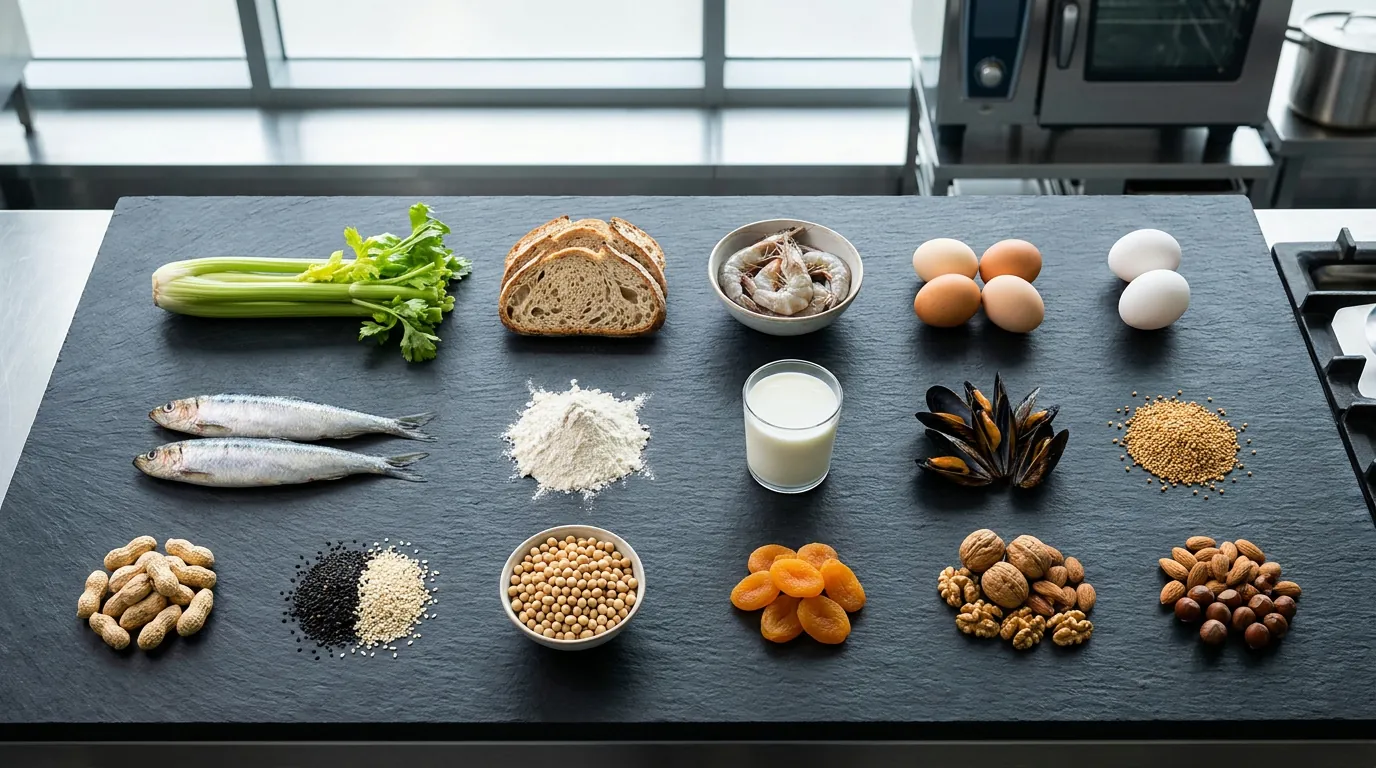
Whether you are preparing for Owen’s Law or simply following current best practice, these are the 14 allergens that must be declared under UK food law whenever they are present as an ingredient:
- Celery – including stalks, leaves, seeds, and celeriac. Common in soups, stocks, sauces, and seasoning blends.
- Cereals containing gluten – wheat (including spelt and khorasan), rye, barley, oats. Present in bread, batter, pasta, sauces thickened with flour, soy sauce.
- Crustaceans – prawns, crabs, lobster, crayfish. Including shrimp paste and fish sauce in some Asian cuisines.
- Eggs – in pasta, cakes, sauces (mayonnaise, hollandaise, bearnaise), batter, some wines and cocktails (egg white fining).
- Fish – including fish sauce, Worcestershire sauce, Caesar dressing, some Asian seasonings.
- Lupin – a legume increasingly used in gluten-free flour blends. Cross-reactive with peanut allergy.
- Milk – including lactose, casein, whey, butter, cream, cheese, and buttermilk. The allergen that killed Owen Carey.
- Molluscs – mussels, oysters, squid, clams. Including oyster sauce.
- Mustard – including seeds, powder, oil, and leaves. Common in dressings, marinades, and spice blends.
- Nuts – almonds, hazelnuts, walnuts, cashews, pecans, Brazil nuts, pistachios, macadamia nuts. Including nut oils, butters, and pastes.
- Peanuts – groundnuts. Including peanut oil, peanut flour, and satay sauce. The allergen in the Zaman and Wilson cases.
- Sesame – sesame seeds, tahini, sesame oil. The allergen that killed Natasha Ednan-Laperouse.
- Soybeans – including soya sauce, tofu, edamame, soya lecithin. Ubiquitous in processed foods and Asian cuisine.
- Sulphur dioxide and sulphites – at concentrations above 10mg/kg or 10mg/litre. Found in wine, dried fruit, some sausages, and preserved foods.
In a restaurant setting, the challenge is that allergens are often hidden in compound ingredients. A “grilled chicken” contains dairy if the marinade includes buttermilk. A “house dressing” contains mustard, egg, and soy if nobody has documented what goes into it. A “chocolate dessert” contains milk, wheat, eggs, and potentially nuts depending on the recipe.
Without a written allergen matrix, every customer interaction becomes an exercise in memory and guesswork. With one, it becomes a verifiable statement of fact.
What to Do Now: Preparing for Owen’s Law
Owen’s Law has not been legislated yet. But the FSA’s voluntary guidance is published, the political direction is set, and – most importantly – providing written allergen information is the right thing to do for your customers regardless of the legal timeline.
Here is what every restaurant, cafe, takeaway, and food service business should be doing now.
1. Put Written Allergen Information on Your Menus
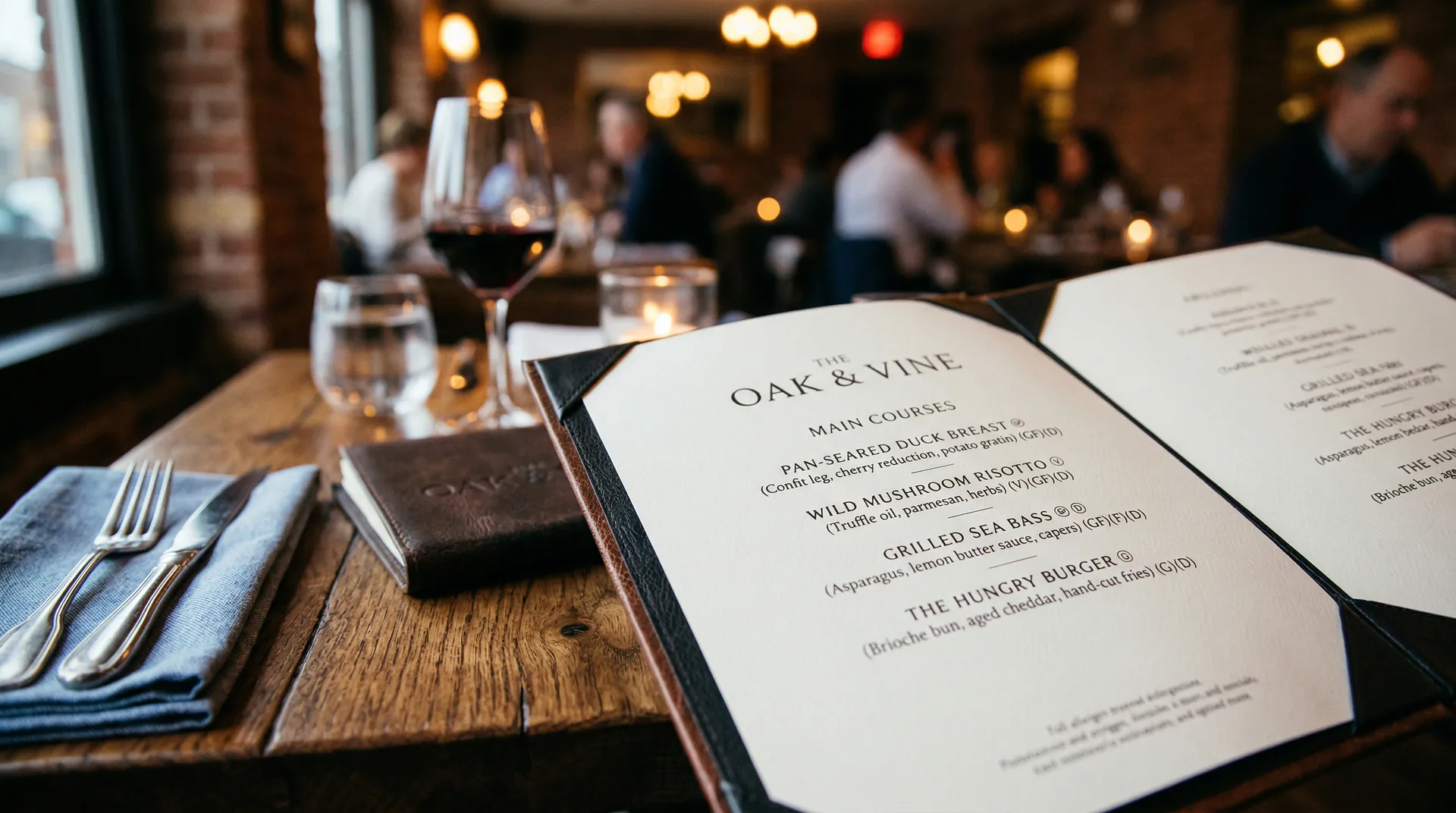
This is the core of Owen’s Law and the single most important step you can take. Every dish on your menu should have its allergens clearly identified in writing, visible to the customer at the point of ordering. Options include:
- Allergen symbols next to each dish – using a standardised icon set for each of the 14 allergens
- Written allergen declarations – listing allergens in text beneath each dish description
- A numbered key system – numbering the 14 allergens and placing the relevant numbers next to each dish
- A separate allergen matrix – a grid showing every menu item against all 14 allergens, available at the table or clearly referenced on the menu itself
The FSA’s voluntary guidance recommends that written allergen information be provided at the point where the customer makes their choice. For dine-in, that means on the menu. For online ordering, that means on the website or app. For phone orders, that means verbally confirmed and supported by written records.
2. Create and Maintain a Full Allergen Matrix
An allergen matrix is a grid that lists every dish or product down one side and all 14 allergens across the top. Each cell indicates whether that allergen is present. This is the master document that underpins everything else – your menu declarations, your staff training, your responses to customer queries.
Building it requires going through every recipe, documenting every ingredient including sub-ingredients, and cross-referencing against the 14 allergen categories. It is painstaking work. It also becomes invalid the moment an ingredient changes unless you have a system to catch and record those changes.
3. Train Every Member of Staff
Not one designated allergen champion. Every front-of-house staff member who takes an order or serves food, and every kitchen staff member who prepares it, must understand:
- What the 14 allergens are
- Which dishes on the current menu contain which allergens
- How to respond when a customer reports an allergy
- What to do if they are unsure about an ingredient
- How to handle an allergic reaction if one occurs
- That they must never guess or assume – if they do not know, they must check
Training must be documented. Records should show who was trained, when, and what was covered. Refresher training should happen when menus change and at regular intervals. The Hannah Jacobs case – where a Costa Coffee employee failed the allergy quiz twenty times before passing – shows that a test pass alone does not guarantee competence. Training must be substantive, not performative.
4. Implement a Communication System for Allergy Orders
When a customer declares an allergy, what happens next? Is there a defined process, or does it depend on who is working that day?
A robust system looks like this:
- The server records the allergy on the order (not just remembers it)
- The kitchen receives the allergy information in writing (a verbal shout across a busy kitchen is not reliable)
- The kitchen confirms which dishes are safe and prepares them with appropriate precautions
- The server double-checks the dish against the allergy before serving it
- A duty manager or senior staff member has oversight of allergy orders
This mirrors the Owen’s Law campaign’s call for designated duty managers to supervise allergy orders. You do not need legislation to implement it.
5. Manage Allergens Digitally
Paper-based allergen matrices are a liability. They go out of date. Multiple versions circulate. Staff refer to last month’s version without realising the recipe has changed. There is no audit trail showing when information was reviewed or updated.
Digital allergen management solves these problems. A centralised system where recipes, ingredients, and allergen data are maintained in one place, updated in real time, and accessible to all staff eliminates the version-control problem that makes paper systems dangerous.
Forkto’s allergen management tools let you build your allergen matrix digitally, link it to your recipes and supplier information, and generate the allergen declarations you need for your menus. When an ingredient changes, you update it once and the information flows through. When an EHO asks to see your allergen records, you have timestamped, auditable documentation rather than a ring binder.
6. Audit Your Allergen Systems Regularly
Set a schedule – monthly at minimum – to verify that:
- Your allergen matrix matches what is actually being served in the kitchen
- Your menu allergen declarations match your allergen matrix
- Supplier specifications are current and have not been superseded by reformulations
- Staff can correctly identify allergens in the dishes they serve
- Your communication process for allergy orders is being followed consistently
- Training records are up to date
An audit is not a formality. It is the mechanism that catches the gap between what your documents say and what is actually happening. That gap is where people get hurt.
7. Plan for Menu Changes
Every menu change – a new dish, a modified recipe, a seasonal special, a substituted ingredient – is an allergen risk event. Before any menu change goes live:
- Document the full recipe including all sub-ingredients
- Identify all 14 allergens present
- Update the allergen matrix
- Update the menu allergen declarations
- Brief all staff on the change
- Update any digital records
This sounds onerous. In practice, it becomes routine once the system is established. The businesses that get into trouble are the ones that change a recipe on Wednesday and update the allergen matrix on Friday – or never.
Owen’s Law Compliance Checklist
Use this to assess your current readiness:
- Does every dish on your menu have its allergens identified in writing, visible to the customer?
- Do you have a complete allergen matrix covering every menu item against all 14 allergens?
- Is the allergen matrix based on verified recipes with full ingredient breakdowns?
- Do you have current supplier specifications confirming allergen content for every ingredient?
- Have all front-of-house and kitchen staff received allergen training, and is it documented?
- Do you have a defined process for handling allergy orders from declaration through to service?
- Is there a system for updating allergen information when recipes, menus, or suppliers change?
- Can you demonstrate to an EHO when your allergen records were last reviewed and by whom?
- For online ordering and delivery platforms, is allergen information available before the customer places their order?
- Do you conduct regular audits to verify that allergen information matches what is actually being served?
If you answered no to any of these, that is where to start. You do not need to wait for legislation.
The Timeline: Where We Are Now
| Date | Event |
|---|---|
| 22 April 2017 | Owen Carey dies at Byron Burgers on his 18th birthday |
| 2018 | Inquest held; Coroner Briony Ballard issues Regulation 28 PFD report |
| 1 October 2021 | Natasha’s Law comes into force (PPDS labelling) |
| April 2021 | Paul Carey launches Owen’s Law campaign |
| 15 May 2023 | Westminster Hall debate on Owen’s Law |
| December 2023 | FSA Board unanimously backs mandatory written allergen information |
| 5 March 2025 | FSA publishes voluntary best practice guidance |
| Spring 2026 | Government evaluation of voluntary guidance uptake |
| Late 2027-2028 | Earliest realistic date for Owen’s Law legislation |
Frequently Asked Questions
Is Owen’s Law already in force?
No. As of March 2026, Owen’s Law has not been legislated. The FSA has published voluntary best practice guidance recommending written allergen information, and the government is evaluating uptake in spring 2026. Legislation could follow in late 2027 or 2028 at the earliest.
Do I legally have to put allergen information on my menu right now?
No. Current law allows you to communicate allergens verbally or through a sign directing customers to ask staff. But the FSA strongly recommends providing written allergen information, and doing so protects your customers and your business. If something goes wrong and you relied solely on verbal communication, that will be scrutinised.
Does Owen’s Law apply to takeaways and delivery?
The campaign and FSA guidance cover all food businesses where customers order from a menu or list – restaurants, cafes, takeaways, canteens, and food delivered through online platforms. Written allergen information should be available wherever the customer makes their ordering decision.
What if my menu changes frequently?
This is one of the most common concerns. Specials boards, seasonal menus, and daily-changing dishes all need allergen information. Digital allergen management systems make this manageable because allergen data is linked to recipes rather than fixed to a printed menu. When a dish is added or changed, the allergen information updates accordingly.
What is the difference between Natasha’s Law and Owen’s Law?
Natasha’s Law requires full ingredient labelling with emphasised allergens on prepacked for direct sale (PPDS) food – items that are packaged before the customer selects them and sold at the same premises. Owen’s Law addresses non-prepacked food – dishes made to order in restaurants, cafes, and takeaways. They cover different categories of food but share the same principle: customers should not have to rely on verbal communication to know what allergens are in their food.
Will Owen’s Law require specific formatting?
The FSA’s voluntary guidance does not prescribe a single format. It recommends that allergen information be written, visible at the point of ordering, and clear enough for customers to understand. Whether you use symbols, text declarations, numbered keys, or a matrix is up to you – as long as the information is accurate, complete, and accessible.
What about “may contain” warnings on menus?
Precautionary allergen labelling (“may contain”) is voluntary and separate from declaring allergens that are definitely present as ingredients. “May contain” should only be used on menus where a genuine cross-contamination risk has been identified through a risk assessment. Blanket “may contain” statements covering all 14 allergens are unhelpful and increasingly viewed as an attempt to avoid responsibility rather than inform customers.
The Numbers
- 2.4 million UK adults have a clinically confirmed food allergy
- Food allergy prevalence in the UK doubled between 2008 and 2018
- 4,323 hospital admissions for anaphylaxis in 2023/24 – a 17.8% year-on-year increase
- Hospital admissions for anaphylaxis have more than doubled since 2002/03
- At least 6 people have died from allergic reactions to restaurant and takeaway food in the UK since 2014
- Ireland has required written allergen information in restaurants since 2014 – over a decade
- The FSA Board voted unanimously for mandatory written allergen information in December 2023
- 1 in 5 adults with food allergies report having had an allergic reaction in a restaurant in the past year
Managing Allergens With Forkto
Building and maintaining an allergen matrix across a changing menu is exactly the kind of operational task that breaks down on paper. Recipes change, suppliers reformulate, new dishes get added to the specials board, and the allergen folder behind the counter does not keep up.
Forkto’s allergen management tools let you maintain your allergen records digitally – linking ingredients to recipes to menu items, with each of the 14 allergens tracked throughout. When a supplier changes a formulation, you update it in one place. When an EHO visits, you have a clean, timestamped audit trail showing exactly what was served, when, and what allergens it contained.
And when Owen’s Law makes written allergen information at the point of ordering mandatory, you are already there. QR allergen menus publish those same records as a customer-facing digital menu: guests scan a QR code at the table, tick the allergens they need to avoid, and see only the dishes that are safe for them – across all 14 allergens, plus vegetarian, vegan, and halal filters. The printed QR code never changes; the menu behind it updates the moment you publish. Try the live demo to see exactly what your customers would see.
Combined with digital checklists, delivery logging, and staff training records, Forkto gives you the complete traceability system that both current law and the coming Owen’s Law will demand.
If you want to see how it works, start your free trial.
The Bottom Line
Owen Carey did everything right. He had managed a severe dairy allergy for his entire life without a single anaphylactic reaction. He told the restaurant staff about his allergy. He ordered what appeared to be a straightforward grilled chicken burger. The menu gave him no reason to think there was dairy in it.
He died because the word “buttermilk” was hidden on the back of a menu, in tiny text, in a colour scheme designed to be ignored.
The campaign his father Paul Carey has built is not asking for anything radical. It is asking for the information to be visible. Written down. On the menu. Before the customer orders. Ireland has required this since 2014. France since 2015. The FSA has unanimously backed it. Parliament has debated it. The voluntary guidance is published.
The only question remaining is how long the law will take to catch up with what the evidence, the experts, and the families who have lost children already know: verbal allergen communication in restaurants is not safe enough.
You do not need to wait for Owen’s Law to provide written allergen information. You can do it today. For Owen, and for every customer who walks into your restaurant trusting that the menu tells them what they need to know.
Related Forkto software
Frequently asked questions
Is Owen's Law already in force?
No. As of March 2026, Owen's Law has not been legislated. The FSA has published voluntary best practice guidance recommending written allergen information, and the government is evaluating uptake in spring 2026. Legislation could follow in late 2027 or 2028 at the earliest.
Do I legally have to put allergen information on my menu right now?
No. Current law allows you to communicate allergens verbally or through a sign directing customers to ask staff. But the FSA strongly recommends providing written allergen information, and doing so protects your customers and your business. If something goes wrong and you relied solely on verbal communication, that will be scrutinised.
Does Owen's Law apply to takeaways and delivery?
The campaign and FSA guidance cover all food businesses where customers order from a menu or list — restaurants, cafes, takeaways, canteens, and food delivered through online platforms. Written allergen information should be available wherever the customer makes their ordering decision.
What if my menu changes frequently?
Specials boards, seasonal menus and daily-changing dishes all need allergen information. Digital allergen management systems make this manageable because allergen data is linked to recipes rather than fixed to a printed menu. When a dish is added or changed, the allergen information updates accordingly.
What is the difference between Natasha's Law and Owen's Law?
Natasha's Law requires full ingredient labelling with emphasised allergens on prepacked for direct sale (PPDS) food — items packaged before the customer selects them. Owen's Law addresses non-prepacked food — dishes made to order in restaurants, cafes, and takeaways. They cover different categories of food but share the same principle: customers should not have to rely on verbal communication.
Will Owen's Law require specific formatting?
The FSA's voluntary guidance does not prescribe a single format. It recommends that allergen information be written, visible at the point of ordering, and clear enough for customers to understand. Whether you use symbols, text declarations, numbered keys, or a matrix is up to you — as long as the information is accurate, complete, and accessible.
What about 'may contain' warnings on menus?
Precautionary allergen labelling ('may contain') is voluntary and separate from declaring allergens that are definitely present as ingredients. It should only be used on menus where a genuine cross-contamination risk has been identified through a risk assessment. Blanket 'may contain' statements covering all 14 allergens are unhelpful and increasingly viewed as avoidance rather than informing customers.
Safe hands, clear records
Stop running food safety on paper
Forkto turns daily checks, temperature logs, HACCP and audits into a few taps on a phone. Your team stays consistent and you're always ready for the EHO.
14-day free trial · No card required