Food safety guide
Allergen Matrix: The UK Food Business Guide (2026)
The complete UK allergen matrix guide for food businesses: what it is, how to build one in 10 steps, a worked cafe example, hidden allergens to watch for, and what EHOs actually check.
5 April 2026
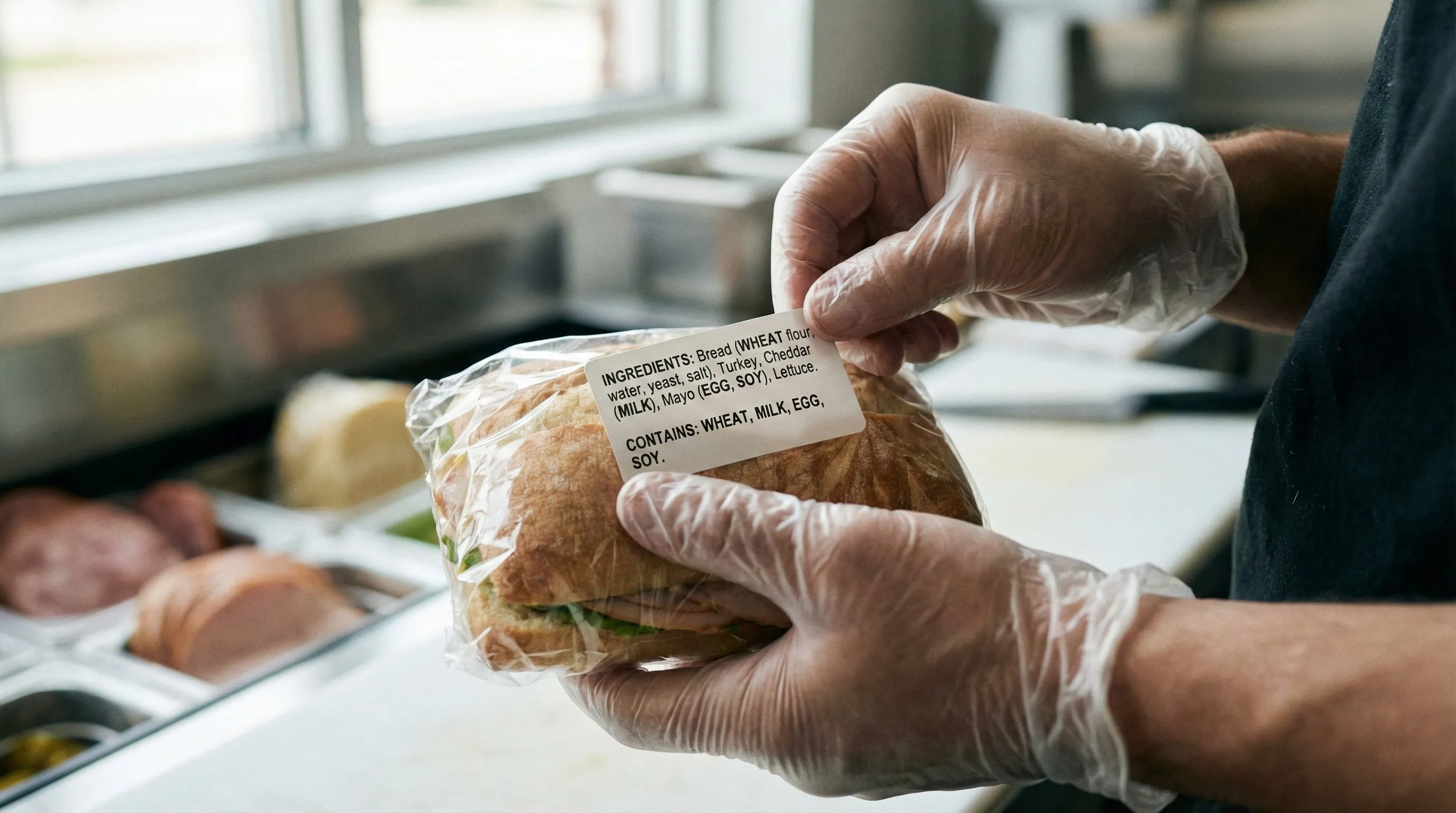
If a customer asked your front-of-house team right now whether the chef’s soup contains celery, how would they know? If the answer is “they’d check with the kitchen” or “they’re pretty sure”, you have a problem. Since 2014, UK food businesses have had a legal duty to provide accurate allergen information. Since Natasha’s Law in 2021, that duty applies to items you pack in-store before sale too.
The document that ties this together — what the FSA calls best practice and what EHOs expect to see at every inspection — is an allergen matrix. This guide covers exactly what a UK allergen matrix is, how to build one in ten steps, a worked cafe example, the hidden allergens that catch most businesses out, and what inspectors actually check.
What is an allergen matrix?
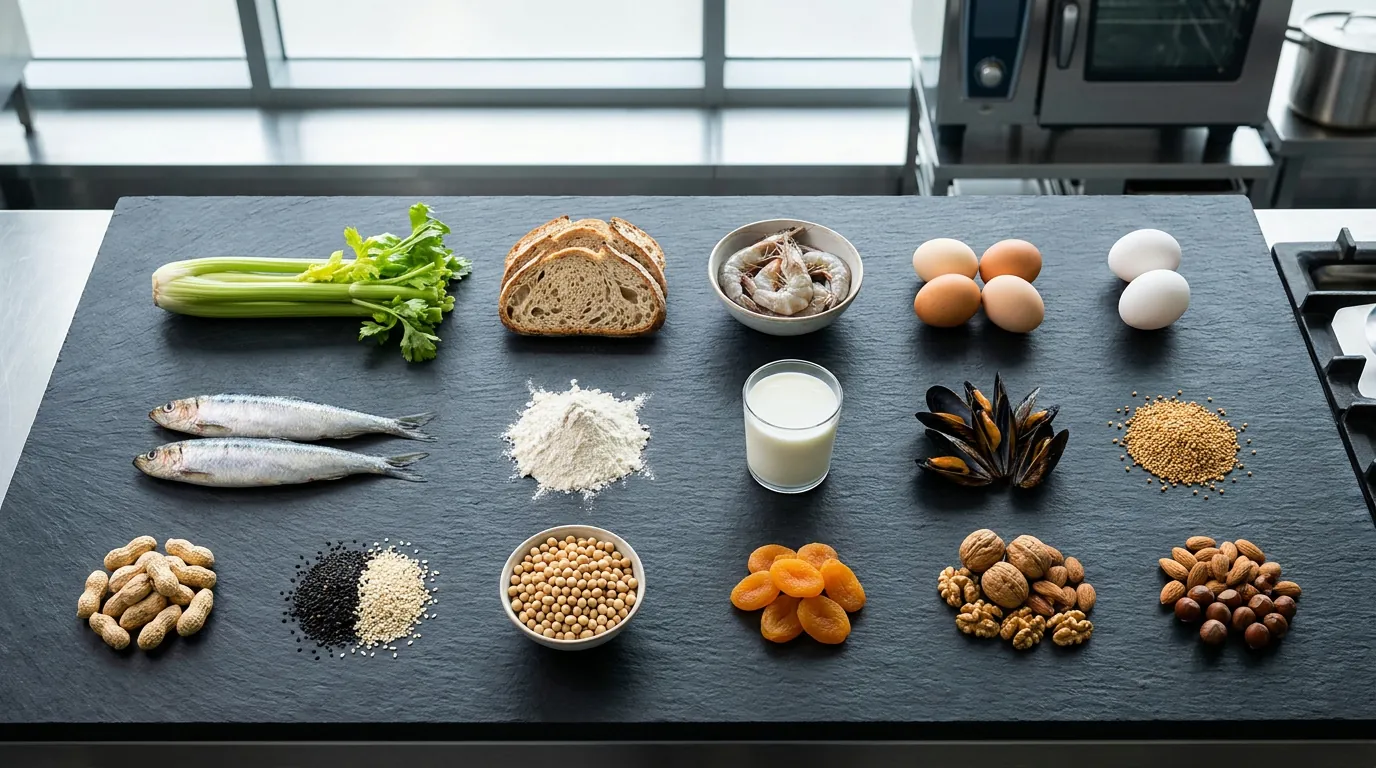
An allergen matrix (also called an allergen chart or allergen grid) is a document that maps every product, dish or recipe your business sells against the 14 allergens that must be declared under UK law. Products appear on one axis, the 14 allergens on the other, and each cell indicates whether that allergen is present — either intentionally as an ingredient or unavoidably through cross-contamination.
The 14 declarable allergens come from Annex II of EU Regulation 1169/2011, now retained as UK assimilated law. They are:
- Celery (including celeriac)
- Cereals containing gluten — wheat, rye, barley, oats and hybridised strains
- Crustaceans
- Eggs
- Fish
- Lupin
- Milk (including lactose)
- Molluscs
- Mustard
- Peanuts
- Sesame
- Soybeans
- Sulphur dioxide and sulphites (above 10mg/kg or 10mg/L)
- Tree nuts — almonds, hazelnuts, walnuts, Brazil nuts, cashews, pecans, pistachios, macadamia nuts
Is the matrix itself legally required?
No. There is no specific legal requirement to maintain an allergen matrix document. What is legally required under the UK Food Information Regulations 2014 is providing accurate allergen information to consumers.
In practice, the distinction is academic. Environmental Health Officers (EHOs) expect to see an allergen matrix at every inspection. Without written allergen documentation, demonstrating compliance with the legal duty becomes extremely difficult — and the likely outcome is an improvement notice plus a negative impact on your food hygiene rating.
How UK allergen law actually works
Three pieces of legislation form the backbone of UK allergen requirements:
- EU Regulation 1169/2011 (the Food Information for Consumers Regulation) established the 14 declarable allergens. Post-Brexit, it became UK “assimilated law” on 1 January 2024 and continues to apply in Great Britain
- UK Food Information Regulations 2014 (SI 2014/1855) provide domestic enforcement powers
- Natasha’s Law (October 2021) closed the Prepacked for Direct Sale loophole — see our detailed breakdown of the regulation
Requirements differ by food type:
- Prepacked food must carry an ingredients list with all 14 allergens emphasised (bold, italics or colour)
- Non-prepacked (loose) food — the most common category for restaurants and cafes — requires allergen information to be available by any means, including verbally. Since March 2025, FSA best practice is “written allergen information, supported by a conversation”
- Prepacked for Direct Sale (PPDS) — items packaged on the same premises before customer selection — must carry a full ingredients list with allergens emphasised on the label
The 2025 FSA best-practice guidance is widely expected to become statutory in the next 18–24 months. That change is known as Owen’s Law — see our Owen’s Law guide for restaurants.
What happens if you get it wrong
Allergen non-compliance is a criminal offence under the FIR 2014. Magistrates’ Court fines are unlimited — the £20,000 cap was removed in March 2015. Enforcement escalates from advice, to improvement notices, to penalties, to criminal prosecution. In the most serious cases, business owners have faced manslaughter charges.
Real UK cases in 2024-2025 include JR Uxbridge Ltd (Javitri, April 2025) — £43,816 total after a customer was hospitalised by undeclared nuts, despite the business having recent FSA allergen training. Paperwork and training don’t prevent incidents on their own — what prevents incidents is a current, accurate allergen matrix that staff actually use.
A worked allergen matrix — cafe menu example
This is a realistic UK cafe matrix. C = Contains, MC = May Contain (unavoidable cross-contamination), blank = not present.
Allergen abbreviations: Ce (Celery), G (Gluten), Cr (Crustaceans), E (Eggs), F (Fish), L (Lupin), M (Milk), Mo (Molluscs), Mu (Mustard), N (Tree Nuts), P (Peanuts), Se (Sesame), So (Soya), Su (Sulphites).
| Item | Key Ingredients | Ce | G | Cr | E | F | L | M | Mo | Mu | N | P | Se | So | Su |
|---|---|---|---|---|---|---|---|---|---|---|---|---|---|---|---|
| BLT Sandwich | Bacon, lettuce, tomato, mayo, white bread | C | C | C | |||||||||||
| Tuna Mayo Sandwich | Tuna, mayo, lettuce, white bread | C | C | C | C | ||||||||||
| Egg Mayo Sandwich | Egg, mayo, cress, white bread | C | C | C | |||||||||||
| Caesar Salad | Romaine, chicken, croutons, Parmesan, Caesar dressing | C | C | C | C | C | |||||||||
| Greek Salad | Feta, olives, cucumber, tomato, onion | C | |||||||||||||
| Tomato Soup | Tomatoes, onion, cream, butter, stock cube | C | C | ||||||||||||
| Chicken Soup | Chicken, veg, stock cube, egg noodles | C | C | C | |||||||||||
| Carrot Cake | Flour, eggs, oil, walnuts, cream cheese frosting | C | C | C | C | ||||||||||
| Victoria Sponge | Flour, eggs, butter, jam, cream | C | C | C | |||||||||||
| Chocolate Brownie | Flour, eggs, butter, dark chocolate | C | C | C | C | ||||||||||
| Latte | Espresso, milk | C | |||||||||||||
| Hot Chocolate | Milk, chocolate powder, cream | C | C | ||||||||||||
| Fruit Smoothie | Banana, strawberries, yoghurt, honey | C | |||||||||||||
| Cheese & Ham Toastie | Bread, cheddar, ham, butter | C | C | C |
Notice what the matrix reveals. Gluten and milk dominate — in 11 and 12 of 14 items respectively. Soya is present in 7 items almost entirely from soya flour in commercial bread and soya lecithin in chocolate — a hidden allergen most operators miss. The Caesar salad is a triple-allergen hazard (eggs, fish in anchovies, mustard in the dressing). The stock cube introduces celery into both soups.
This is why the matrix works. Until you see it laid out, cross-contamination routes and compound-ingredient allergens aren’t visible.
The hidden allergens that catch food businesses out
The most common source of allergen incidents isn’t missing the obvious ingredient — it’s missing the compound ingredient’s sub-ingredients. Here’s what to watch for in UK kitchens.
Celery hides in: stock cubes (virtually all brands), Marmite, gravy granules, Worcestershire sauce, seasoning blends, crisps flavourings, curry pastes, Heinz Tomato Ketchup, and the mirepoix base in Italian and French cooking. Heat does not destroy celery proteins.
Cereals (gluten) beyond bread: soy sauce (brewed with wheat), malt vinegar (from barley), beer and lager, gravy granules, sausage rusk, imitation crab/surimi, some coated French fries, couscous, bulgur wheat, and modified starch when wheat-derived.
Eggs as invisible binder: fresh pasta and egg noodles, mayonnaise, pastry glazes, Quorn non-vegan range, some wines (fining), marshmallows, hollandaise, Yorkshire pudding, some chocolate nougat bars, ice cream, custard, lemon curd, and egg-white cocktails.
Fish — anchovies are the biggest trap: Worcestershire sauce, Caesar dressing, Thai fish sauce, some wines and beers (isinglass fining), Gentleman’s Relish, kimchi, some steak sauces, and dashi/bonito broth.
Milk — the 60% problem: most commercial bread (milk powder as improver — Hovis, Kingsmill, Warburtons all routinely contain milk), many crisps flavours (not just cheese & onion), processed meats (casein in sausages and deli meats), margarine, non-dairy coffee creamers (often contain casein), and over 20% of prescription medicines.
Soya — in 60% of manufactured foods. Most commercial bread (soya flour), virtually all mainstream chocolate (soya lecithin E322), margarine, processed meats, Worcestershire sauce, many biscuits, tinned fish (packed in soybean oil), surimi, breakfast cereals, ready meals.
Sulphites — the preservative problem: wine (white and rosé especially), dried fruit (apricots can exceed 1000ppm), most UK sausages, vinegar, pickled foods, bottled lemon/lime juice, maraschino cherries, pre-cut/peeled potatoes, frozen French fries, some prawns, guacamole.
Mustard is heat-resistant and undetectable in many dishes: pickles and piccalilli, salad dressings, curry powder (mustard seed is standard), BBQ sauce, some ketchups, Cumberland sauce, mayonnaise, cheese sauce, many Indian dishes.
Sesame hides in: burger buns and bread rolls (seeds in dough), hummus (tahini), halva, falafel, many Asian dishes, and some bread improvers.
Lupin is increasingly in gluten-free products (lupin flour as wheat substitute), continental breads, some pasta, vegan meat alternatives, and pizza bases. Significant cross-reactivity risk for peanut-allergic customers.
Tree nuts hide in: pesto (pine nuts), marzipan (almonds), korma and passanda (cashews/almonds), Nutella, macarons, mortadella (pistachios), and dukkah spice mix.
How to build an allergen matrix in 10 steps
1. List every product
Every item you sell — daily specials, seasonal items, sauces, dressings, condiments, garnishes, children’s menu, drinks (smoothies, lattes and hot chocolate all contain allergens). The FSA specifically warns against forgetting specials.
2. Get supplier specifications
Request full specifications from every supplier. Specs should include complete ingredients with allergens highlighted, any “may contain” statements, whether products are manufactured on shared lines, and a commitment to notify you of formulation changes. Cross-check the ingredients list against the declared allergens — industry data suggests over 60% of supplier spec sheets contain errors.
3. Break down compound ingredients
Compound ingredients are the primary source of hidden allergens. Worcestershire sauce contains fish (anchovies), gluten (barley malt vinegar), and soya. Soy sauce contains both soya and wheat. Stock cubes typically contain celery. Chocolate contains soya lecithin. Check for allergens hiding under technical names: casein = milk, albumin = egg, lecithin = usually soya.
4. Create recipe cards
One card per dish listing every ingredient (including oils, seasonings, garnishes), allergens present in each ingredient, the source/brand of each bought-in ingredient, the completion date, and who completed it. The FSA provides free recipe card templates.
5. Build the grid
Create a table with products as rows and the 14 allergens as columns. Walk through each recipe card and mark allergen presence. The FSA provides free downloadable matrix templates in PDF and PowerPoint format, with colour allergen icons.
6. Distinguish “contains” from “may contain”
Use clear notation:
- C = Contains (intentional ingredient)
- MC = May Contain (genuine, unavoidable cross-contamination)
- Blank = Not present
FSA guidance (updated September 2023) is clear: “may contain” should only be used where a genuine unavoidable risk exists that cannot be controlled by segregation and cleaning. Be specific (“may contain peanuts”, not “may contain nuts”). Never use blanket statements.
7. Specify allergen sub-types
Where possible, specify which cereal (wheat/barley/oats) and which tree nut (almonds/walnuts/cashews). Someone allergic to hazelnuts may tolerate other tree nuts — specificity adds value and demonstrates due diligence.
8. Add document metadata
Header: business name and site, document title, version number, date of creation/last update, author, verifier, next review date. Footer: key/legend explaining all symbols, a statement that the matrix must be reviewed when recipes/ingredients/suppliers change.
9. Verify and sign off
Cross-check every entry against actual labels and supplier specs. Have a second person independently verify. Physically walk through recipes in the kitchen to confirm actual ingredients match records. Date and sign. Get management sign-off. File supporting evidence (labels, spec sheets) in an allergen folder.
10. Train staff and deploy
Brief every staff member — kitchen and front-of-house — before the matrix goes live. Display the matrix in the kitchen and at service points. Ensure front-of-house staff know where to find it and how to read it. Staff should never answer allergen questions from memory — they must check the document every single time.
What triggers an update
An allergen matrix is a living document. Update immediately when any of the following happen:
- Recipe changes (including garnishes, oils, sauces)
- Supplier changes
- Product substitutions when a usual brand is out of stock and a substitute is delivered — this is a very common cause of incidents
- Supplier reformulations (a “new recipe” label on an existing product must trigger review)
- New menu items or seasonal rotations
- New equipment or facility changes affecting cross-contamination risk
- Staff changes (a new chef may alter recipes)
- Changes in preparation method (shared fryer where dedicated equipment was used before)
Even without changes, review at minimum annually, and ideally quarterly. Every delivery should prompt a check.
The ten most common maintenance mistakes
Food businesses fail on allergen compliance in predictable ways:
- Not checking substitute products when the usual brand is unavailable
- Ignoring supplier reformulations
- Leaving outdated matrices in circulation
- Assuming “vegan” means allergen-free (the FSA specifically warns against this)
- Not checking compound ingredient sub-lists
- Updating the document but not briefing staff
- Treating the matrix as a one-off task
- Allowing staff to rely on memory
- Writing “nuts” without specifying which tree nut
- Failing to pass on supplier “may contain” information to the customer
What EHOs actually check
At inspection, an EHO doesn’t just look at your labels — they follow the thread. Label → allergen matrix → supplier specifications → delivery records. If you can’t demonstrate that trail, you have a compliance gap even if the label itself looks correct.
They specifically look for:
- A written allergen matrix available and accurate for the current menu
- Supplier specifications retained to verify allergen content
- Staff training records within 12 months
- Documented procedures for handling customer allergen requests
- PPDS labels present on every qualifying item (see our PPDS compliance checklist)
- Staff knowledge — the EHO will spot-quiz your team on the 14 allergens
Why paper matrices fail
Paper allergen matrices are the most common format in small UK food businesses, and they fail in predictable ways:
- Version control collapses. When the matrix is updated, every printed copy must be physically replaced. In practice, old versions persist across sites, and staff give incorrect information.
- Paper gets food-stained, wet, torn and illegible in busy kitchens.
- Accessibility. The matrix lives in an office folder while a customer asks a front-of-house team member at the counter.
- Multi-site businesses face the nightmare of keeping every location on the current version.
- No audit trail. No way to prove when changes were made, who made them, or what the previous version said.
- No alerts when a review is due or a supplier reformulates.
Spreadsheets (Excel, Google Sheets) are a practical middle ground — free, supports conditional formatting and colour coding, Google Sheets provides automatic version history, can still be printed for kitchen display. Limitations: manual data entry and no automatic allergen flagging.
FSA resources you can use free today
The FSA provides extensive free allergen resources:
- Free allergen matrix template in PDF and PowerPoint (editable) with the 14 allergen icons. Available in English and Welsh: food.gov.uk/business-guidance/allergen-guidance-for-food-businesses
- Free online FSA allergen training at allergytraining.food.gov.uk
- Allergen icons (colour and black-and-white, minimum 0.6cm × 0.6cm)
- “Think Allergy” kitchen poster (English, Welsh, Bengali, Cantonese, Punjabi, Urdu)
- Allergen checklist for managers, kitchen staff, and front-of-house
- Interactive allergen and ingredients food labelling decision tool
The FSA template is fine as a starting point for very small, stable-menu businesses. It has two weaknesses: no distinction between “contains” and “may contain”, and no audit trail. Either means you’ll need to extend it yourself.
If you want a printable matrix you can put up in the kitchen today, download our free Allergen Matrix template — a landscape grid of menu items against all 14 allergens, with completion guidance and a manager sign-off built in. It pairs with our Allergen Management SOP for the front-of-house and kitchen procedures around it.
Ready to move beyond paper
An allergen matrix that lives in a paper folder, gets wet, and gets out of date is a compliance risk — not a compliance solution. The businesses that survive the next allergen incident without fines, closure or worse are the ones whose allergen information is live, versioned, and instantly accessible to staff at the point of service.
Forkto’s allergen management lets you build and maintain your matrix digitally, tracking each product against the 14 allergens, linking to supplier specifications, and flagging reviews when they’re due. When a formulation changes, you update it in one place and the change flows through to every product that uses it. When an EHO visits, you have a clean, timestamped record of exactly when information was reviewed and by whom — no Tipp-Ex needed.
Your matrix doesn’t have to stop at the pass, either. The same data can be published as a QR allergen menu: customers scan a code on the table or counter, select the allergens they need to avoid, and the menu filters itself — so front-of-house stops relaying allergen questions to the kitchen mid-service (try the live demo).
Combined with digital checklists and delivery logging, Forkto gives you the traceability chain inspectors want to see: from supplier delivery through production to the label on the product.
Start a free trial or browse our free downloadable checklists — no email required.
Last updated: 18 April 2026. This guide reflects the UK Food Information Regulations 2014, retained EU Regulation 1169/2011, Natasha’s Law (October 2021), and the March 2025 FSA best-practice guidance on allergen information for non-prepacked foods.
Related Forkto software
Frequently asked questions
What is an allergen matrix?
An allergen matrix is a grid that maps every product, dish or recipe your business sells against the 14 allergens that must be declared under UK law. It's the FSA-recommended way to prove you know exactly which allergens are in each item and how you communicate that to customers and staff.
Is an allergen matrix a legal requirement?
No, the matrix itself is not legally required. What is legally required is providing accurate allergen information to consumers under the UK Food Information Regulations 2014. An allergen matrix is the FSA-recommended way to achieve this, and EHOs expect to see one at inspection.
What are the 14 allergens UK food businesses must declare?
The 14 declarable allergens are: celery, cereals containing gluten (wheat, rye, barley, oats), crustaceans, eggs, fish, lupin, milk, molluscs, mustard, peanuts, sesame, soybeans, sulphur dioxide and sulphites (above 10mg/kg), and tree nuts. These come from Annex II of retained EU Regulation 1169/2011.
How often should you update an allergen matrix?
Every time you change a recipe, switch supplier, use a substitute product, or receive a reformulated ingredient. Even with no changes, the matrix should be reviewed at least annually, and ideally quarterly, to verify supplier specifications remain current.
What is the difference between 'contains' and 'may contain' on an allergen matrix?
'Contains' means the allergen is an intentional ingredient. 'May contain' means there is a genuine, unavoidable cross-contamination risk that cannot be fully controlled by segregation and cleaning. FSA guidance from September 2023 states that 'may contain' should only be used where a real risk exists, not as a blanket disclaimer.
Does an allergen matrix need to cover PPDS items?
Yes. Prepacked for Direct Sale (PPDS) items — such as in-store-packed sandwiches — must carry a label showing the full ingredients list with the 14 allergens emphasised under Natasha's Law. Your allergen matrix must include every PPDS item, and the information on the matrix must match the label exactly.
Can staff answer allergen questions from memory?
No. FSA guidance is explicit: staff should never answer allergen questions from memory. Every enquiry should prompt a check of the matrix or equivalent written source. Allergen training is required for all food handlers and should be documented.
What does the FSA provide for free on allergens?
The FSA provides a free allergen matrix template in PDF and PowerPoint, allergen icons for each of the 14 allergens, a 'Think Allergy' kitchen poster, menu planning recipe sheets, a customer-facing allergy sign, and a free online allergen training course at allergytraining.food.gov.uk.
Where do hidden allergens catch food businesses out most?
The most commonly missed sources are: celery in stock cubes and gravy, fish (anchovies) in Worcestershire sauce and Caesar dressing, milk in bread and processed meats, soya in chocolate and commercial bread, sulphites in sausages and dried fruit, and mustard in curry powder and salad dressings. Always check compound ingredient specs, not just the top-line recipe.
What are the penalties for allergen non-compliance?
Failure to comply with allergen labelling requirements is a criminal offence under the Food Information Regulations 2014. Magistrates' Court fines are unlimited since March 2015 (when the £20,000 cap was removed). In the most serious cases — where a customer has died — business owners have faced manslaughter charges.
Safe hands, clear records
Stop running food safety on paper
Forkto turns daily checks, temperature logs, HACCP and audits into a few taps on a phone. Your team stays consistent and you're always ready for the EHO.
14-day free trial · No card required