Food safety guide
Cross-Contamination Prevention in Commercial Kitchens
Learn how to prevent cross-contamination in your commercial kitchen. Covers bacterial, chemical, physical and allergen risks plus what EHOs look for.
4 March 2026
Cross-contamination is one of the most common reasons food businesses get hit with enforcement action. It’s also one of the most preventable.
Every year, the Food Standards Agency links thousands of foodborne illness cases back to cross-contamination in commercial kitchens. Since Natasha’s Law came into force, allergen cross-contamination has moved even further up the enforcement agenda. An Environmental Health Officer finding evidence of poor separation practices in your kitchen isn’t going to give you the benefit of the doubt.
The good news: preventing cross-contamination isn’t complicated. It just needs to be systematic.
What Cross-Contamination Actually Means
Cross-contamination is the transfer of harmful substances — bacteria, chemicals, allergens, or physical contaminants — from one surface, food, or person to another. It’s usually indirect. Raw chicken doesn’t need to touch a salad for the salad to become contaminated. A shared chopping board, a pair of unwashed hands, or a splash of dirty water can do the job just as effectively.
The reason it’s such a persistent problem in commercial kitchens is volume and speed. When you’re pushing out 200 covers on a Friday night, it takes discipline to maintain separation practices. But that’s exactly when cross-contamination is most likely to happen.
The Four Types of Cross-Contamination
Bacterial Cross-Contamination
This is the one most people think of first. Pathogenic bacteria — Salmonella, E. coli, Campylobacter, Listeria — transfer from raw foods (particularly raw meat, poultry, and seafood) to ready-to-eat foods.
Common routes include:
- Using the same chopping board for raw chicken and salad vegetables
- Storing raw meat above ready-to-eat food in the fridge
- Handling raw proteins then touching other surfaces without washing hands
- Using the same cloth to wipe down different prep areas
- Defrosting meat where the liquid can drip onto other items
Bacterial cross-contamination is behind most serious food poisoning outbreaks traced back to commercial kitchens. The consequences range from a bad review to a hospitalised customer and a hygiene improvement notice.
Chemical Cross-Contamination
Cleaning chemicals, sanitisers, pesticides, and other non-food substances can contaminate food if they’re stored or used incorrectly. This happens more often than you’d think.
Typical causes:
- Storing cleaning products in the same area as food or food packaging
- Using unlabelled spray bottles (staff grab the wrong one)
- Not rinsing surfaces properly after cleaning with chemical sanitisers
- Pesticide overspray near food prep or storage areas
- Decanting chemicals into food containers
Chemical contamination can cause immediate illness and is treated very seriously by EHOs. Proper COSHH (Control of Substances Hazardous to Health) procedures aren’t optional — they’re a legal requirement.
Physical Cross-Contamination
Foreign objects ending up in food. Glass, metal fragments, hair, plasters, packaging material, insects, jewellery — anything that shouldn’t be there.
This type often comes from:
- Broken equipment or chipped crockery
- Staff not wearing hair nets or removing jewellery
- Poor pest control
- Damaged packaging making its way into storage
- Worn or fraying cleaning equipment (scourer fragments, bristles from brushes)
Physical contamination is the type customers notice immediately. A piece of glass in a meal doesn’t just cause injury — it destroys trust and can result in prosecution.
Allergen Cross-Contamination
This is the one that’s changed the most in recent years. Since Natasha’s Law (October 2021), the requirements around allergen information for prepacked for direct sale (PPDS) foods tightened significantly. But the underlying obligation has always been there: you must be able to tell customers what allergens are in your food, and you must take reasonable steps to prevent allergen cross-contact.
Allergen cross-contamination happens through:
- Shared cooking oil (frying fish then chips for a customer with a fish allergy)
- Using the same utensils for dishes containing different allergens
- Flour dust settling on surfaces during bread or pastry prep
- Not cleaning equipment properly between allergen-containing and allergen-free products
- Poor labelling of ingredients and prep containers
For someone with a severe allergy, trace amounts can trigger anaphylaxis. There have been fatal cases in the UK directly linked to allergen cross-contamination in food businesses. EHOs take this extremely seriously, and so should you.
What EHOs Are Looking For
When an Environmental Health Officer walks into your kitchen, cross-contamination controls are high on their checklist. Here’s what they’ll be assessing:
Physical separation. Are raw and ready-to-eat foods stored separately? Are there dedicated prep areas or, at minimum, clear procedures for using shared spaces safely?
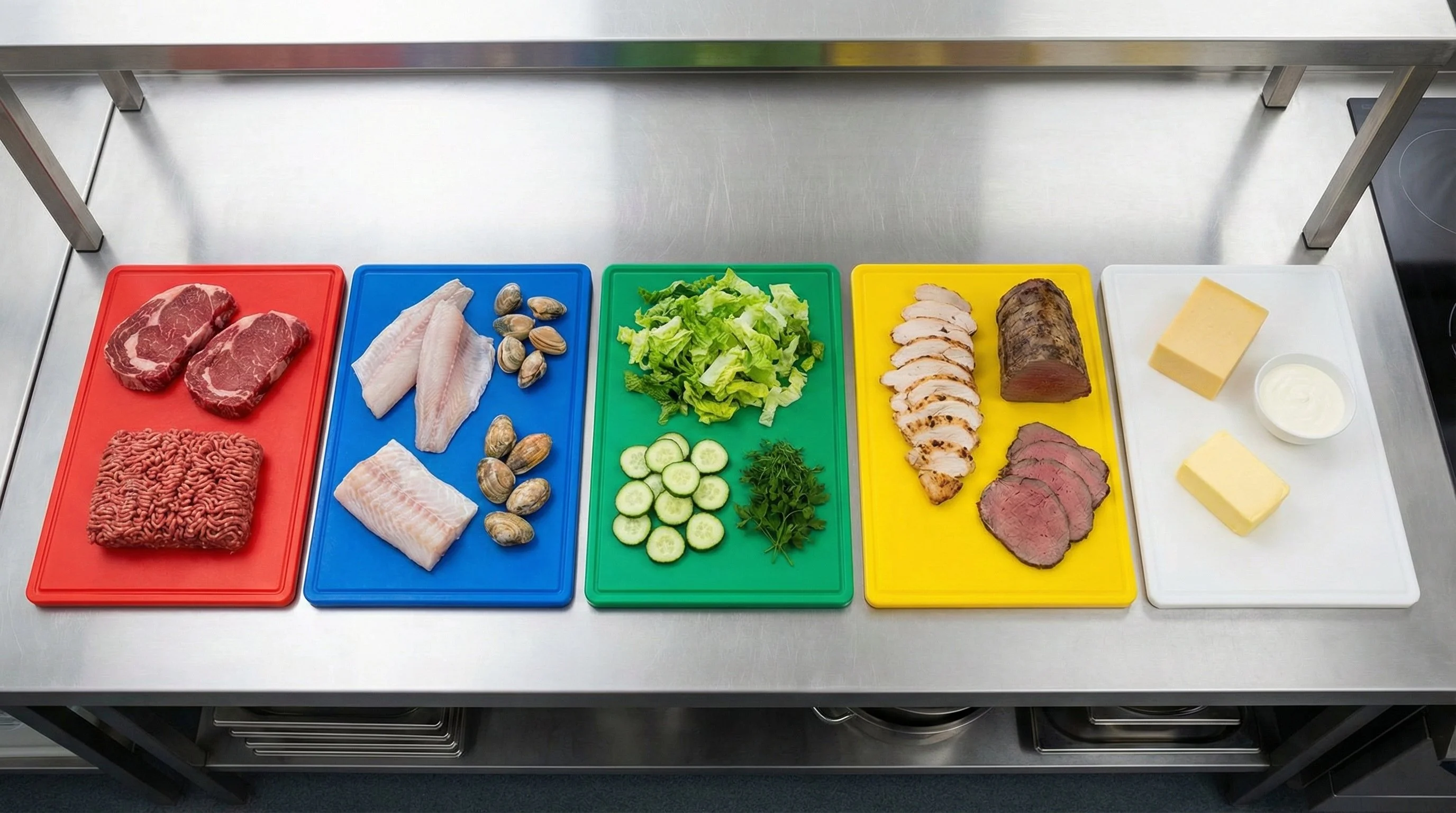
Colour-coded equipment. Are you using colour-coded chopping boards, knives, and utensils? Red for raw meat, blue for raw fish, green for salad and fruit, yellow for cooked meat, brown for vegetables, white for dairy and bakery. They’ll check whether staff actually follow it.
Fridge storage. Raw meat must be stored below ready-to-eat food. Always. They’ll open your fridge and look.
Handwashing. Is the handwash basin accessible, stocked with soap and paper towels, and actually being used? They’ll watch your team.
Cleaning schedules. Do you have a documented cleaning schedule? Are surfaces and equipment being cleaned and sanitised between tasks, particularly when switching between raw and ready-to-eat food prep?
Allergen controls. Can your staff identify the 14 major allergens? Do you have a documented system for communicating allergen information? Are there procedures to prevent allergen cross-contact?
Staff knowledge. EHOs will ask your team questions. If your kitchen porter can’t explain basic cross-contamination prevention, that’s a problem — and it reflects on your training records.
Documentation. They want to see that your systems aren’t just in someone’s head. Written HACCP plans, cleaning schedules, training records, and allergen matrices all demonstrate that you’re managing food safety proactively.
Practical Prevention: Building It Into Daily Operations
Knowing the theory is one thing. Making it stick when the kitchen is slammed is another. Here’s how to make cross-contamination prevention part of the routine rather than an afterthought.
Get Your Storage Right
- Raw meat, poultry, and fish on the bottom shelves of fridges — always
- Separate fridges for raw and ready-to-eat if space allows
- All food covered and labelled with contents and date
- Chemicals stored in a locked or separate cupboard, away from food
- Dry goods in sealed containers, off the floor
Use Colour-Coded Equipment Consistently
Buy the colour-coded boards and utensils. Put up a chart showing which colour is for what. Then enforce it. The system only works if everyone follows it every time.
Clean Between Tasks
“Clean as you go” isn’t just a nice idea — it’s a cross-contamination control. When switching between raw and ready-to-eat food prep:
- Clear the workspace
- Clean the surface with hot soapy water
- Sanitise with an appropriate food-safe sanitiser
- Use fresh cloths or disposable paper towels
Use separate cleaning cloths for different areas. Colour-code them if possible.
Handwashing Is Non-Negotiable
Hands are the single biggest vector for cross-contamination in a kitchen. Wash hands:
- Before handling food
- After handling raw meat, poultry, fish, or eggs
- After touching bins, cleaning chemicals, or phones
- After using the toilet (obviously, but it still needs saying)
- After handling packaging or deliveries
Use the proper technique — soap, warm water, 20 seconds, dry with paper towels. Hand sanitiser is not a substitute for handwashing.
Train Your Team — And Keep Training Them
One induction session isn’t enough. Cross-contamination prevention needs regular reinforcement. New starters, agency staff, and anyone who’s been away for a while should all get refreshed.
Cover:
- Why cross-contamination matters (make it real — share case studies)
- The four types and how to prevent each one
- Your specific kitchen procedures
- Allergen awareness — the 14 allergens, where they hide, how to prevent cross-contact
- What to do if something goes wrong
Document all training. If an EHO asks when your team last had allergen training and you can’t show records, that’s a gap in your compliance.
Make Allergen Management Systematic
Post-Natasha’s Law, allergen management can’t be informal. You need:
- A complete allergen matrix for your menu
- Clear procedures for handling allergen-related customer requests
- Documented processes for preventing cross-contact during prep and cooking
- Staff who can confidently discuss allergens with customers
This is one area where digital tools make a genuine difference. Platforms like Forkto let you manage allergen information alongside your HACCP plans, cleaning schedules, and training records in one place — which means everything an EHO might ask for is documented and accessible, not buried in a folder behind the office door.
Document Everything
Your HACCP plan should identify cross-contamination as a hazard at every relevant step — receiving deliveries, storage, preparation, cooking, and serving. For each step, define the control measure, the critical limit, and what to do if something goes wrong.
Keep records of:
- Daily cleaning schedules (signed off by staff)
- Fridge temperature checks
- Staff training dates and topics covered
- Any corrective actions taken when something went wrong
- Allergen information updates when the menu changes
Good documentation isn’t bureaucracy — it’s evidence that you’re running a safe kitchen. When something does go wrong (and eventually it will), your records are what protect you.
The Cost of Getting It Wrong
A food hygiene rating of 1 or 0 is visible to every potential customer checking your rating online. Enforcement notices are public. Prosecution for allergen offences can result in fines, closure, and even prison sentences in the most serious cases.
But the real cost is simpler than that. Cross-contamination makes people ill. In severe allergen cases, it can be fatal. Every control measure you put in place is protecting someone’s health.
Making Compliance Part of the Culture
The kitchens that handle cross-contamination well aren’t the ones with the thickest policy documents. They’re the ones where every member of staff — from the head chef to the weekend KP — understands why separation matters and follows the procedures without being watched.
That takes consistent training, visible leadership, and systems that make doing the right thing easier than cutting corners. Whether you’re managing compliance with spreadsheets or using a platform like Forkto to keep your HACCP plans, checklists, and training records in one digital system, the principle is the same: make it simple, make it visible, and make it part of every shift.
Cross-contamination prevention isn’t a one-off project. It’s a daily practice. Build it into your kitchen’s DNA, and you’ll pass inspections, protect your customers, and sleep better at night.
Further reading
- What is Cross Contamination? The Complete UK Guide — the glossary companion, covering FSA legal definitions, UK outbreak data, hidden sources, and the FHRS scoring consequence
- Allergen Matrix: The UK Food Business Guide — the operational framework for allergen cross-contact control
- How to Get a 5-Star Food Hygiene Rating — how cross-contamination controls feed your FHRS score
Ready to get your cross-contamination controls documented and inspection-ready? See how Forkto can help →
Related Forkto software
Safe hands, clear records
Stop running food safety on paper
Forkto turns daily checks, temperature logs, HACCP and audits into a few taps on a phone. Your team stays consistent and you're always ready for the EHO.
14-day free trial · No card required