Food safety guide
What is Cross Contamination? The Complete UK Guide (2026)
Complete UK glossary guide to cross contamination: FSA definitions, 4 types and 4 routes, hidden sources operators miss, UK regulatory framework (852/2004 and Natasha's Law), and named UK prosecutions.
8 May 2026
Cross contamination is the mechanism behind most UK foodborne illness outbreaks traced to commercial kitchens. It’s in every EHO inspection report that ends badly. It’s in the FHRS Confidence in Management score that caps your rating. It’s in the prosecution statistics: every named UK case where someone died from an allergen incident — Natasha Ednan-Laperouse, Owen Carey, Hannah Jacobs, Megan Lee — came down to a failure of cross-contact control.
This guide is the definitive UK glossary reference. It explains exactly what cross contamination is under UK law, the four types, the four routes, the hidden sources professional kitchens miss most often, recent UK outbreak and prosecution data, and what the Food Standards Agency expects in 2026. For the operational playbook on preventing it, see our companion cross-contamination prevention in commercial kitchens guide.
What is cross contamination? The FSA definitions
The Food Standards Agency uses three subtly different definitions across its guidance, and they all matter:
FSA consumer definition:
“Cross-contamination occurs when bacteria is transferred between different foods, from food to surfaces, and from surfaces to food.”
FSA business guidance definition:
“Cross-contamination is what happens when bacteria or other microorganisms are unintentionally transferred from one object to another. The most common example is the transfer of bacteria between raw and cooked food. This is thought to be the cause of most foodborne infections.”
FSA E. coli O157 guidance:
“Cross-contamination is a common cause of food poisoning. It is the process by which harmful microorganisms (germs) are transferred from raw meat or soiled vegetables to ready-to-eat food with harmful effect.”
In practice, UK food safety professionals use the term to cover all four types of transfer — bacterial, allergen, chemical and physical — even though the FSA’s primary focus is bacterial.
Cross-contamination vs cross-contact — the terminology that matters
FSA usage is inconsistent across its own pages:
- Its precautionary allergen labelling checklist uses “cross-contact”: “Allergen cross-contact occurs when an allergenic food is unintentionally incorporated into another food that is not intended to contain that allergenic food.”
- Its allergen labelling for food manufacturers page uses “cross-contamination”: “Cross-contamination happens when traces of allergens get into products accidentally during the manufacturing, handling, transport or storage of foods.”
The working distinction: “cross-contact” is the technically preferred term for allergens, aligning with US FDA and Codex usage. “Cross-contamination” more commonly refers to pathogens. Either is acceptable but precision helps: pathogens contaminate; allergens cross-contact. We’ll use both throughout this guide depending on context.
The 4 types of cross contamination
1. Bacterial (microbiological)
Transfer of pathogens from raw foods (particularly raw meat, poultry and seafood) to ready-to-eat foods, surfaces, equipment or hands. The UK organisms of concern:
- Campylobacter — the leading bacterial cause of UK foodborne illness, with over 500,000 cases estimated annually. Found in raw chicken at around 60% positivity per FSA retail surveys.
- Salmonella — 10,388 cases in England in 2024, a 17% rise and a 10-year high. Strongly associated with raw shell eggs (particularly imported, non-Lion Mark).
- E. coli O157 and non-O157 STEC — 2,544 culture-confirmed cases in England in 2024, a 26% rise. Raw/undercooked minced beef and contaminated salad leaves are the key vehicles.
- Listeria monocytogenes — 179 listeriosis cases in England and Wales in 2024; 28 deaths among 142 non-pregnancy cases (19.9% case fatality rate). Soft/unpasteurised cheese, smoked fish, chilled ready meals are historic vehicles.
- Norovirus — the UK’s most common cause of acute gastroenteritis; 76.2% of UK oyster samples were norovirus-positive in the FSA baseline survey.
- Clostridium perfringens, Bacillus cereus, Staphylococcus aureus — temperature-control failures.
2. Allergen (cross-contact)
Unintended incorporation of one of the 14 regulated UK allergens into a food not intended to contain it. The FSA’s March 2025 best-practice guidance is the current operational standard: written allergen information supported by a conversation. See our allergen matrix guide for the operational framework and our Natasha’s Law guide for the legal framework.
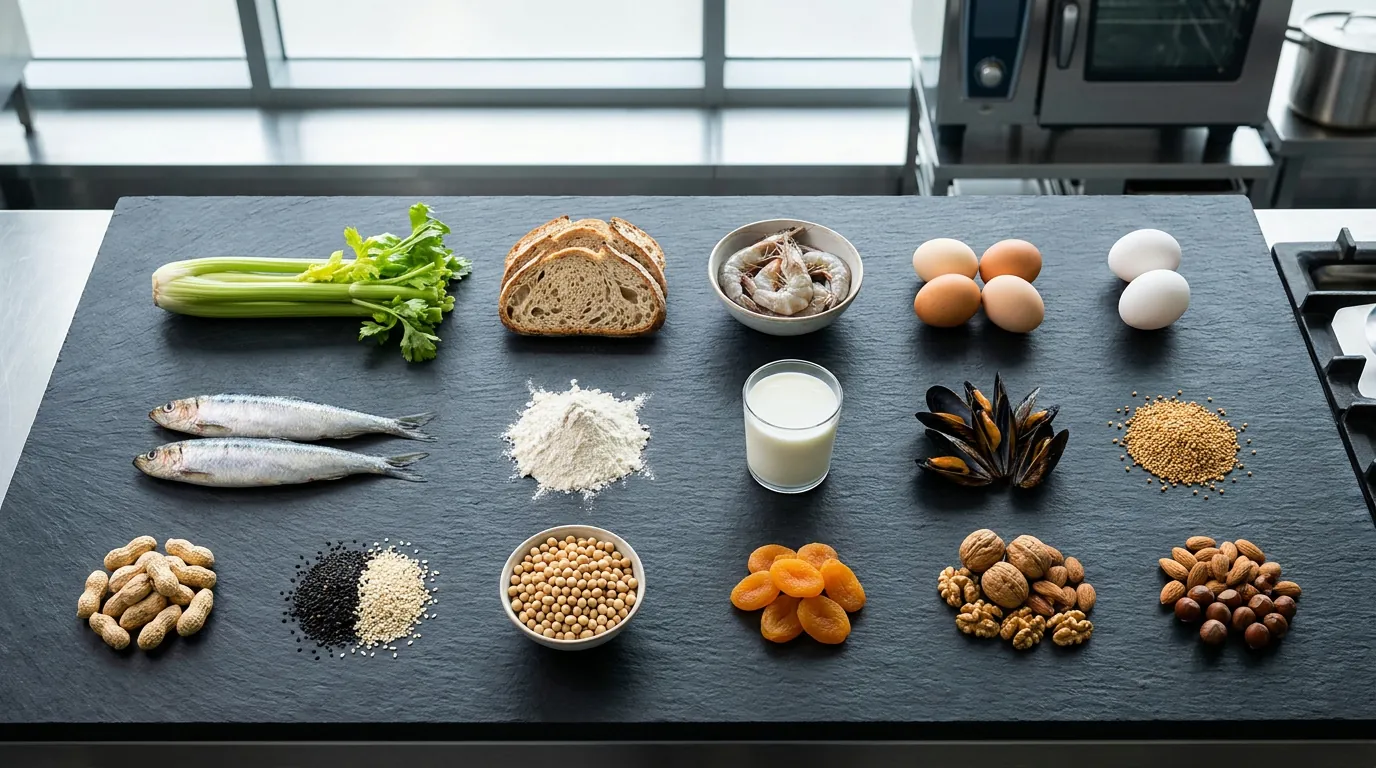
The 14 regulated allergens under Regulation (EU) 1169/2011 Annex II (assimilated law):
- Celery (including celeriac)
- Cereals containing gluten (wheat, rye, barley, oats)
- Crustaceans
- Eggs
- Fish
- Lupin
- Milk
- Molluscs
- Mustard
- Tree nuts
- Peanuts
- Sesame
- Soybeans
- Sulphur dioxide and sulphites above 10 mg/kg or 10 mg/L
3. Chemical
Transfer of cleaning chemicals, sanitisers, pesticides, lubricants, dishwasher rinse-aid or other non-food substances. Covered by Regulation (EC) 852/2004 Annex II Chapter IX, paragraph 3.
Common causes:
- Cleaning products stored in the same area as food or food packaging
- Unlabelled spray bottles (staff grab the wrong one)
- Not rinsing surfaces properly after cleaning with chemical sanitisers
- Pesticide overspray near food prep or storage areas
- Decanting chemicals into food-grade containers
- Dishwasher rinse-aid carryover on poorly-rinsed ware
4. Physical (foreign bodies)
Foreign objects in food. Covered by Regulation (EC) 852/2004 Annex II Chapter I.
- Broken equipment or chipped crockery
- Hair, jewellery, plasters (blue plasters are the industry norm for exactly this reason)
- Glass and metal fragments
- Damaged packaging material
- Worn cleaning equipment (scourer fragments, bristles from brushes)
- Pest fragments (rodent hair, insect parts)
- Stone and bone in natural ingredients
The 4 routes of cross contamination (FSA framing)
The FSA classifies transfer routes by the pathway of movement rather than the contaminant itself:
Food-to-food. “If raw meat drips onto a cake in the fridge, bacteria will spread from the meat to the cake.” This is why raw meat always stores below ready-to-eat food, never above.
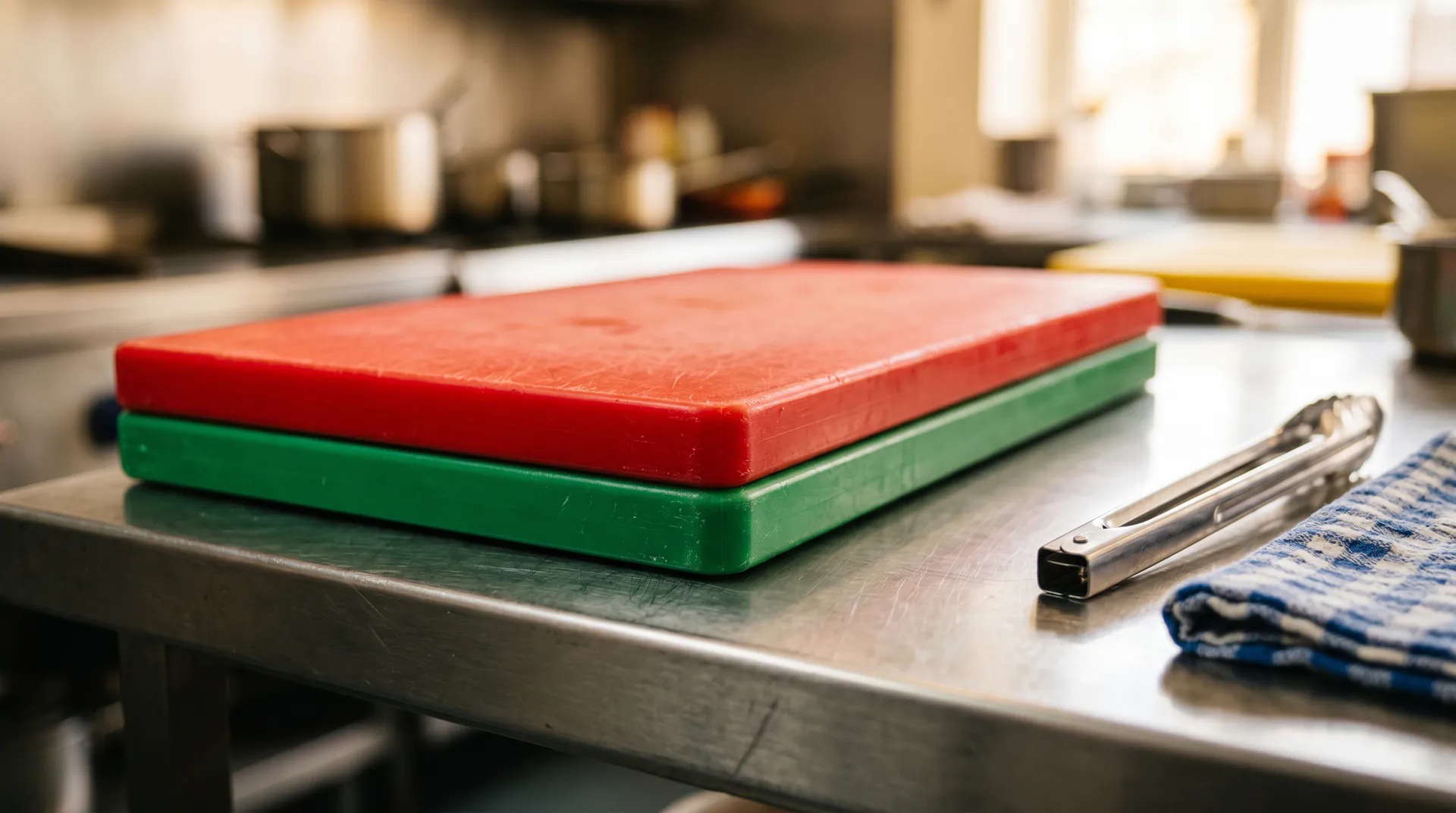
Equipment-to-food. “If you cut raw chicken on a chopping board, bacteria will spread from the chicken to the board and knife.” Colour-coded boards, dedicated utensils per task and cleaning/sanitising between tasks address this.
People-to-food. Hands, clothing, hair, coughing, sneezing. The single most-cited failing in FSA inspections. Handwashing frequency, technique and hand-drying method (paper towel, not cloth) all matter.
Environment-to-food. “Touch areas such as door handles, bins, tills and touch screen electronics, or in the drips and splashes produced if meat is washed.” This is the reason the FSA specifically recommends not washing raw chicken — it atomises Campylobacter across a 1-metre radius.
Direct vs indirect
A direct transfer is raw food physically contacting ready-to-eat food. An indirect transfer is via a vehicle — cloth, hand, board, utensil. Indirect transfers cause most UK commercial-kitchen outbreaks because they’re less visible at the time they happen.
The UK legal framework
Regulation (EC) 852/2004 Annex II Chapter IX
Retained as assimilated UK law since 1 January 2024. The operative paragraphs for cross contamination:
- Paragraph 2: raw materials and ingredients must be kept to prevent harmful deterioration and protect from contamination
- Paragraph 3 (the core duty): food must be protected against any contamination likely to render it unfit for human consumption, injurious to health, or contaminated in such a way that it would be unreasonable to expect it to be consumed in that state
- Paragraph 4: pest control and prevention of domestic animal access
- Paragraph 5: the cold chain is not to be interrupted
Related Annex II chapters:
- Chapter I — premises, airborne contamination
- Chapter II — rooms, layout preventing contamination between operations
- Chapter V — equipment cleaning and disinfection
- Chapter VIII — personal hygiene
Enforcement
Breaches are enforced by local authorities under Regulation 19 of the Food Safety and Hygiene (England) Regulations 2013 (and equivalents in Wales, Scotland and NI). Penalties: unlimited fines on conviction; up to 2 years’ imprisonment on indictment; director disqualification; loss of the Section 21 due diligence defence. See our due diligence defence guide for the legal framework.
Allergen-specific legislation
- Food Information Regulations 2014 (SI 2014/1855) implement assimilated Regulation 1169/2011 in the UK
- Article 9(1)(c) of FIC: declaration of 14 major allergens in Annex II
- Regulation 5 of FIR: duty on non-prepacked food to declare any Annex II allergen used as an ingredient or processing aid
- Natasha’s Law (Food Information (Amendment) (England) Regulations 2019, in force 1 October 2021): PPDS food must carry name plus full ingredients list with the 14 allergens emphasised
- Owen’s Law precursor (March 2025 FSA best-practice guidance): written allergen information supported by a conversation for non-prepacked foods
The FHRS consequence — how cross contamination pulls your rating down
Cross contamination scores directly into the Hygiene Practices element of your FHRS rating. Under FHRS Brand Standard Revision 8:
- Hygiene Practices score 0: all necessary control measures in place to prevent cross-contamination; safe food preparation, cooking, reheating, cooling and storage demonstrated
- Hygiene Practices score 25 (almost total non-compliance): evidence of actual cross-contamination; food kept out of temperature control; fridge not operating at correct temperature
A Hygiene Practices score of 15 or above immediately caps your overall rating at 2 or below. A score of 20 caps at 1. A score of 25 caps at 0.
And because Brand Standard paragraph 3.8 specifies that food hygiene failures reflecting non-adherence to HACCP additionally pull down the Confidence in Management score, a single cross-contamination finding can damage two elements simultaneously. See our food hygiene rating scoring guide for the full scoring mechanics.
The UK surveillance numbers that matter
Every 2024-2025 trend line is rising:
| Pathogen | 2024 UK cases | Trend |
|---|---|---|
| Campylobacter (England) | 70,352 | +17% vs 2023, decade-high |
| Salmonella (England) | 10,388 | +17%, decade-high |
| STEC culture-confirmed (England) | 2,544 (564 O157, 1,980 non-O157) | +26% vs 2023 |
| Listeria (England and Wales) | 179 | stable; 28 deaths |
The FSA estimates UK foodborne illness at around 2.4 million cases, 16,400 hospital admissions and 180 deaths annually — total societal cost £10.4 billion (2022 prices). Cross contamination is the leading mechanism.
Named UK outbreaks and prosecutions 2023-2026
The Cool Delight Desserts Listeria cluster (Feb-Mar 2025)
Chocolate/vanilla and strawberry/vanilla mousses supplied to an NHS hospital in South West England. Three deaths reported. FSA recall issued. Case remains under UKHSA and FSA investigation as of April 2026.
The STEC O145 salad leaves outbreak (May-November 2024)
The largest UK STEC outbreak since routine whole-genome sequencing began in 2015:
- 293 confirmed cases (196 in England)
- 126 hospitalised
- 11 haemolytic uraemic syndrome (HUS) cases
- 2 deaths
- Traced to UK-grown Apollo lettuce in sandwiches and wraps from Greencore, Samworth Brothers and THIS!
No prosecutions announced — root cause was not identified. UKHSA noted the implicated sandwich makers had “detailed and robust HACCP plans.” A cautionary tale about upstream supply-chain failures.
The Mrs Kirkham’s Lancashire STEC O145:H28 outbreak (Late 2023)
Unpasteurised cheese:
- 36 confirmed + 1 probable case
- 47% hospitalisation rate
- 1 death
- Affected ages 7-93
- Notable vehicle: first-class train charcuterie board
Allergen cross-contact prosecutions and inquests
- Natasha Ednan-Laperouse (2016, Pret A Manger) — sesame in a baguette, driver for Natasha’s Law
- Megan Lee (Royal Spice, January 2017) — anaphylaxis from takeaway flagged “nuts, prawns”; owner sentenced to 2 years, manager to 3 years for manslaughter (R v Kuddus and Rashid)
- Owen Carey (Byron Burgers, April 2017) — buttermilk in a marinade not declared; driver for Owen’s Law campaign
- Hannah Jacobs (Costa Coffee, 2023) — barista completed online training but hadn’t consulted under-till allergen guide; inquest concluded August 2024
- Javitri Indian Restaurant (Hillingdon, April 2025) — £43,816 total fine after a customer was hospitalised with anaphylaxis from undeclared nuts
- The Rusty Gun pub / Innventure Ltd (Hitchin, May 2025) — £26,802 total after near-fatal anaphylaxis in a 9-year-old wheat-allergic boy served sausages containing wheat
- Gradegold Catering Ltd (Ealing, December 2024) — £20,000 fine; airline catering supplier illegally extending shelf lives on ready-to-eat products
For the full 2024-2026 prosecution picture see our UK food recalls and fines report.
Common UK kitchen cross-contamination incidents
From FSA research, CIEH commentary and UK outbreak reports:
- Raw meat to RTE food (E. coli O157, Campylobacter) — the classic, leading cause
- Shared chopping boards — FSA Kitchen Life 2 research identified boards as the highest microbial-load surface
- Shared fryers — frying at 175-190°C does not denature allergenic proteins enough; gluten, seafood and dairy residues persist
- Dairy/dairy-free shared prep — milk protein residue on jugs, steam wands and blenders transfers casein into plant-milk drinks. Milk is the most commonly undeclared allergen in UK FSA alerts
- Cleaning cloths — CIEH/HPA research: 56% of restaurant dishcloths carried E. coli or Listeria
- Cooked food re-contamination at plating — same tongs, same hands, same board
- Handwashing failures — FSA flags this as the single most common operational failing
- Glove reuse — gloves deliver a false sense of security and transfer pathogens as readily as bare hands
- Service tongs at buffet and carvery — a repeatedly documented E. coli O157 vehicle
- Blue roll cross-use — same roll used on raw-meat spills and then surfaces
The hidden sources most operators miss
This is the section where most competitor content falls short. These are the genuine UK kitchen hotspots that experienced EHOs look for and that rookie operators overlook:
Deli slicers
Residual product stays in blade channels, gears and adjustment mechanisms for days. The FSA specifically identifies deli slicers as high-risk Listeria vehicles. Daily disassembly and sanitisation isn’t optional. UK Listeria recalls involving sliced meat and smoked fish routinely trace back to slicer cleaning failures.
Ice machines
Biofilm build-up in ice machines is a Listeria (and occasionally Pseudomonas) reservoir. Listeria is survivable in an ice machine drain for months. Weekly sanitisation and quarterly deep clean is the standard; many UK operators run 12+ months without touching them.
Cleaning cloths
Hilton & Austin (Birmingham City Council, 2000) research: cloths transferred around 56% of bacterial load onto surfaces versus 4.7% for sponges. CIEH/HPA survey: 56% of UK restaurant dishcloths carry E. coli or Listeria. Use single-use disposable roll or hot-wash (90°C+) laundering only. Colour-code for task.
Shared fryers — allergen carry-over in oil
Frying temperatures of 175-190°C do NOT denature allergen proteins. Gluten, seafood, dairy and peanut residues persist in oil. A fryer used for battered fish then cooked chips is not safe for a customer with a fish allergy — the oil carries fish protein. Dedicated fryers and oil are the only compliant approach.
Dairy / dairy-free barista stations
Milk protein residue on jugs, steam wands, blenders and frothing attachments transfers casein into plant-milk drinks. The Hannah Jacobs case (Costa, 2023) illustrates exactly this risk. Milk is consistently the most commonly undeclared allergen in UK FSA Allergy Alerts.
Ingredient scoops and containers
Same scoop in the flour bin and the gluten-free flour bin. Same container holding nuts then reused for dried fruit. Bulk-ingredient cross-contact accounts for a large share of “unexpected” allergen incidents.
Oven gloves and tea towels
Used to handle raw trays, then cooked. Used to wipe up raw meat juice, then hands. Launder hot, replace regularly, colour-code where possible.
Shared vacuum packer, sous vide bags, mixer attachments
Every shared piece of equipment is a potential cross-contact route if cleaning between uses is inadequate. ATP or protein-swab validation is industry best practice for higher-risk changeovers.
Shared mop and bucket between kitchen zones
The mop used on the raw-meat prep floor, then the pastry area. Colour-code mops and buckets; keep dirty water off food-prep floors.
Deliveries — crates from suppliers
External crates that sat on a warehouse floor should never be brought into the kitchen prep zone. Decant at goods-in, store packaging out of food-handling areas. See our goods-in delivery checks guide for the operational procedure.
Temperature control — the other side of cross contamination
Cross contamination and temperature control are inseparable. The same failure — poor segregation — becomes dangerous when temperature fails:
- Danger zone: 8°C to 63°C. Pathogens transferred by cross-contamination multiply rapidly in this range
- Chilled storage: legal maximum ≤ 8°C (FSA recommends ≤ 5°C)
- Hot hold: ≥ 63°C
- Cooking: 75°C core for 30 seconds (or equivalent — 70°C / 2 min, 80°C / 6 sec, 65°C / 10 min)
- Scotland reheat: 82°C (a UK-wide exception)
- Cooling: 63°C to 8°C within 90 minutes
A cross-contaminated surface at 4°C is a contained problem. The same cross-contamination at 35°C is a public health incident.
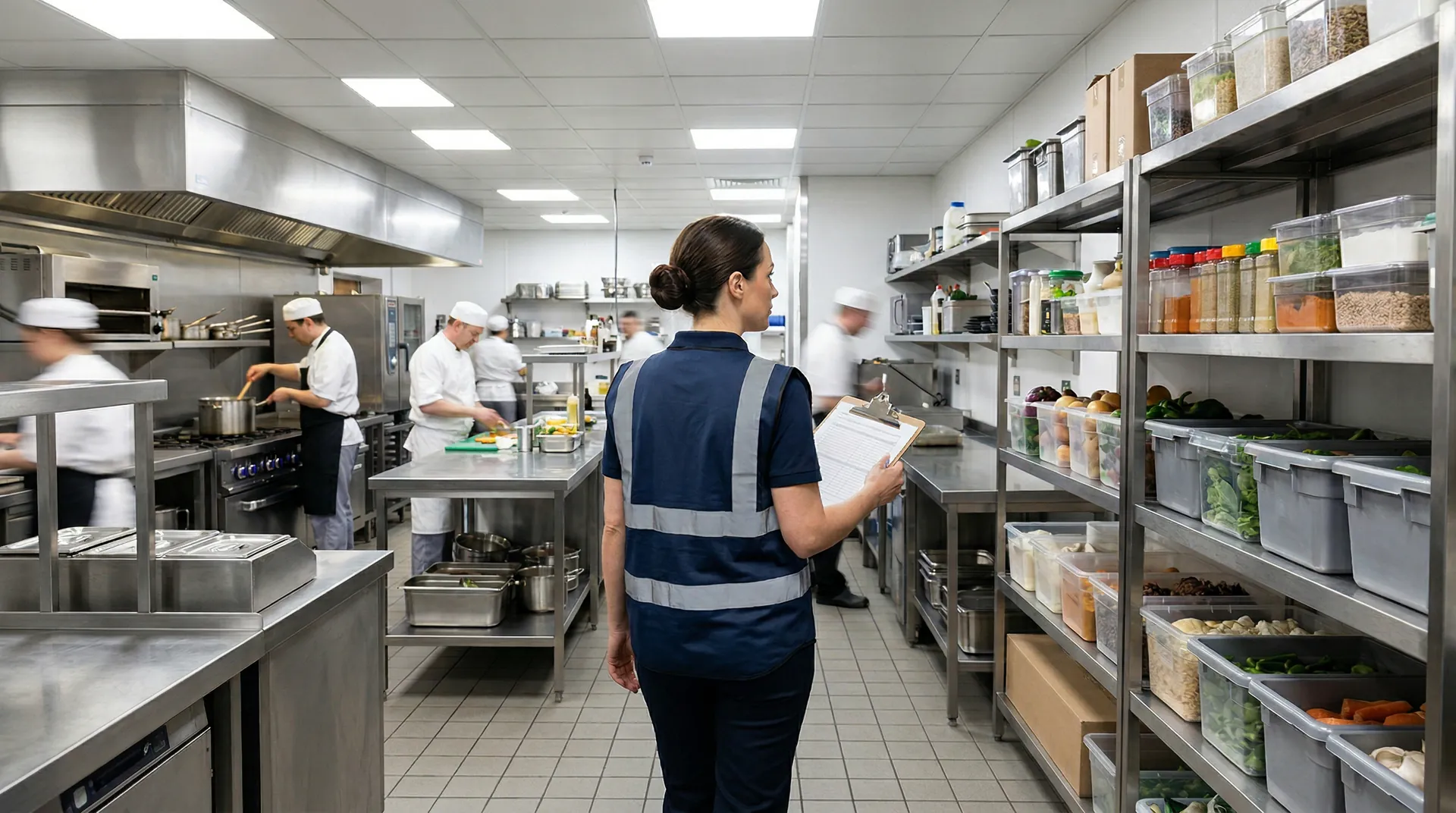
What inspectors look for
EHOs assess cross-contamination controls as part of the Hygiene Practices FHRS element. They specifically check:
- Physical separation of raw and ready-to-eat foods
- Colour-coded equipment — red for raw meat, blue for raw fish, green for salad/fruit, yellow for cooked meat, brown for vegetables, white for dairy/bakery. Watch whether staff actually follow it
- Fridge storage hierarchy — raw meat always on the bottom shelf
- Handwashing — accessible basin, stocked with soap and paper towels, actually being used
- Cleaning and sanitising between tasks, particularly when switching between raw and RTE prep
- Allergen controls — documented allergen matrix, staff knowledge of the 14 allergens, procedures for customer allergen requests
- Staff knowledge under pressure — EHOs ask your team questions. If your kitchen porter can’t explain basic cross-contamination prevention, that’s on record
- Documentation — written HACCP plans, cleaning schedules, training records, allergen matrices
See our EHO inspection guide for the full inspection process and our cross-contamination prevention guide for the operational playbook.
Cross-contact and precautionary allergen labelling (“may contain”)
The FSA’s September 2023 update to PAL guidance is the current standard:
“Precautionary allergen labelling should only be used if there is an unavoidable risk of allergen cross-contact that cannot be sufficiently controlled by segregation and cleaning.”
Translation: “may contain” is not a blanket insurance policy. Using it on every product as a disclaimer is bad practice. It reduces consumer choice without improving safety and is increasingly challenged at audit.
Proper use requires:
- A documented risk assessment for each product
- Evidence that segregation and cleaning cannot sufficiently reduce the risk
- Specific allergen(s) named (not “may contain all 14”)
- Review whenever the supplier, recipe or process changes
March 2025 FSA allergen best-practice guidance
Published 14 March 2025, applies to England, Wales and NI. Core principle:
Allergen information should be “easily available in writing and underpinned with a conversation.”
Coverage includes restaurants, cafés, bakeries, takeaways, delis, market stalls and online/distance selling (information must be available at the order point AND at delivery). Cross-contact is explicitly addressed: staff should proactively raise risks of unintentional allergen presence. “Free-from” claims require dedicated utensils, segregated storage, documented cleaning and supplier certification.
Critically: “vegan” is not equivalent to allergen-free. FSA national sampling in 2025 found 5 of 115 vegan dairy-free samples contained milk. See our Owen’s Law guide for where this guidance is heading statutorily.
What good cross-contamination control actually looks like
If you want the operational playbook — the chopping-board colour system, the daily cleaning schedule, the allergen-change-over process, the handwashing protocol — our cross-contamination prevention in commercial kitchens guide covers the practical implementation.
The headline actions that EHOs reward:
- Physical separation of raw and ready-to-eat from goods-in to service
- Colour-coded boards, knives, tongs and cloths with the system visibly posted and enforced
- Fridge hierarchy — raw meat always bottom, RTE always top
- Dedicated handwash basins stocked with hot water, soap and single-use paper towels
- Cleaning and sanitising between tasks with validated contact times
- Documented allergen matrix linked to supplier specs, updated when recipes change
- Staff training with competency assessment — the Hannah Jacobs standard: certificates prove attendance, observed behaviour proves competence
- Temperature logs at point of task — no back-filling
- Pest control contract and documentation
- HACCP-based FSMS that reflects what actually happens in your kitchen
Where Forkto fits
Every cross-contamination prosecution shares a characteristic: the kitchen had procedures written down, but the records didn’t reflect what actually happened at service time. Cleaning schedules signed before the cleaning was done. Temperature logs copy-pasted across weeks. Allergen matrices two menu versions out of date.
Forkto’s platform is designed to close exactly that evidential gap. Every cleaning sign-off captured at the point of task. Every temperature check time-stamped and user-attributed. Every supplier reformulation flowing into the allergen matrix automatically. The audit trail an EHO wants to see — already built, not assembled the night before an inspection.
If you’d like to see how that looks in a UK hospitality kitchen, start a free trial or browse our free downloadable checklists — no email required.
Last updated 8 May 2026. This guide reflects UK regulatory and surveillance data as at May 2026, including Regulation (EC) 852/2004 (assimilated), the Food Safety and Hygiene (England) Regulations 2013, the FSA March 2025 non-prepacked allergen best-practice guidance, the September 2023 FSA PAL update, the FHRS Brand Standard Revision 8, UKHSA 2024 foodborne illness surveillance data, and the 2024-2025 FSA Annual Report of Incidents. For the operational prevention playbook, see our cross-contamination prevention in commercial kitchens companion guide.
Related Forkto software
Frequently asked questions
What is cross contamination in food safety?
Cross contamination is the transfer of harmful bacteria, allergens, chemicals or physical objects from one food, surface, person or environment to another. The Food Standards Agency defines it as 'what happens when bacteria or other microorganisms are unintentionally transferred from one object to another.' It's the most common cause of UK foodborne illness outbreaks in commercial kitchens.
What are the 4 types of cross contamination?
Bacterial (pathogens like Campylobacter, Salmonella, E. coli O157, Listeria transferring between foods), allergen (also called cross-contact — unintended incorporation of allergens into foods not intended to contain them), chemical (cleaning chemicals, pesticides, lubricants, dishwasher rinse-aid), and physical (foreign bodies: glass, metal, plastic, hair, jewellery, packaging fragments).
What are the 4 routes of cross contamination?
Food-to-food (raw meat dripping onto ready-to-eat items in the fridge), equipment-to-food (cutting raw chicken on a board then using it for salad), people-to-food (hands, clothing, hair, coughing, sneezing), and environment-to-food (touch areas like door handles, bins, tills, touch screens, or splashes from washing meat).
What is the difference between cross contamination and cross contact?
In UK food safety, 'cross-contamination' most commonly refers to transfer of pathogens (bacteria and viruses). 'Cross-contact' is the technically preferred term for unintended transfer of allergens — aligning with US FDA and Codex usage. The FSA uses both terms inconsistently. Either is acceptable but precision helps: pathogens contaminate, allergens cross-contact.
Is cross contamination a criminal offence in the UK?
Failing to prevent cross contamination breaches Regulation (EC) 852/2004 Annex II Chapter IX, paragraph 3, which requires food to be 'protected against any contamination likely to render the food unfit for human consumption, injurious to health or contaminated in such a way that it would be unreasonable to expect it to be consumed in that state.' Breaches are enforced by local authorities under Regulation 19 of the Food Safety and Hygiene (England) Regulations 2013, with unlimited fines on conviction.
What is the most common type of cross contamination in UK kitchens?
Bacterial cross-contamination from raw meat to ready-to-eat food is the FSA's primary focus and the leading cause of UK foodborne infection. Campylobacter from raw chicken is the single biggest pathogen of concern — UK retail chicken surveys found around 60% of samples Campylobacter-positive. Shared chopping boards, inadequate handwashing and reused cloths are the most common transfer routes.
What is an example of cross contamination?
A chef chops raw chicken on a red board, rinses the knife, then uses the same knife to slice a salad tomato. Campylobacter survives the rinse and contaminates the salad. The customer develops food poisoning 2-5 days later. This is food-to-food (via equipment) bacterial cross-contamination — the single most common UK kitchen incident. The preventive control: colour-coded boards AND knives, plus proper cleaning between tasks.
What colour chopping board is for raw meat in the UK?
UK industry standard is red for raw meat and poultry, blue for raw fish, yellow for cooked meat, green for salad and fruit, brown for vegetables, and white for dairy and bakery. This isn't a legal requirement, but FSA Safer Food Better Business guidance recommends it and EHOs expect to see a consistent colour-coding system in any commercial kitchen handling both raw and ready-to-eat food.
Can you get sick from cross contamination?
Yes. In 2024 the UK recorded 2,544 STEC cases (26% rise on 2023), 70,352 Campylobacter cases (17% rise), 10,388 Salmonella cases (17% rise, a decade high), and 179 listeriosis cases with 28 deaths — many traceable to cross-contamination incidents. For allergen cross-contact, the consequences range from mild discomfort to fatal anaphylaxis, as in the cases of Natasha Ednan-Laperouse, Owen Carey and Hannah Jacobs.
How do you prevent cross contamination in a commercial kitchen?
Core controls: raw/ready-to-eat segregation (storage hierarchy, dedicated prep areas, colour-coded boards and utensils); temperature control (chilled ≤8°C, hot hold ≥63°C, core cooking 75°C/30 sec or equivalent); documented cleaning and sanitisation between tasks; enforced handwashing; single-use or properly-laundered cloths; allergen matrix linked to supplier specs; staff training and competency checks. See our dedicated guide on cross-contamination prevention in commercial kitchens for the full operational framework.
Does 'may contain' labelling mean a food will cause an allergic reaction?
Not necessarily. Precautionary allergen labelling ('may contain') is voluntary in the UK. FSA guidance (September 2023) states it 'should only be used if there is an unavoidable risk of allergen cross-contact that cannot be sufficiently controlled by segregation and cleaning'. Overuse of blanket 'may contain' statements on all 14 allergens is considered bad practice — it reduces informed consumer choice without improving safety.
What are the hidden cross contamination sources operators miss most often?
The five commonly-overlooked UK kitchen hotspots: deli slicers (residual product stays in blade channels and gears; FSA identifies these as high-risk Listeria vehicles), ice machines (biofilm build-up; Listeria survivable for months), cleaning cloths (56% carry E. coli or Listeria per CIEH/HPA research), shared fryers (allergen protein survives frying temperatures — gluten, seafood, dairy residues persist), and dairy/dairy-free prep at barista stations (milk protein residue on steam wands and jugs).
Safe hands, clear records
Stop running food safety on paper
Forkto turns daily checks, temperature logs, HACCP and audits into a few taps on a phone. Your team stays consistent and you're always ready for the EHO.
14-day free trial · No card required