Food safety guide
Vacuum Packing & Sous-Vide Food Safety: A UK Guide for Kitchens
Vacuum packing and sous-vide need documented controls in UK kitchens. The FSA 10-day rule, the 70°C/2-min cook benchmark and the botulism risk, explained.
28 June 2026
Vacuum packing and sous-vide have moved from fine-dining kitchens into cafés, butchers, gastropubs and central production units across the UK. Both extend shelf life and improve consistency — but both also remove the one thing that keeps a lot of dangerous bacteria in check: oxygen. Done without documented controls, a routine prep job can become a genuine public-health risk.
We work with UK food businesses that vacuum pack and cook sous-vide every day, and the questions are always the same: how long can I keep it, what temperature do I cook to, and what will my EHO want to see? This guide answers those against current Food Standards Agency (FSA) guidance and UK law — and points to where you need to do your own validation.
Key facts
- The main hazard in vacuum-packed (VP) and modified atmosphere packed (MAP) chilled food is non-proteolytic Clostridium botulinum, which can grow and produce a toxin without oxygen from 3°C upwards.
- The FSA’s “10-day rule” caps the shelf life of VP/MAP chilled food at 10 days unless validated controlling factors apply.
- Safe sous-vide cooking means reaching a core of 70°C for 2 minutes, or a validated equivalent — a six-log (99.9999%) reduction in harmful bacteria.
- Both processes need documented HACCP-based controls under Article 5 of Regulation (EC) No 852/2004, and the shelf life you set is your responsibility to prove.
Is vacuum packing and sous-vide safe? What the FSA actually requires
In short: yes, but only under control. The FSA’s guidance on the safety and shelf-life of vacuum and modified atmosphere packed chilled foods is non-binding best-practice advice on how to produce these foods safely so you comply with Article 5 of Regulation (EC) No 852/2004. It applies across the whole UK to both raw and ready-to-eat foods (with one exemption for specified fresh beef, lamb and pork, covered below).
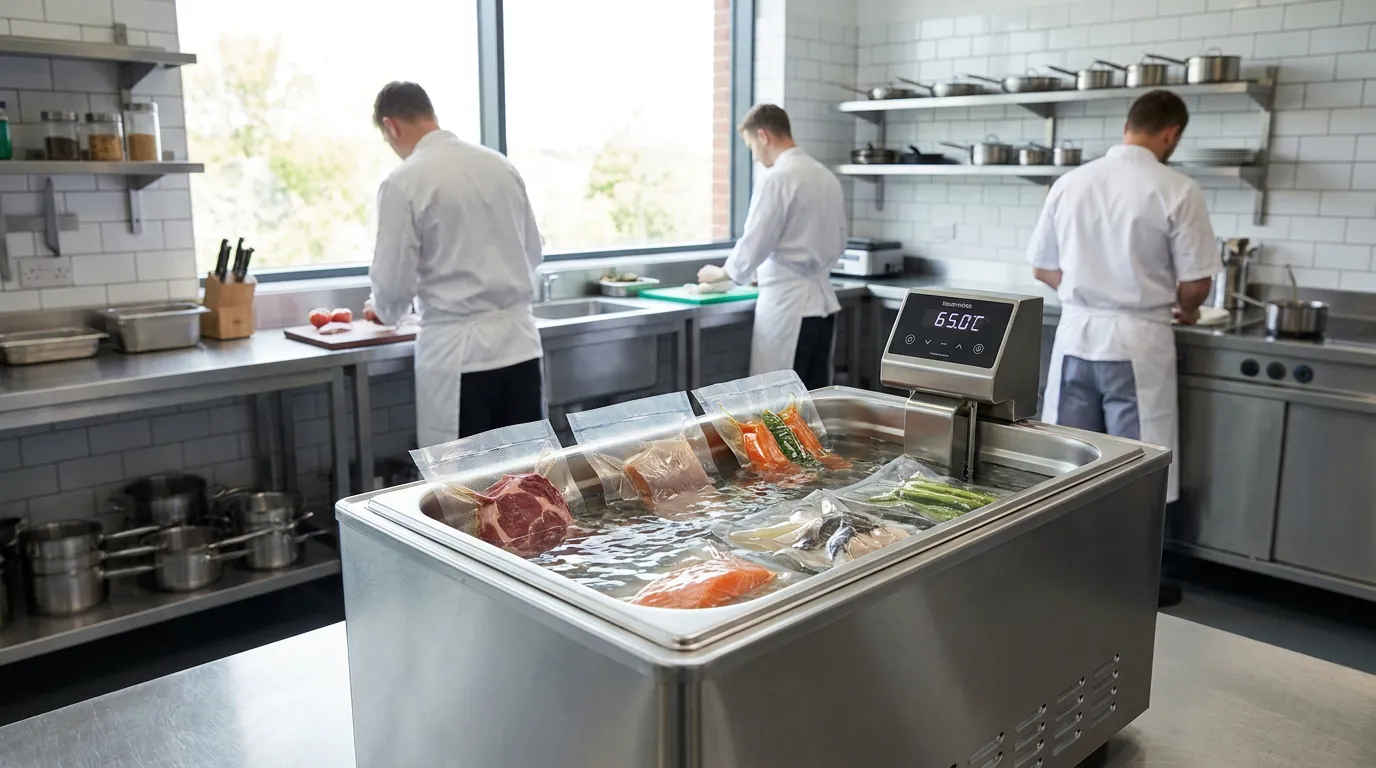
Sous-vide gets its own treatment. The FSA describes sous vide as placing food in a vacuum sealed bag and cooking it in a water bath, for a longer time and at a lower temperature than conventionally cooked food. It calls this a complex process that must be validated before it is introduced, with checks to ensure the time/temperature combination is consistently achieved — and notes that businesses may wish to appoint an expert food safety consultant.
The thread running through both: vacuum packing and sous-vide are accepted UK kitchen techniques, but the FSA expects specific, documented, validated controls rather than “we’ve always done it this way”.
Why vacuum packing is risky — the real hazards
Clostridium botulinum and anaerobic growth (the botulism risk from 3°C)
The headline hazard is non-proteolytic Clostridium botulinum. In the absence of oxygen — exactly the environment a vacuum pack creates — it can grow and produce a harmful toxin at temperatures of 3°C and above. That matters because most commercial chillers run warmer than that.
This is not a minor risk. The FSA notes that botulinum toxin is the most potent biological toxin known; the bacterium produces it in food and causes botulism, a potentially fatal form of food poisoning. C. botulinum spores are widely distributed in the environment, so you can’t assume your raw ingredients are free of them.
The NHS describes botulism as rare but life-threatening, needing immediate hospital treatment. Symptoms include blurred or double vision, drooping eyelids, difficulty swallowing and speaking, and weak muscles, and untreated it can progress to paralysis affecting breathing. That is the worst case the 10-day rule and the controlling factors below are designed to prevent.
Listeria monocytogenes at chill temperatures
The C. botulinum guidance is focused on that one organism, but the FSA is clear that food businesses must still take other pathogens into account. Listeria monocytogenes is also a concern in VP/MAP chilled foods because it grows at chill temperatures, and its controls should be included in your HACCP-based procedures. Don’t let a focus on botulism crowd out Listeria — both belong in your hazard analysis.
E. coli O157 (VTEC) and cross-contamination from shared equipment
Vacuum packing introduces a cross-contamination hazard through the equipment itself. The FSA’s E. coli O157 cross-contamination guidance states that vacuum packers, slicers and mincers must not be dual-used for raw and ready-to-eat foods because of the cross-contamination risk — unless the equipment is fully dismantled and disinfected between uses. For a vacuum packer, a full dismantle should only be undertaken by a competent engineer, which in practice means you can’t realistically swap a single machine between raw and ready-to-eat work during service.
The 10-day rule — how long can you keep vacuum-packed chilled food?
The single most important number for VP/MAP chilled food is 10 days. The FSA’s rule is that these foods should be given a maximum shelf life of 10 days unless additional controlling factors are applied. Where no other controlling factor can be identified, the maximum shelf life is 10 days from when the product is first vacuum packed or modified atmosphere packed — not from when you remember to date it, and not reset by later handling.
The controlling factors that allow more than 10 days
To justify a shelf life of more than 10 days, the Advisory Committee on the Microbiological Safety of Food (ACMSF) recommends that, in addition to chill temperatures of 3–8°C, you apply one or a combination of these controlling factors:
- a heat treatment of 90°C for 10 minutes (or an equivalent lethality at the slowest heating point);
- a pH of 5.0 or less throughout the food;
- a minimum salt level of 3.5% in the aqueous phase;
- a water activity (aw) of 0.97 or less; or
- a validated combination of heat and preservative factors.
Each of these has to be demonstrated through your HACCP plan, not assumed. If you use additives such as nitrite or curing salts as a preservative controlling factor, you also have to comply with the food additives rules under Regulation (EC) No 1333/2008.
The heat-treatment equivalence table
Most kitchens can’t realistically hold food at a true 90°C core for 10 minutes, so the FSA provides equivalent heat treatments that deliver the same lethality against non-proteolytic C. botulinum, measured at the slowest heating point:
| Temperature (core) | Time |
|---|---|
| 80°C | 129 minutes |
| 85°C | 36 minutes |
| 90°C | 10 minutes |
| 95°C | 3.2 minutes |
| 100°C | 1 minute |
These are the benchmarks for extending shelf life beyond 10 days — they are a higher bar than the 70°C/2-minute sous-vide cook used to control vegetative bacteria (see below).
Raw fresh beef, lamb and pork — the 13-day exemption
There is one carve-out. The C. botulinum guidance does not apply to VP/MAP chilled fresh beef, lamb and pork with no added ingredients and no processing beyond cutting, packing and chilling. For these products, food businesses maintaining good hygiene may choose to apply a shelf life of up to a maximum of 13 days without further verification or validation in relation to C. botulinum (a position the ACMSF endorsed on 30 January 2020). Add a marinade, a cure, or any other ingredient and you’re back under the standard 10-day rule.
Avoiding a ‘rolling’ shelf life when re-wrapping
A common and serious mistake is the “rolling” shelf life. The FSA’s vacuum packaging guidance for caterers flags this as a real concern: if a product is unwrapped — for example to slice it — and then re-wrapped under vacuum or MAP, the shelf life given to the re-wrapped product must not exceed that of the original product, and it must not be restarted. The clock keeps running from the first pack. Build that into your date labelling routine so a re-wrapped pack never quietly buys itself another 10 days.
Sous-vide time and temperature — hitting 70°C for 2 minutes (or equivalent)
For cooking, the UK benchmark is a core temperature of 70°C for 2 minutes, or an equivalent. The FSA’s overview of cooking methods explains that this achieves a six-log (99.9999%) reduction in harmful bacteria.
Importantly, that cook controls vegetative bacteria — it is not the same as the 90°C/10-minute treatment needed to justify an extended chilled shelf life against C. botulinum spores. The FSA does, however, recognise that if a VP/MAP food or ingredient is given a further processing treatment to destroy vegetative cells — for example heating to 70°C for 2 minutes or equivalent — its shelf life does not need to be incorporated into that of the final product, provided your HACCP plan demonstrates the result is safe.
The FSA cooking equivalence table
Sous-vide trades temperature for time, so the equivalents matter. The FSA lists these as delivering the same six-log reduction, measured at the centre or thickest part of the food:
| Temperature (core) | Time |
|---|---|
| 60°C | 45 minutes |
| 65°C | 10 minutes |
| 70°C | 2 minutes |
| 75°C | 30 seconds |
| 80°C | 6 seconds |
The lower-temperature, longer-time combinations are what make sous-vide possible — but they only work if you actually hit and hold the core temperature. For how to probe and verify core temperatures reliably across different foods, see our guide to temperature check best practices for different food types.
Validating your sous-vide process and when to use an expert consultant
Because sous-vide is a complex process, the FSA expects it to be validated before you introduce it, with ongoing checks to ensure the time/temperature combination is consistently achieved in your kitchen, with your equipment, on your portion sizes. Where the science gets beyond in-house expertise — particularly for any extended-shelf-life or cook-chill product — the FSA notes businesses may wish to appoint an expert food safety consultant. Validation is a one-off proof that the process works; monitoring is the day-to-day evidence that it keeps working.
Cooling, chilled storage and the 8-63°C danger zone
Vacuum-packed and cook-chill foods live or die on temperature control. The FSA’s guidance on chilling food correctly sets out the legal baseline: cold food that is likely to support the growth of pathogenic micro-organisms must be kept at or below 8°C in food premises in England, Wales and Northern Ireland, and in practice the FSA recommends setting the fridge at 5°C or below. That 8°C maximum is set out in Schedule 4 of the Food Safety and Hygiene (England) Regulations 2013, which also allows specific exceptions such as food kept hot at 63°C or above, ambient-stable products, and a limited service tolerance.
The range between 8°C and 63°C is the “danger zone” in which bacteria may grow and make people ill, so cooked food — including anything pulled from a sous-vide bath that won’t be served straight away — must be cooled as quickly as possible before refrigeration. Remember that 3°C floor for C. botulinum growth: a fridge drifting up towards 8°C is still legal, but it gives non-proteolytic C. botulinum room to work in a vacuum pack, which is exactly why the 10-day rule exists.
Do you need documented HACCP or local-authority agreement?
HACCP under Regulation (EC) 852/2004 and the FSA decision tree
Yes — documented HACCP is the legal foundation. Article 5 of Regulation (EC) No 852/2004 requires food business operators to put in place, implement and maintain a permanent procedure or procedures based on the HACCP principles: hazard identification, critical control points, critical limits, monitoring, corrective action, verification and documentation. The FSA’s shelf-life guidance includes a HACCP decision tree to help you work out which controls apply to your products. If you’re building or reviewing your plan from scratch, our complete UK guide to HACCP walks through the seven principles in plain terms.
When to talk to your EHO / local authority before vacuum packing
You don’t need formal “permission” to vacuum pack, but you do remain legally responsible for the outcome. The FSA advises businesses with specific VP/MAP queries to seek the advice of their local enforcement agency — usually the environmental health department of the local authority (your EHO) — or the FSA if the establishment is FSA-approved. It’s worth that conversation before you extend any shelf life beyond 10 days.
Crucially, it is the food business operator’s responsibility to ensure the shelf life they set is appropriate and that the safety of the food at the end of shelf life can be demonstrated, using appropriate methodology such as predictive modelling, challenge testing and other means of validation. “It looked fine” is not a defence.
Never dual-use one vacuum packer for raw and ready-to-eat food
It bears repeating as an operational rule: don’t run one vacuum packer, slicer or mincer across raw and ready-to-eat foods. The FSA’s E. coli O157 guidance only permits it if the equipment is fully dismantled and disinfected between uses, and a vacuum packer should only be fully dismantled by a competent engineer. The practical answer is dedicated equipment, or a strict raw-then-deep-clean schedule that you can evidence.
Shelf life and labelling — setting and proving a safe ‘use by’
Setting a shelf life on VP/MAP food is a decision you have to be able to defend. The FSA is explicit that proving end-of-life safety is the operator’s job, through predictive modelling, challenge testing or other validation — not something the EHO signs off for you. In day-to-day terms that means three things: a sensible “use by” date that reflects the 10-day rule (or your validated controlling factors), a consistent application of date marking covered in our date labelling guide, and a record that ties each pack back to the date it was first vacuum packed.
That last point is where most kitchens come unstuck at inspection: the label says one thing, but there’s no underlying record showing when the product was packed, who packed it, and what controls applied. Keeping that evidence captured at the point of work — rather than reconstructed before an audit — is exactly what tools like Forkto’s food records are built for.
A practical food-safety checklist for UK kitchens that vacuum pack or sous-vide
- Identify the hazard. Build non-proteolytic C. botulinum and Listeria monocytogenes into your HACCP plan for any VP/MAP or sous-vide product.
- Default to 10 days. Give VP/MAP chilled food a maximum 10-day shelf life from first packing, unless you have validated controlling factors.
- Justify anything longer. Extend only with 90°C/10 min (or a Table 1 equivalent), pH ≤5.0, ≥3.5% salt in the aqueous phase, aw ≤0.97, or a validated combination.
- Cook to 70°C for 2 minutes core, or a validated equivalent (60°C/45 min, 65°C/10 min, 75°C/30 s, 80°C/6 s) at the thickest point.
- Validate sous-vide before service, then monitor every batch; bring in an expert consultant where the process is beyond in-house expertise.
- Hold the cold chain at or below 8°C (aim for 5°C), and cool cooked food fast through the 8–63°C danger zone.
- Never reset a rolling shelf life when you unwrap and re-wrap — the original date stands.
- Don’t dual-use vacuum packers, slicers or mincers across raw and ready-to-eat food.
- Keep the records — packing dates, temperatures, validation and monitoring — captured at the point of work, not before an audit.
- Talk to your EHO before extending shelf life beyond 10 days.
Frequently asked questions
Is sous vide cooking safe to do in a commercial kitchen? Yes, but only under control. Sous vide means sealing food in a vacuum bag and cooking it in a water bath at a lower temperature for longer. The FSA says the process is complex, must be validated before use, and businesses may wish to appoint an expert food safety consultant; you must consistently achieve a validated time/temperature combination equivalent to 70°C for 2 minutes.
What temperature and time do you need for safe sous vide cooking? A core of 70°C for 2 minutes (a six-log, 99.9999% bacterial reduction) or a validated equivalent. The FSA lists equivalents as 60°C for 45 minutes, 65°C for 10 minutes, 75°C for 30 seconds and 80°C for 6 seconds, measured at the centre or thickest part of the food.
Why is vacuum packing food potentially dangerous? Removing oxygen creates conditions where non-proteolytic Clostridium botulinum can grow and produce a toxin at temperatures of 3°C and above. Botulinum toxin is the most potent biological toxin known and causes botulism, a potentially fatal illness, so vacuum-packed chilled foods need specific controls.
How long can you keep vacuum-packed or MAP chilled food (the 10-day rule)? A maximum of 10 days at 3–8°C unless you apply additional controlling factors. To go beyond 10 days you must justify it with a heat treatment of 90°C for 10 minutes (or equivalent), a pH of 5.0 or less, at least 3.5% salt in the aqueous phase, a water activity of 0.97 or less, or a validated combination, demonstrated through your HACCP plan.
Do I need to tell or get agreement from my local authority/EHO to vacuum pack raw chilled food? You remain legally responsible for setting and validating a safe shelf life and demonstrating safety to your competent authority. The FSA advises businesses with VP/MAP queries to seek advice from their local enforcement agency, usually the environmental health department of the local authority (your EHO), or the FSA if the establishment is FSA-approved — especially before extending shelf life beyond 10 days.
Can I use the same vacuum packing machine for raw and ready-to-eat food? No. The FSA’s E. coli O157 guidance states that vacuum packers, slicers and mincers must not be dual-used for raw and ready-to-eat foods because of cross-contamination risk, unless the equipment is fully dismantled and disinfected between uses, and a vacuum packer should only be fully dismantled by a competent engineer.
Do I need a HACCP plan for vacuum packing or sous vide? Yes. Article 5 of Regulation (EC) No 852/2004 requires food businesses to implement and maintain documented HACCP-based procedures. Because VP/MAP and sous vide are higher-risk, the FSA expects specific documented controls, validation and records, and the controlling factors for any extended shelf life must be built into your HACCP plan.
The bottom line
Vacuum packing and sous-vide are perfectly legitimate in UK kitchens — the FSA treats them as accepted techniques, not banned ones. What they aren’t is casual. The oxygen-free environment that gives you longer shelf life and better texture is the same environment that lets C. botulinum grow from 3°C, which is why the 10-day rule, the controlling factors and the 70°C/2-minute cook all exist.
Get three things right and you’re on solid ground: a HACCP plan that names the real hazards, a shelf life you can prove rather than guess, and records captured as the work happens. That’s the difference between a process an EHO trusts and one they want to take apart.
Related Forkto software
Frequently asked questions
Is sous vide cooking safe to do in a commercial kitchen?
Yes, but only under control. Sous vide means sealing food in a vacuum bag and cooking it in a water bath at a lower temperature for longer. The FSA says the process is complex, must be validated before use, and businesses may wish to appoint an expert food safety consultant; you must consistently achieve a validated time/temperature combination equivalent to 70°C for 2 minutes.
What temperature and time do you need for safe sous vide cooking?
A core of 70°C for 2 minutes (a six-log, 99.9999% bacterial reduction) or a validated equivalent. The FSA lists equivalents as 60°C for 45 minutes, 65°C for 10 minutes, 75°C for 30 seconds and 80°C for 6 seconds, measured at the centre/thickest part of the food.
Why is vacuum packing food potentially dangerous?
Removing oxygen creates conditions where non-proteolytic Clostridium botulinum can grow and produce a toxin at temperatures of 3°C and above. Botulinum toxin is the most potent biological toxin known and causes botulism, a potentially fatal illness, so vacuum-packed chilled foods need specific controls.
How long can you keep vacuum-packed or MAP chilled food (the 10-day rule)?
A maximum of 10 days at 3-8°C unless you apply additional controlling factors. To go beyond 10 days you must justify it with a heat treatment of 90°C for 10 minutes (or equivalent), a pH of 5.0 or less, at least 3.5% salt in the aqueous phase, a water activity of 0.97 or less, or a validated combination, demonstrated through your HACCP plan.
Do I need to tell or get agreement from my local authority/EHO to vacuum pack raw chilled food?
You remain legally responsible for setting and validating a safe shelf life and demonstrating safety to your competent authority. The FSA advises businesses with VP/MAP queries to seek advice from their local enforcement agency, usually the environmental health department of the local authority (your EHO), or the FSA if the establishment is FSA-approved, especially before extending shelf life beyond 10 days.
Can I use the same vacuum packing machine for raw and ready-to-eat food?
No. The FSA's E. coli O157 guidance states that vacuum packers, slicers and mincers must not be dual-used for raw and ready-to-eat foods because of cross-contamination risk, unless the equipment is fully dismantled and disinfected between uses, and a vacuum packer should only be fully dismantled by a competent engineer.
Do I need a HACCP plan for vacuum packing or sous vide?
Yes. Article 5 of Regulation (EC) No 852/2004 requires food businesses to implement and maintain documented HACCP-based procedures. Because VP/MAP and sous vide are higher-risk, the FSA expects specific documented controls, validation and records, and the controlling factors for any extended shelf life must be built into your HACCP plan.
Safe hands, clear records
Stop running food safety on paper
Forkto turns daily checks, temperature logs, HACCP and audits into a few taps on a phone. Your team stays consistent and you're always ready for the EHO.
14-day free trial · No card required