Food safety guide
UK Food Temperature Chart: Every Legal & Safe Temperature
The complete UK food temperature chart: fridge, freezer, cooking, hot holding, reheating and cooling temperatures, with the legal figures and FSA sources.
11 July 2026
Every temperature a UK food business needs to control sits between two numbers: 8°C (the legal maximum for chilled food) and 63°C (the legal minimum for hot holding). Everything in between is the danger zone, where bacteria multiply fastest (FSA, chilling food correctly in your business). This page is the definitive quick-reference chart for those figures and every other temperature that matters — cooking, reheating, cooling, deliveries — with the legal position and the Food Standards Agency source for each.
Use the master table below as your at-a-glance reference, then read the section under it for the detail, the exceptions, and where the law differs between England, Wales and Northern Ireland on one hand and Scotland on the other.
The UK food temperature chart
| Process | Temperature | Legal or best practice | Source / rule |
|---|---|---|---|
| Chilled storage (fridge) | 8°C or below (operate at 5°C) | Legal maximum (England, Wales, NI) | Food Safety and Hygiene (England) Regulations 2013; FSA |
| Freezer storage | −18°C or below | Best practice | FSA |
| Danger zone | 8°C – 63°C | Avoid — keep food out of this range | FSA |
| Cooking core temperature | 70°C for 2 minutes (or equivalent) | Best-practice benchmark; 75°C is the simple single check | FSA time/temperature combinations |
| Hot holding | 63°C or above | Legal minimum | Food Safety and Hygiene (England) Regulations 2013 |
| Hot food out of hot holding | Below 63°C for max 2 hours, once only | Legal tolerance | FSA |
| Reheating (England, Wales, NI) | Steaming hot (≈70°C for 2 min) | Best practice; reheat once only | FSA |
| Reheating (Scotland) | 82°C minimum | Legal | Food Hygiene (Scotland) Regulations 2006 |
| Cooling cooked food | Cool within 90 minutes, then chill to 8°C or below | Best practice | Safer Food, Better Business |
| Chilled delivery / goods-in | 8°C or below (5°C target) | Accept / reject guide | FSA |
| Frozen delivery / goods-in | −18°C or below | Accept / reject guide | FSA |
The rest of this guide explains each of these in turn.
Cold storage: fridges and freezers
Chilled food must be kept at 8°C or below. This is a legal requirement in England, Wales and Northern Ireland, set out in the Food Safety and Hygiene (England) Regulations 2013 and their equivalents (FSA, chilling food correctly in your business). It applies to anything that needs refrigeration to keep it safe: dairy, cooked meats, prepared salads, sandwiches, and any food with a “keep refrigerated” instruction.
In practice, the FSA recommends setting your fridge to 5°C or below. The gap between the 8°C legal ceiling and the 5°C working target is deliberate: it absorbs the warm air that floods in every time a door opens, the load of a fresh delivery, and the natural cycling of the compressor, so the food itself never actually breaches 8°C. Run at 8°C and a busy service will push you over the line; run at 5°C and you have headroom.
Freezers should run at −18°C or below. At that temperature bacterial growth is effectively paused. Freezing does not kill bacteria — it stops them multiplying — so food must be frozen while still fresh and in date, and defrosted safely (in the fridge, not at room temperature) before use.
Record fridge and freezer readings at least twice a day and log them. Our free fridge and freezer temperature log gives you a printable record; if you want the readings captured automatically, digital temperature monitoring time-stamps every check and flags a unit before it drifts out of range.
The danger zone: 8°C to 63°C
The danger zone is 8°C to 63°C — the temperature band in which harmful bacteria such as Salmonella, E. coli and Listeria multiply, with growth fastest around body temperature (37°C). The whole logic of temperature control is to keep food out of this range: below 8°C bacteria are dormant, and above 63°C they are killed or held in check.
That is why the two governing numbers are 8°C and 63°C. Food does not become unsafe the instant it enters the danger zone, but the longer it spends there, the more bacteria grow and the more toxins some of them produce — and reheating will not destroy those toxins. The practical rule is to move food through the danger zone quickly: chill it fast, cook it fully, hold it hot, and never leave it sitting at room temperature.
Cooking core temperatures
There is no single legal cooking temperature in the UK. Instead, the FSA publishes a set of equivalent time and temperature combinations that all achieve the same kill of harmful bacteria at the core of the food:
| Core temperature | Hold for |
|---|---|
| 60°C | 45 minutes |
| 65°C | 10 minutes |
| 70°C | 2 minutes |
| 75°C | 30 seconds |
| 80°C | 6 seconds |
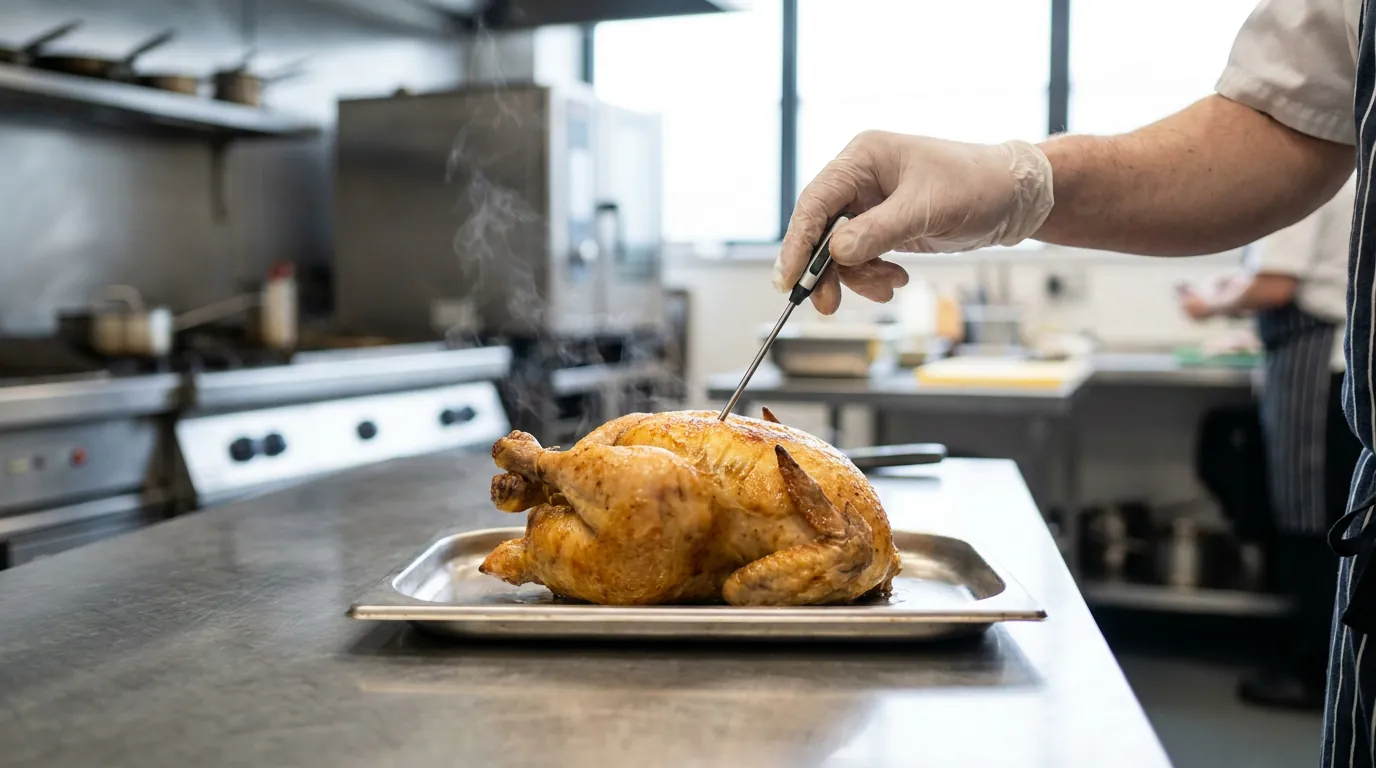
The most widely quoted of these is 70°C for two minutes, and the simplest single check on a busy line is a core reading of 75°C, at which point the required kill is achieved almost instantly. Probe the thickest part of the food — the centre of a chicken breast, the middle of a lasagne, the deepest point of a rolled joint — because that is the last place to reach temperature.
Whole cuts of beef and lamb are the exception. Because bacteria on an intact steak or joint live only on the outer surface, these can be served pink or rare provided the outside has been thoroughly seared to kill surface bacteria. This does not apply to poultry, pork, rolled or stuffed joints, burgers, sausages, kebabs, offal or any minced or rolled meat — all of which mix surface bacteria through the food and must be cooked thoroughly to 70°C for two minutes (or an equivalent above). For the food-by-food detail, see our guide to temperature best practices for different food types.
Hot holding: 63°C and the two-hour rule
Hot food held for service must be kept at 63°C or above. This is a legal requirement. Use suitable hot-holding equipment — a bain-marie, hot cabinet or heated display — and probe the food itself, not the air or the water bath, to confirm it is genuinely at 63°C throughout.
There is one legal tolerance. If you cannot keep food at 63°C — for example on a carvery or buffet without hot-holding equipment — you may display it below 63°C for a single period of up to two hours. You can only do this once. Once that two-hour window is up, the food must be:
- reheated until steaming hot and returned to hot holding, or
- chilled down as quickly as possible to 8°C or below, or
- thrown away.
If hot food has been out of temperature control for more than two hours, it must be discarded — it cannot be salvaged by reheating.
Reheating: 75°C, or 82°C in Scotland
In England, Wales and Northern Ireland, there is no single legal reheating temperature. The requirement is that reheated food is steaming hot all the way through, which corresponds to the same 70°C-for-two-minutes benchmark used for cooking (75°C is the easy single check). Reheat in the centre and the thickest part, and confirm with a probe.
In Scotland the law is stricter: food that is reheated must be raised to a minimum of 82°C, under the Food Hygiene (Scotland) Regulations 2006 (with a defence available where reaching 82°C would spoil the food’s quality). If you operate in Scotland, this is the number to build your procedures around.
Across the whole UK, the rule is the same: only reheat food once. Every trip through the danger zone as food heats and cools gives bacteria another chance to grow, so repeated reheating compounds the risk.
Cooling cooked food
Food you are not serving straight away has to get out of the danger zone quickly. The Safer Food, Better Business guidance is to cool cooked food as fast as possible — ideally within 90 minutes — before moving it to the fridge, and the FSA advises refrigerating or freezing within one to two hours at the outside. Speed it up by dividing food into smaller portions, spreading it in shallow trays, or using a blast chiller.
Do not put hot food straight into the fridge: it warms every other item around it and can push the whole unit into the danger zone. Cool first, then chill to 8°C or below. See our Safer Food, Better Business guide for how cooling fits into a full food safety management system.
Deliveries and goods-in
Temperature control starts at the back door. When a chilled delivery arrives, check and record its temperature: it should be 8°C or below (aim for 5°C), and anything warmer should be questioned and, if in doubt, rejected. Frozen deliveries should be −18°C or below. Recording goods-in temperatures is a core part of your due diligence and one of the first things an environmental health officer will ask about — our guide to goods-in and delivery checks covers exactly what to log and when to refuse a load.
Using and calibrating a probe
Every temperature above is only as reliable as the thermometer you read it with. To take an accurate core reading:
- Clean and disinfect the probe before and after each use to avoid cross-contamination.
- Insert it into the thickest part or centre of the food.
- Leave it in place until the reading stabilises — for most probes that is around 10 to 15 seconds — before recording the number.
A probe that has been dropped or is simply out of true will read wrong in a way you cannot see, so calibrate it regularly: it should read 0°C in melting iced water and 100°C in boiling water (at sea level). Our probe thermometer calibration guide walks through the ice-point and boiling-point checks step by step, and the free thermometer calibration log gives you a record to prove you did them.
Where the law differs: England, Wales and NI vs Scotland
Most UK food temperature rules are shared, but two differences matter:
- Reheating. England, Wales and Northern Ireland require food to be “steaming hot”; Scotland sets a legal minimum of 82°C.
- The chilled 8°C figure is written into the Food Safety and Hygiene (England) Regulations 2013 and the equivalent Welsh and Northern Irish regulations; Scotland’s temperature-control regime is framed slightly differently but the practical target — keep chilled food at 8°C or below, ideally 5°C — is the same.
When in doubt, work to the stricter figure. For a full walkthrough of how these temperatures feed into daily practice, EHO inspections and record-keeping, see our complete guide to restaurant temperature checks and what EHOs check on temperature.
Frequently asked questions
What is the legal fridge temperature in the UK?
Chilled food must be kept at 8°C or below — this is a legal requirement in England, Wales and Northern Ireland. In practice the Food Standards Agency recommends setting your fridge to 5°C or below to allow for door openings and temperature fluctuations.
What is the danger zone temperature in the UK?
The danger zone is 8°C to 63°C. Harmful bacteria multiply most rapidly in this range, roughly around body temperature, so food should be kept below 8°C or above 63°C and spend as little time as possible in between.
What temperature should food be reheated to in the UK?
In England, Wales and Northern Ireland food must be reheated until it is steaming hot all the way through — equivalent to 70°C for two minutes. In Scotland the law sets a minimum of 82°C. Food should only ever be reheated once.
What is the minimum hot holding temperature in the UK?
Hot food held for service must be kept at 63°C or above, which is a legal requirement. You may take food out of hot holding to display below 63°C for a single period of up to two hours, after which it must be reheated to steaming hot and returned, chilled to 8°C or below, or thrown away.
What core temperature should food be cooked to?
There is no single legal cooking temperature, but the Food Standards Agency publishes equivalent time and temperature combinations that all kill harmful bacteria: 60°C for 45 minutes, 65°C for 10 minutes, 70°C for 2 minutes, 75°C for 30 seconds or 80°C for 6 seconds. A core reading of 75°C is the simplest single benchmark to check against.
What temperature should a freezer be in a food business?
Freezers should run at −18°C or below. At this temperature bacterial growth is paused and food is safe to store, provided it was frozen while still fresh and defrosted safely in a fridge rather than at room temperature.
Related Forkto software
Frequently asked questions
What is the legal fridge temperature in the UK?
Chilled food must be kept at 8°C or below — this is a legal requirement in England, Wales and Northern Ireland. In practice the Food Standards Agency recommends setting your fridge to 5°C or below to allow for door openings and temperature fluctuations.
What is the danger zone temperature in the UK?
The danger zone is 8°C to 63°C. Harmful bacteria multiply most rapidly in this range, roughly around body temperature, so food should be kept below 8°C or above 63°C and spend as little time as possible in between.
What temperature should food be reheated to in the UK?
In England, Wales and Northern Ireland food must be reheated until it is steaming hot all the way through — equivalent to 70°C for two minutes. In Scotland the law sets a minimum of 82°C. Food should only ever be reheated once.
What is the minimum hot holding temperature in the UK?
Hot food held for service must be kept at 63°C or above, which is a legal requirement. You may take food out of hot holding to display below 63°C for a single period of up to two hours, after which it must be reheated to steaming hot and returned, chilled to 8°C or below, or thrown away.
What core temperature should food be cooked to?
There is no single legal cooking temperature, but the Food Standards Agency publishes equivalent time and temperature combinations that all kill harmful bacteria: 60°C for 45 minutes, 65°C for 10 minutes, 70°C for 2 minutes, 75°C for 30 seconds or 80°C for 6 seconds. A core reading of 75°C is the simplest single benchmark to check against.
What temperature should a freezer be in a food business?
Freezers should run at -18°C or below. At this temperature bacterial growth is paused and food is safe to store, provided it was frozen while still fresh and defrosted safely in a fridge rather than at room temperature.
Safe hands, clear records
Stop running food safety on paper
Forkto turns daily checks, temperature logs, HACCP and audits into a few taps on a phone. Your team stays consistent and you're always ready for the EHO.
14-day free trial · No card required