Food safety guide
The 14 Allergens: The Complete UK List for Food Businesses
The 14 allergens UK food businesses must declare by law — the full list, where each one hides in the kitchen, and how to label and manage them safely.
8 July 2026
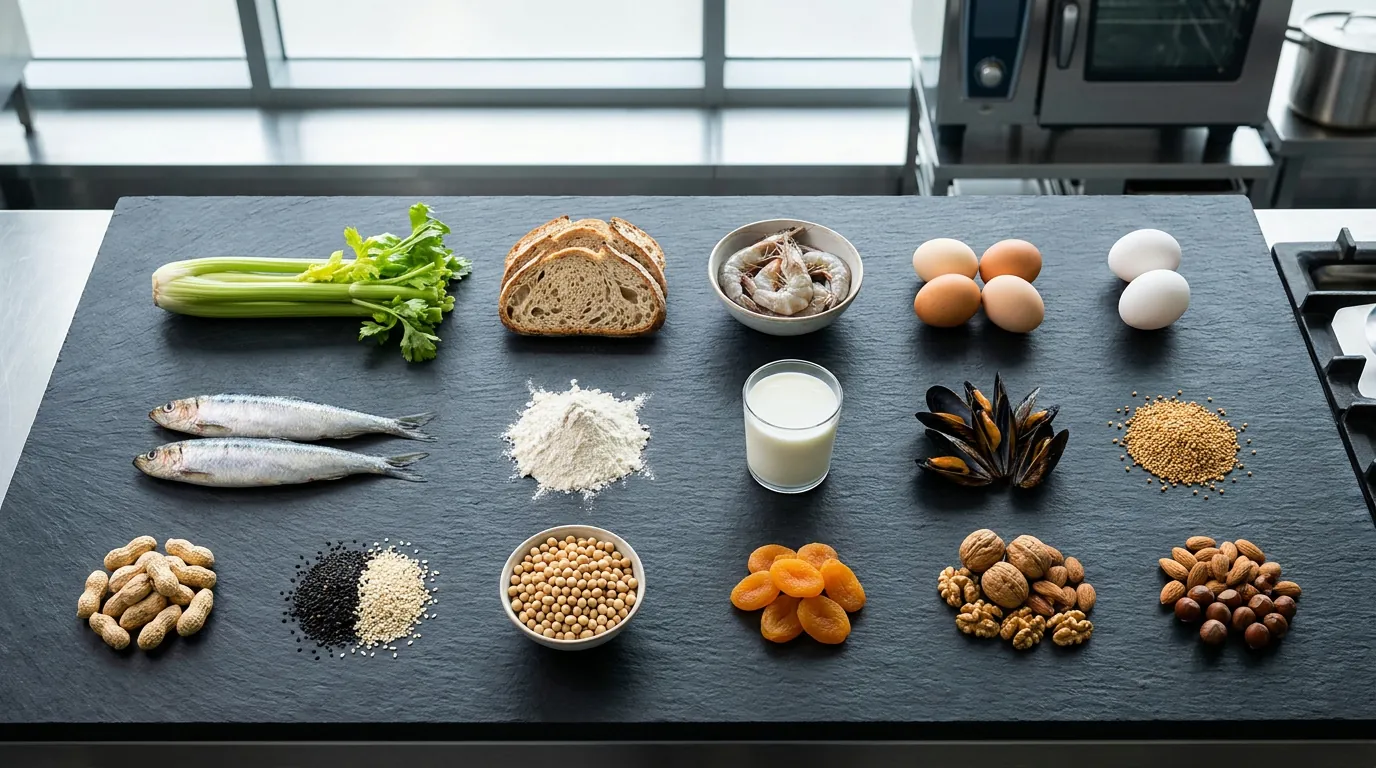
The 14 allergens are the specific ingredients UK law says every food business must declare, because they cause the overwhelming majority of serious allergic reactions. The full list is: celery, cereals containing gluten, crustaceans, eggs, fish, lupin, milk, molluscs, mustard, peanuts, sesame, soybeans (soya), sulphur dioxide and sulphites, and tree nuts (FSA, Allergen guidance for food businesses). They come from Annex II of retained EU Regulation 1169/2011, and knowing which of them sit in every dish you serve is a legal duty — not best practice.
This is the reference page. Below you get the full list at a glance, then each allergen in detail — what it actually includes, the everyday foods it hides in, and the one kitchen watch-out that catches businesses out — followed by how the rules apply to prepacked, PPDS and loose food, the real penalties, and how to manage all of it without living in fear of a mistake.
The 14 allergens at a glance
| Allergen | What it includes | Where it commonly hides |
|---|---|---|
| Celery | Stalks, leaves, seeds and celeriac | Stock cubes, soups, gravies, salads, spice mixes |
| Cereals containing gluten | Wheat (incl. spelt, khorasan), rye, barley, oats | Bread, pasta, batter, breadcrumbs, sauces thickened with flour, soy sauce |
| Crustaceans | Crab, lobster, prawns, shrimp, scampi, langoustine | Shrimp paste, some fish stocks, laksa, XO sauce |
| Eggs | Whole egg, egg white, egg yolk, egg products | Mayonnaise, cakes, mousses, fresh pasta, quiche, egg wash/glaze, some batters |
| Fish | All fish and fish products | Worcestershire sauce, Caesar dressing, some relishes, stocks, isinglass in fined wine |
| Lupin | Lupin seeds and lupin flour | Some breads, pastries, pizza bases and gluten-free products |
| Milk | Cow, goat, sheep milk and all dairy | Butter, cheese, cream, yoghurt, caramel, ghee, some breads and processed meats |
| Molluscs | Mussels, clams, oysters, squid, scallops, snails, whelks | Oyster sauce, some fish stews, paella, laksa |
| Mustard | Mustard seeds, powder, oil and liquid mustard | Curry powder, marinades, salad dressings, soups, mayonnaise, sausages |
| Peanuts | Groundnuts, peanut flour, peanut oil | Satay sauce, some biscuits, cakes, curries and cold-pressed groundnut oil |
| Sesame | Sesame seeds, sesame oil, tahini | Hummus, burger buns, breadsticks, falafel, halva |
| Soybeans (soya) | Soya beans, tofu, edamame, soy protein | Soy sauce, miso, bread, some ice cream, chocolate, vegetarian and vegan products |
| Sulphur dioxide / sulphites | Where above 10mg/kg or 10mg/litre (as SO₂) | Dried fruit, wine, sausages, burgers, some soft drinks and processed potato |
| Tree nuts | Almonds, hazelnuts, walnuts, cashews, pecans, brazils, pistachios, macadamias | Pesto, marzipan, praline, ground almonds, nut oils, some breads and desserts |
The list is identical across England, Scotland, Wales and Northern Ireland. What changes between businesses is only how you have to communicate it — covered further down.
The 14 allergens in detail
1. Celery
Celery covers the stalks, leaves and seeds, and — critically — celeriac, which many kitchens forget is the same allergen. It is one of the most-missed allergens because it rarely appears as “celery” on a plate. Kitchen watch-out: celery is a base ingredient in most stock cubes, bouillon, gravies and ready-made soups. If you use a compound stock or a spice blend, assume celery until the specification proves otherwise.
2. Cereals containing gluten
This means wheat (including spelt and khorasan/Kamut), rye, barley and oats — each of which must be named, not just described as “gluten”. It appears in the obvious places (bread, pasta, pastry, breadcrumbs, batter) and the less obvious ones. Kitchen watch-out: flour used to thicken sauces and gravies, barley in some stocks and beers, and wheat in ordinary soy sauce. Note that “gluten-free” is a separate, tightly regulated claim about level, not the same as declaring the cereal allergen.
3. Crustaceans
Crabs, lobster, prawns, shrimp, scampi and langoustine. Kept separate in law from molluscs, so a customer can react to one and not the other. Kitchen watch-out: shrimp paste and dried shrimp are hidden crustacean sources in Thai and Southeast Asian pastes, curries and some fish stocks — check the label of every paste and sauce.
4. Eggs
Whole egg and its separated and processed forms. Beyond the obvious omelettes and cakes, egg is a functional ingredient across the menu. Kitchen watch-out: mayonnaise and aioli, fresh egg pasta, mousses and meringue, quiche, and the egg wash brushed onto pastry and bread — an easily forgotten source when someone else made the pastry.
5. Fish
All fish and fish products. Kitchen watch-out: fish is a stealth ingredient in condiments — anchovies in Worcestershire sauce and Caesar dressing, fish sauce in Southeast Asian cooking, and fish stock in risottos and soups. A dish with no visible fish can still be unsafe for a fish-allergic customer.
6. Lupin
Lupin is a legume, and lupin flour and seeds turn up more in the UK than most operators expect — often as a wheat-flour substitute. Kitchen watch-out: check gluten-free bread, pastry and pizza bases, and some imported bakery products, where lupin flour is used for texture. People with a peanut allergy can also react to lupin.
7. Milk
Cow, goat and sheep milk and every dairy derivative — butter, cheese, cream, yoghurt, milk powder, whey and casein. One of the broadest allergens on the list. Kitchen watch-out: milk hides in caramel and toffee, ghee, some breads and rolls (milk powder for softness), and processed and cured meats. “Dairy-free” claims need the same rigour as any other allergen control.
8. Molluscs
Mussels, clams, oysters, squid, scallops, snails and whelks. Kitchen watch-out: oyster sauce is the classic hidden mollusc, appearing across stir-fries and marinades. Molluscs also lurk in some paellas, seafood stews and Asian pastes. Declared separately from crustaceans — never merge the two.
9. Mustard
Mustard seeds, mustard powder, mustard oil and prepared/liquid mustard. A tiny quantity is enough to trigger a reaction. Kitchen watch-out: mustard is a background flavouring in curry powder, piccalilli, marinades, salad dressings, mayonnaise, soups and many sausages — rarely the star ingredient, frequently present.
10. Peanuts
A legume, not a tree nut, and one of the most severe allergens. Covers groundnuts, peanut flour and peanut oil (refined peanut oil may be exempt, but crude/cold-pressed is not). Kitchen watch-out: satay and some curry sauces, ground peanut used as a thickener, and cross-contact from shared woks and fryers. Peanut demands strict segregation, not just declaration.
11. Sesame
Sesame seeds, sesame oil and tahini. The allergen that killed Natasha Ednan-Laperouse, baked invisibly into bread. Kitchen watch-out: sesame is in hummus, burger buns and seeded breads, breadsticks, falafel and halva, and sesame oil dresses many dishes without ever appearing as “sesame” on the spec.
12. Soybeans (soya)
Soya beans and derivatives — tofu, edamame, soy protein, soy sauce, miso. Extremely widespread as a cheap protein and emulsifier. Kitchen watch-out: soya lecithin in chocolate, soya flour in commercial bread, and soy protein across vegetarian and vegan products and ready-made sauces. If a product is processed, check for soya.
13. Sulphur dioxide and sulphites
Declared only where the concentration is above 10mg/kg or 10mg/litre (expressed as SO₂). Used as a preservative and colour-keeper. Kitchen watch-out: dried fruit, wine and some soft drinks, and — the one that surprises people — sausages, burgers and some processed potato products, where sulphites keep the colour fresh. Can trigger asthma-type reactions rather than classic anaphylaxis.
14. Tree nuts
Eight named nuts must be declared: almonds, hazelnuts, walnuts, cashews, pecans, brazil nuts, pistachios and macadamia (Queensland) nuts. Best practice is to name the specific nut, as reactions can be nut-specific. Kitchen watch-out: pesto (pine nuts and cashews), marzipan and praline, ground almonds in cakes and sauces, nut oils, and some breads and desserts. Coconut is not classed as a tree nut here, but check your own risk assessment.
How the 14-allergen rules apply to your business
Knowing the list is step one. The law then dictates how you communicate it, and that depends entirely on how the food is sold.
Prepacked food
Food packaged before it is put on sale — where the food is fully enclosed before a customer selects it — must carry a full ingredients list with the 14 allergens emphasised within it, typically in bold. The customer must be able to read which of the 14 are present from the label alone, with no need to ask.
Prepacked for direct sale (PPDS) — Natasha’s Law
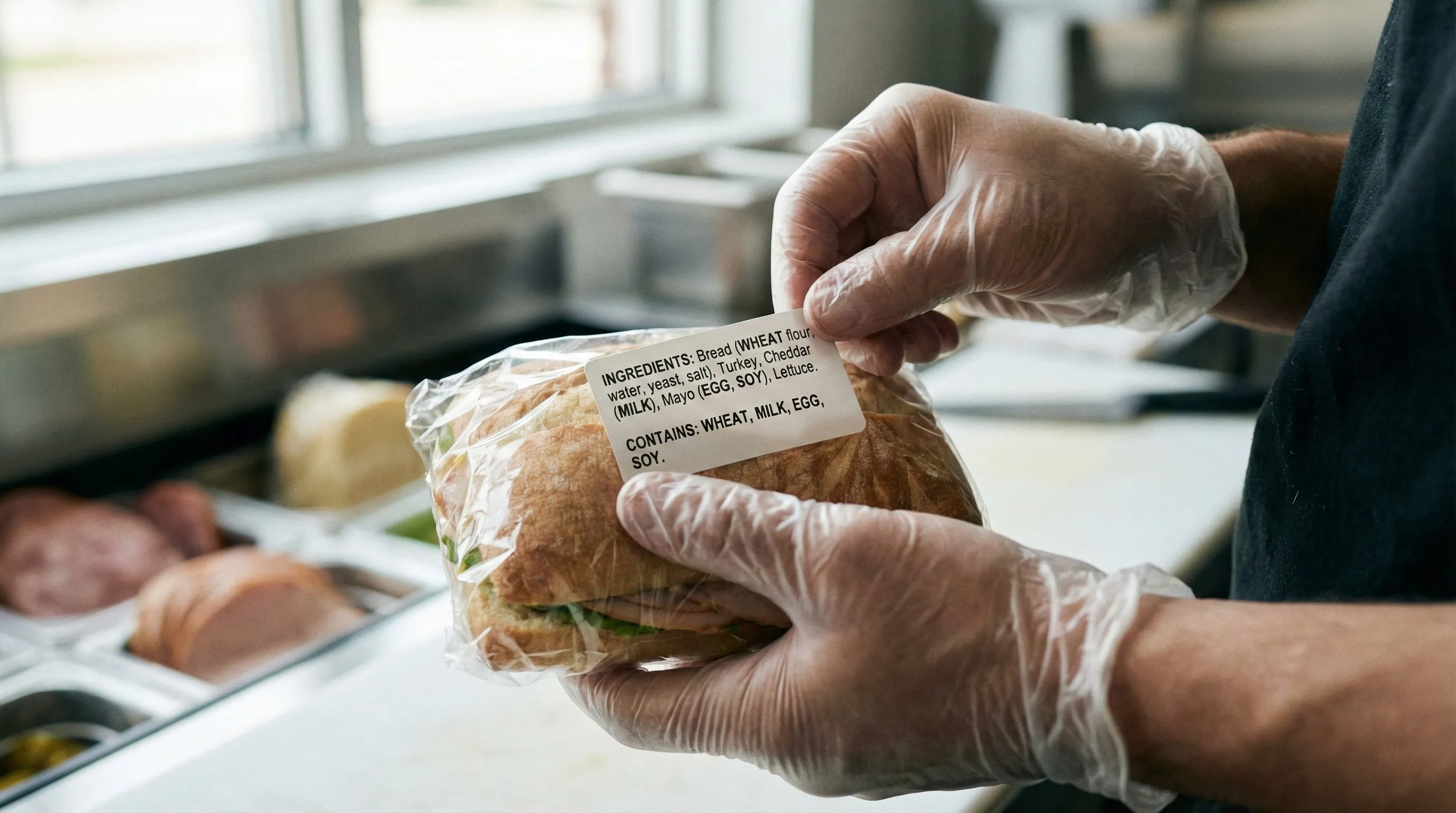
Since October 2021, food that is packed on the same premises from which it is sold — the sandwich you make and wrap before the lunch rush, the boxed salad on the counter — is prepacked for direct sale (PPDS) and must be labelled with the name of the food and a full ingredients list with the 14 allergens emphasised. This is Natasha’s Law. If you are unsure whether an item counts, our PPDS classification guide walks through 55+ real examples, and the full Natasha’s Law guide covers the labelling rules in depth.
Non-prepacked (loose) food
Food sold without packaging — a plated restaurant dish, a made-to-order sandwich, food from a deli counter — can have its allergen information provided in writing or verbally. But there is a hard rule underneath it: staff must never answer from memory. Every allergen question must be checked against an accurate written source. Proposals known as Owen’s Law may make written allergen information on menus mandatory for the restaurant sector in future — worth preparing for now.
Penalties and the real risk
Providing inaccurate or missing allergen information is a criminal offence under the Food Information Regulations 2014. Since the £5,000 cap was removed in 2015, Magistrates’ Court fines are unlimited. But the fine is rarely the real story.
Where an allergen failure has caused a death, operators have faced gross negligence manslaughter charges and prison sentences. The 2016 death of Natasha Ednan-Laperouse — from sesame baked into a baguette with no allergen label — is what drove Natasha’s Law onto the statute book. The point of the 14-allergen list is not to pass an inspection; it is that a single wrong answer at the counter can kill someone. Treat it that way and compliance follows.
How to manage the 14 allergens in practice
Getting this right day to day rests on four things:
- Build an allergen matrix. Map every dish and product against all 14 allergens in one grid, so any team member can answer any allergen question in seconds from a single trusted source. Our allergen matrix guide shows how to build one in ten steps, with a worked cafe example.
- Interrogate your suppliers. Your matrix is only as accurate as the specifications behind it. Get allergen data for every compound ingredient, and re-check whenever a supplier reformulates or you swap a product — a changed recipe on a bought-in sauce can silently add an allergen.
- Train every food handler. Allergen awareness is not optional and should be documented. Everyone who takes an order or plates a dish needs to know the 14, how to check the matrix, and how to handle a customer declaring an allergy. See UK food safety training requirements.
- Control cross-contamination. Declaration is not enough for severe allergens like peanuts and tree nuts — separate storage, dedicated equipment or utensils, and cleaning between tasks are what actually keep an allergic customer safe.
Doing this on paper works until a recipe changes and the printed matrix goes stale. Digital allergen management keeps the matrix tied to your recipes, so when an ingredient changes the allergen data updates everywhere at once, and front-of-house is always looking at the current version. Pair it with a digital labelling system and your PPDS labels stay in sync with the same source of truth — the ingredients list and the emphasised allergens both come from one place, not a laminated sheet someone forgot to reprint. For front-of-house, QR allergen menus put the same information directly in customers’ hands — they scan a code, tick the allergens they need to avoid, and see only the dishes that are safe for them (see a live example).
Frequently asked questions
What are the 14 allergens that must be declared in the UK?
The 14 are: celery, cereals containing gluten (wheat, rye, barley, oats), crustaceans, eggs, fish, lupin, milk, molluscs, mustard, peanuts, sesame, soybeans (soya), sulphur dioxide and sulphites (above 10mg/kg or 10mg/litre), and tree nuts. They come from Annex II of retained EU Regulation 1169/2011 and every UK food business must be able to tell customers which of them are in each item.
Is the list of 14 allergens the same across the UK?
Yes. The same 14 allergens apply in England, Scotland, Wales and Northern Ireland. The list is fixed in law and does not change from business to business — what changes is how you communicate it, which depends on whether food is prepacked, prepacked for direct sale (PPDS), or sold loose.
Do I have to label the 14 allergens or can I tell customers verbally?
It depends on how the food is sold. Prepacked and PPDS food must carry a written ingredients list with the 14 allergens emphasised. For non-prepacked (loose) food — a plated dish, a sandwich made to order — you can provide the information in writing or verbally, but staff must never answer from memory; they must check an accurate written source such as an allergen matrix.
What is the difference between the 14 allergens and “may contain”?
The 14 allergens are declared when they are a deliberate ingredient. “May contain” is a precautionary statement used only where there is a genuine, unavoidable cross-contamination risk you cannot fully control. FSA guidance is clear that “may contain” must not be used as a blanket disclaimer to cover poor practice.
What are the penalties for getting allergen information wrong?
Providing inaccurate or missing allergen information is a criminal offence under the Food Information Regulations 2014, with unlimited fines in the most serious cases. Where an allergen failure has caused a death, business operators have faced manslaughter charges and custodial sentences.
Where do the 14 allergens most often hide?
The most commonly missed sources are celery in stock cubes and gravy, fish in Worcestershire sauce and Caesar dressing, milk in bread and processed meats, soya in chocolate and commercial bread, sulphites in dried fruit and sausages, and mustard in curry powder and salad dressings. Always check the specification of every compound ingredient, not just the headline recipe.
Related Forkto software
Frequently asked questions
What are the 14 allergens that must be declared in the UK?
The 14 are: celery, cereals containing gluten (wheat, rye, barley, oats), crustaceans, eggs, fish, lupin, milk, molluscs, mustard, peanuts, sesame, soybeans (soya), sulphur dioxide and sulphites (above 10mg/kg or 10mg/litre), and tree nuts. They come from Annex II of retained EU Regulation 1169/2011 and every UK food business must be able to tell customers which of them are in each item.
Is the list of 14 allergens the same across the UK?
Yes. The same 14 allergens apply in England, Scotland, Wales and Northern Ireland. The list is fixed in law and does not change from business to business — what changes is how you communicate it, which depends on whether food is prepacked, prepacked for direct sale (PPDS), or sold loose.
Do I have to label the 14 allergens or can I tell customers verbally?
It depends on how the food is sold. Prepacked and PPDS food must carry a written ingredients list with the 14 allergens emphasised. For non-prepacked (loose) food — a plated dish, a sandwich made to order — you can provide the information in writing or verbally, but staff must never answer from memory; they must check an accurate written source such as an allergen matrix.
What is the difference between the 14 allergens and 'may contain'?
The 14 allergens are declared when they are a deliberate ingredient. 'May contain' is a precautionary statement used only where there is a genuine, unavoidable cross-contamination risk you cannot fully control. FSA guidance is clear that 'may contain' must not be used as a blanket disclaimer to cover poor practice.
What are the penalties for getting allergen information wrong?
Providing inaccurate or missing allergen information is a criminal offence under the Food Information Regulations 2014, with unlimited fines in the most serious cases. Where an allergen failure has caused a death, business operators have faced manslaughter charges and custodial sentences.
Where do the 14 allergens most often hide?
The most commonly missed sources are celery in stock cubes and gravy, fish in Worcestershire sauce and Caesar dressing, milk in bread and processed meats, soya in chocolate and commercial bread, sulphites in dried fruit and sausages, and mustard in curry powder and salad dressings. Always check the specification of every compound ingredient, not just the headline recipe.
Safe hands, clear records
Stop running food safety on paper
Forkto turns daily checks, temperature logs, HACCP and audits into a few taps on a phone. Your team stays consistent and you're always ready for the EHO.
14-day free trial · No card required