Fire Safety Log Book
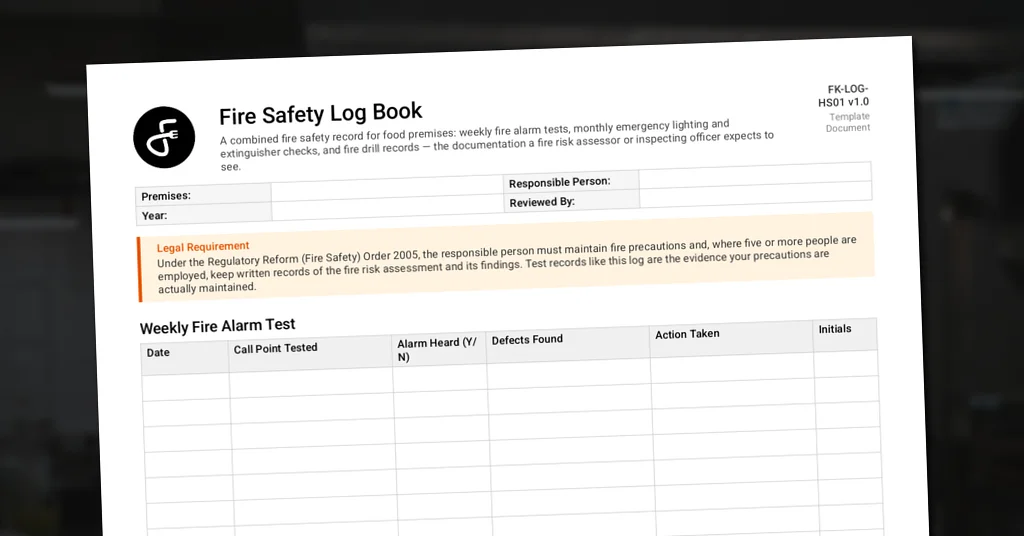
A free printable fire safety log book for UK food premises. Record weekly fire alarm tests, monthly emergency lighting and extinguisher checks, and fire drills in one place.
Download resource
Download PDFFire safety paperwork is one of the first things a fire risk assessor or inspecting officer asks to see, and “we test the alarm now and then” is not an answer that holds up. A fire safety log book gives you the written proof that your precautions are maintained, week in and week out. This free, printable fire safety log book pulls weekly alarm tests, monthly emergency lighting and extinguisher checks, and fire drill records into a single sheet built for busy food premises.
Why a Fire Safety Log Book Matters
Under the Regulatory Reform (Fire Safety) Order 2005, the “responsible person” for your premises must put in place and maintain appropriate fire precautions. Where five or more people are employed, you are legally required to keep written records of your fire risk assessment and its significant findings — and routine test records are how you prove those precautions have not quietly fallen into disrepair.
Commercial kitchens carry a higher fire risk than most workplaces: hot surfaces, oils, gas, and a constant flow of staff and deliveries. A working alarm, functioning emergency lighting and accessible, in-date extinguishers are the controls that protect people when something goes wrong — and a log book is how you show they were checked, not just installed. If a fire ever does occur, this record is a core part of your defence that you took fire safety seriously.
For the wider picture on managing fire risk in a kitchen, read our guide to fire safety in the commercial kitchen.
What the Log Book Tracks
The book is organised into four separate records, each with a header block for the premises, responsible person, year and reviewer:
- Weekly Fire Alarm Test — date, the call point tested, whether the alarm was heard, defects found, action taken, and initials, with space for 12 weeks per sheet
- Monthly Emergency Lighting Test — date, areas tested, pass or fail, defects and action taken, and initials
- Fire Extinguisher Monthly Visual Check — date, extinguisher ID and location, and tick checks that the pin and seal are intact, the pressure gauge is in the green, and the unit is unobstructed
- Fire Drill Record — date, time taken to evacuate, issues identified, action taken, and initials
- Responsible Person Sign-off — to confirm the records have been reviewed
How to Use It
-
Assign a responsible person. One named individual should own the log book and make sure each check happens on schedule. The Fire Safety Order places accountability on this person by name.
-
Test one call point every week. Rotate through your manual call points so each is tested over time, confirm the alarm sounds throughout the premises, and record the point used. Warn staff first so a real evacuation is never confused with a test.
-
Check emergency lighting and extinguishers monthly. For lighting, confirm each unit illuminates when mains power is simulated off. For extinguishers, check the pin and seal are intact, the gauge reads in the green, and nothing is blocking access.
-
Run and record fire drills. Hold a drill at least annually — more often for high-risk or high-turnover sites — and log how long evacuation took and any problems, such as a blocked exit or staff who missed the muster point.
-
Record every defect and the action taken. A fault that is written down and fixed is evidence your system works. Never leave a failed check with an empty action column.
-
Sign off and keep completed books. The responsible person should review the records regularly, and completed log books should be kept as part of your fire safety file, ready for inspection.
Part of a Complete Compliance System
Fire safety records sit alongside the rest of your premises documentation. This log book works well with:
- Fire safety in the commercial kitchen — the practical controls and risk factors behind the checks in this log
- EHO Inspection Checklist — how your safety records fit into the wider inspection picture
If you would rather not chase paper log books and hope the weekly test actually got done, Forkto’s audits feature lets you schedule recurring fire safety checks, capture them digitally with photos and sign-off, and flag any missed or failed check before it becomes a problem.
Frequently asked questions
What is a fire safety log book?
A fire safety log book is a single record where you document your routine fire safety checks — weekly alarm tests, monthly emergency lighting and extinguisher inspections, and fire drills. It is the written evidence that the fire precautions identified in your fire risk assessment are actually being maintained.
Is a fire safety log book a legal requirement in the UK?
The Regulatory Reform (Fire Safety) Order 2005 requires the 'responsible person' to maintain fire precautions, and where five or more people are employed you must keep written records of your fire risk assessment and its significant findings. A log book is the standard way to demonstrate those precautions are kept in working order.
How often should a fire alarm be tested?
Best practice is a weekly test of one manual call point — rotating which point you use each week — to confirm the alarm sounds, alongside a periodic full service by a competent engineer. Record every weekly test, the call point used, whether the alarm was heard, and any fault found.
Who is the responsible person for fire safety?
Usually the employer, owner or occupier who has control of the premises. They are legally accountable for the fire risk assessment, the fire precautions and the record-keeping — and for making sure the checks recorded in the log book are actually carried out and signed off.
Tired of paper checklists?
Run this checklist digitally with Forkto
Assign checks to staff, get reminders, capture photos and timestamps, and keep a tamper-proof record for the EHO — no more lost paper or missed checks.
14-day free trial · No card required