Allergen Management SOP
A free printable allergen management SOP for UK food businesses. Covers the 14 declarable allergens, order-taking procedure, kitchen controls, a monthly allergen audit, incident record and staff training log.
Download resource
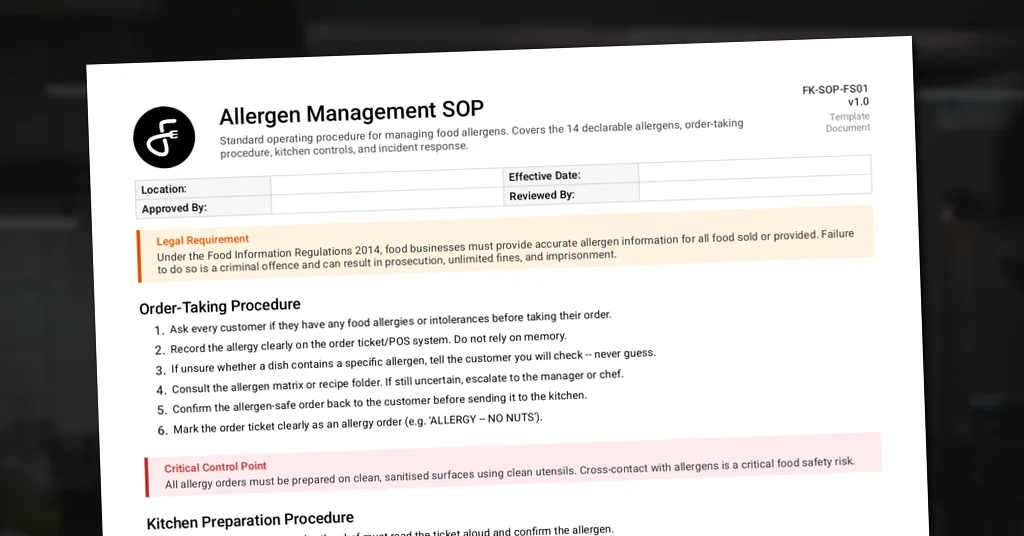
Download PDFIf a customer with a nut allergy orders at your counter tonight, does every member of staff know exactly what happens next? An allergen management SOP answers that question in writing. This free template gives you a complete, printable procedure covering order-taking, kitchen controls, a monthly audit, incident recording and staff training — the documentation an Environmental Health Officer expects to see behind your allergen claims.
Why a Written Allergen Procedure Matters
Under the Food Information Regulations 2014, every food business must provide accurate allergen information for all food sold or provided. Getting it wrong is a criminal offence that can lead to prosecution, unlimited fines and, in the most serious cases, imprisonment — and behind the legal risk sits the human one, which is why Natasha’s Law and Owen’s Law exist.
Most allergen failures are not knowledge failures — they are handover failures. The waiter knew, the ticket didn’t say, the chef didn’t ask. A written SOP closes those gaps by making every step explicit: who asks, who records, who checks, who confirms.
It also directly supports your food hygiene rating. The confidence in management element of your inspection score rests on documented, working procedures. An allergen SOP that staff actually follow is strong evidence.
What the SOP Covers
Order-taking procedure — six steps from “ask every customer” through recording the allergy on the ticket or POS, checking the allergen matrix rather than guessing, confirming the order back to the customer, and clearly marking the ticket (e.g. “ALLERGY — NO NUTS”).
Kitchen preparation procedure — seven steps for the allergy order itself: read the ticket aloud, wash hands and change gloves, use clean sanitised boards and utensils, prepare separately, check every ingredient label including sauces and garnishes, plate separately away from the pass, and hand over directly to the right customer.
Monthly allergen controls audit — an eight-question yes/no audit covering the allergen matrix, new menu items, delivery label checks, designated prep areas, staff training currency, incident procedures, “may contain” warnings and record availability.
Incident record — space to log any allergen incident, near-miss or complaint with the date, details, action taken and outcome.
Staff allergen training record — a signature table proving who was trained, when, and by whom.
Manager sign-off — monthly review signature and corrective action notes.
The document also includes location, effective date, approval and review fields at the top, so it slots straight into your food safety management system as a controlled document (ref: FK-SOP-FS01).
How to Use It
-
Adapt it before you adopt it. Read each step against how your kitchen actually runs. Cross out what does not apply, add what is missing — an SOP that describes a fictional kitchen fails at inspection and in service.
-
Pair it with a current allergen matrix. The SOP tells staff to consult the matrix rather than guess, so the matrix must exist and be up to date. Our allergen matrix guide covers how to build and maintain one.
-
Train against it, and record the training. Walk every front-of-house and kitchen team member through the procedure, then capture signatures in the training record. Repeat for every new starter and at least annually.
-
Run the monthly audit. Eight questions, five minutes. The audit exists to catch drift — the matrix that quietly went out of date, the new dish nobody assessed — before an inspector or a customer does.
-
Record every incident and near-miss. A near-miss that gets written down and fixed is evidence your system works. The same near-miss repeated three times unrecorded is how serious incidents happen.
-
Review after every menu change. New dishes, new suppliers and reformulated products are the most common way allergen information silently goes wrong.
Part of a Complete Allergen System
This SOP is the procedural layer of allergen control. It works alongside:
- Cross-contamination prevention — the physical controls the SOP’s kitchen steps depend on
- Is my food PPDS? — whether your products need full Natasha’s Law labelling
- Opening & Closing Checklist — build the matrix check into your daily routine
- EHO Inspection Checklist — see how allergen documentation fits the wider inspection picture
If you would rather not manage paper SOPs, training records and audits by hand, Forkto’s allergen management feature keeps your allergen matrix, procedures and staff sign-offs digital, versioned and audit-ready.
Frequently asked questions
What is an allergen management SOP?
A standard operating procedure that sets out exactly how your business handles food allergies — how orders are taken, how allergy orders are prepared in the kitchen, and what happens if something goes wrong. It turns 'we're careful with allergies' into a written, trainable, auditable process.
Is an allergen SOP a legal requirement in the UK?
The Food Information Regulations 2014 legally require you to provide accurate allergen information for every item you sell, and failure is a criminal offence. A written SOP is not named in the regulations, but it is how you demonstrate a working system — and it is exactly the kind of evidence an EHO looks for when scoring confidence in management.
What should an allergen procedure cover?
At minimum: how staff ask about allergies at order-taking, how the allergy is recorded and communicated to the kitchen, how the kitchen prevents cross-contact during preparation, how the finished dish is delivered to the right customer, and how incidents and near-misses are recorded and reviewed.
How often should allergen procedures be reviewed?
Review the SOP at least annually, and immediately after any menu change, supplier change, or allergen incident. The monthly audit section of this template exists so problems are caught between reviews, not at the next inspection.
What should staff do during an allergen incident?
Stop service of the affected dish, tell the manager immediately, and if a customer has a reaction call 999 without delay. Afterwards, record what happened, what was done, and the outcome in the incident record — and fix the gap in the procedure that let it happen.
Tired of paper checklists?
Run this checklist digitally with Forkto
Assign checks to staff, get reminders, capture photos and timestamps, and keep a tamper-proof record for the EHO — no more lost paper or missed checks.
14-day free trial · No card required