BOH Daily Cleaning Schedule
A printable back-of-house daily cleaning schedule for commercial kitchens. Pre-filled tasks with Mon-Sun columns for daily tick-off and manager sign-off.
Download resource
Download PDFBack-of-house cleaning is where food safety starts. A dirty kitchen is a direct risk to public health, and it’s the area EHO inspectors will scrutinise most closely. This BOH Daily Cleaning Schedule provides your kitchen team with a structured daily routine that’s easy to follow and easy to evidence.
Why BOH Cleaning Documentation Matters
An EHO inspection will always include a thorough assessment of your kitchen hygiene. Inspectors don’t just look at whether the kitchen is clean right now — they want to see evidence that cleaning happens consistently. A completed cleaning schedule with daily tick-offs and sign-off is exactly that evidence.
Poor kitchen hygiene is one of the most common reasons businesses receive low food hygiene ratings. Documented cleaning procedures also contribute to your confidence in management score, which is often the hardest area to score well on.
What’s Included
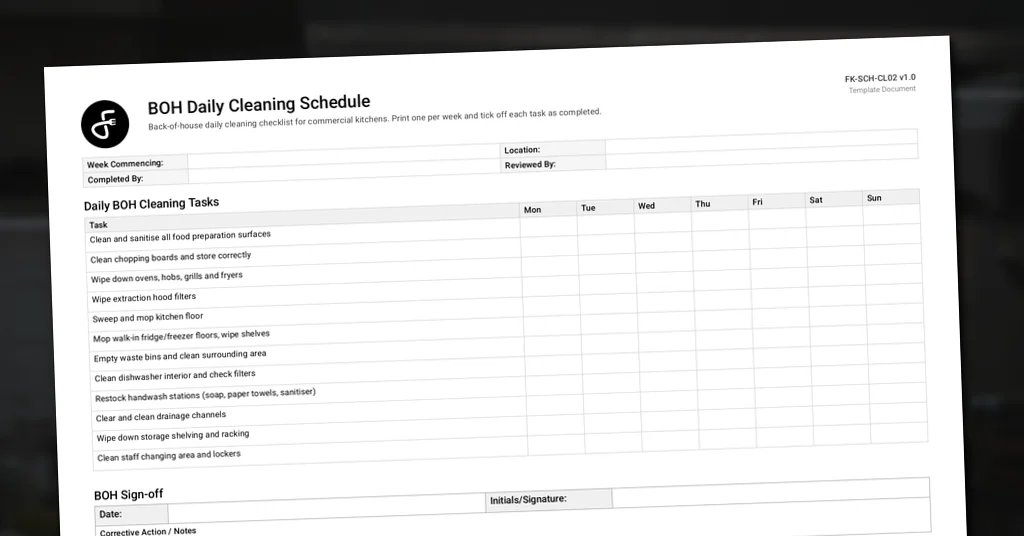
This one-page landscape schedule covers 12 daily BOH cleaning tasks with columns for each day of the week:
- Cleaning and sanitising all food preparation surfaces
- Cleaning chopping boards and storing correctly
- Wiping down ovens, hobs, grills and fryers
- Cleaning extraction hood filters
- Sweeping and mopping kitchen floors
- Cleaning walk-in fridge and freezer areas
- Emptying waste bins and cleaning the area
- Cleaning dishwasher interior and filters
- Restocking handwash stations
- Clearing and cleaning drainage channels
The schedule includes fields for Week Commencing, Location, Completed By, and Reviewed By.
How to Use It
- Print one per week and display it in the kitchen
- Assign responsibility — the person completing each task ticks it off
- Sign off at the bottom at the end of the week
- Store completed schedules — keep at least 12 months of records
- Adapt the tasks — every kitchen is different, add or remove tasks to suit your operation
Part of a Complete Cleaning System
This BOH schedule works alongside our other cleaning resources:
- FOH Daily Cleaning Schedule — for front-of-house areas
- Weekly Deep Clean Checklist — for monthly deep cleaning cycles
- Kitchen Opening & Closing Checklist — daily BOH and FOH tasks for the start and end of each shift
For a full breakdown of how to structure cleaning across your entire premises, read our Ultimate Guide to FOH and BOH Cleaning Schedules.
Go Digital
Paper schedules get lost, damaged, and are hard to review at audit time. With Forkto, your cleaning schedules become digital, version-controlled records — always accessible, always up to date, and always ready for inspection.
Frequently asked questions
Is a kitchen cleaning schedule a legal requirement?
Food law requires premises and equipment to be kept clean (Annex II, Chapters I, II and V of assimilated Regulation (EC) 852/2004), and your food safety management system must show how you achieve this. A documented cleaning schedule with daily tick-offs and sign-off is the standard way to evidence it — the FSA's Safer Food Better Business pack uses the same approach.
What should a back-of-house cleaning schedule include?
Daily tasks such as sanitising food preparation surfaces and chopping boards, cleaning ovens, hobs and fryers, degreasing extraction filters, mopping floors, cleaning fridges and freezers, emptying bins, and restocking handwash stations. Each task should have space to record who did it and when.
What is the difference between cleaning and sanitising?
Cleaning removes visible dirt, grease and food debris. Sanitising then reduces bacteria on a surface to a safe level. Food contact surfaces need both — clean first, then apply a sanitiser that meets BS EN 1276 or BS EN 13697 and leave it for the contact time stated on the label.
How does kitchen cleaning affect a food hygiene rating?
Poor kitchen hygiene is one of the most common reasons for a low rating. It affects both the food hygiene and safety score and the structural compliance score, while missing cleaning records lower the heavily weighted confidence in management score.
Tired of paper checklists?
Run this checklist digitally with Forkto
Assign checks to staff, get reminders, capture photos and timestamps, and keep a tamper-proof record for the EHO — no more lost paper or missed checks.
14-day free trial · No card required