Food safety guide
Food Safety in Care Homes: A UK Compliance Guide (CQC, Allergens & Vulnerable Groups)
How UK care homes keep vulnerable residents safe: the 5°C cold chain, Listeria controls, CQC Regulations 12 and 14, the 14 allergens, IDDSI and records.
1 July 2026
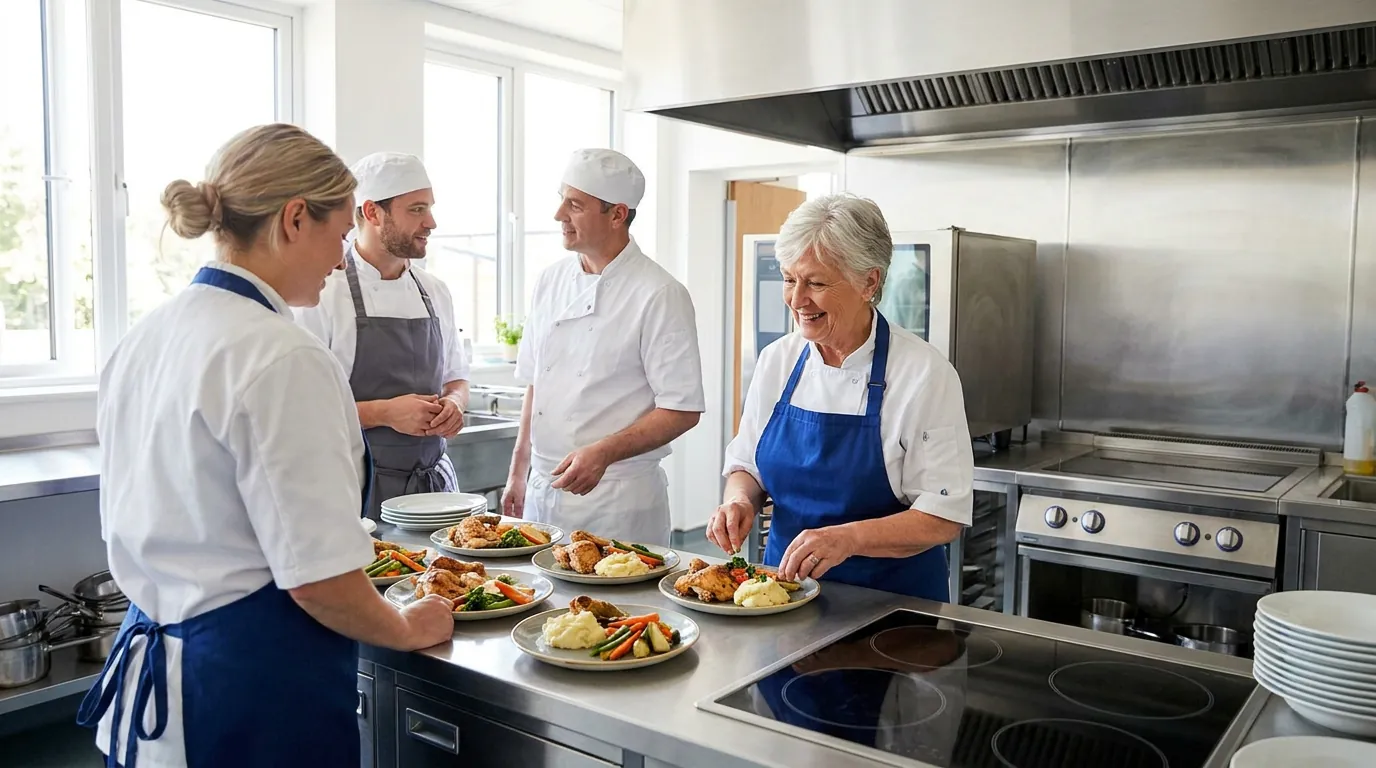
Food safety in a care home is not the same job as food safety in a café. The food can be prepared to an identical standard, but the people eating it are far more vulnerable to the consequences when something goes wrong. That single fact changes the risk maths — and it changes what the Food Standards Agency (FSA) and the Care Quality Commission (CQC) expect you to control and evidence.
We work with UK food businesses on exactly this, and care settings are a category of their own. This guide maps the rules that apply to care home kitchens, the Listeria controls that matter most for vulnerable residents, the temperatures that keep food safe, allergen and texture-modified diets, and the records that prove safe care to an inspector.
Key facts: the short answer
- Keep chilled ready-to-eat food at 5°C (the FSA good-practice target) from delivery to service. 8°C is the legal maximum.
- Follow the FSA’s care-home and Listeria guidance — residents are the group most likely to be hospitalised or die from a foodborne infection.
- Manage the 14 named allergens and IDDSI texture levels for each resident.
- Keep records that evidence CQC-safe care under Regulation 12 (safe care) and Regulation 14 (nutrition and hydration).
Is food safety really higher-risk in care homes?
Yes — and the reason is the residents, not the recipes. Older people and people with weakened immune systems are precisely the groups most likely to be hospitalised or to die from a foodborne illness. The NHS lists higher-risk groups for listeriosis as pregnant women and their babies, older people, and people with weakened immune systems — including those with cancer, diabetes, liver or kidney disease, or taking immunosuppressive medication (NHS). That description fits a large share of any care home’s residents.
The FSA is blunt about why this category gets special attention: vulnerable consumers are particularly susceptible to listeriosis, and the disease has a high hospitalisation and fatality rate compared with infections from other bacterial pathogens (FSA listeriosis guidance). A bug that gives a healthy adult a few rough days can be fatal for a frail resident.
The numbers: listeriosis in England and Wales
In England and Wales in 2024 there were 179 listeriosis cases (142 non-pregnancy and 37 pregnancy-associated), a 14.0% increase on the previous five-year median of 157 (UKHSA 2024 surveillance). The 2024 case fatality rate was 6.3% (down from 7.4% in 2023), and among the 142 non-pregnancy cases there were 28 deaths — a 19.9% fatality rate in that group. Crucially for care providers, incidence in 2024 was highest in people aged 80 and over (UKHSA).
A real warning: the 2019 hospital sandwich outbreak
This is not abstract. A 2019 outbreak linked to pre-packed sandwiches supplied to hospitals resulted in seven patient deaths, prompting FSA action and the review of its listeriosis guidance (FSA). It is the clearest illustration of why chilled, ready-to-eat food served to vulnerable people is treated as a priority hazard rather than a routine one.
The UK rules that apply to care home kitchens
Care home catering sits at the intersection of food law and health and social care regulation. Three frameworks matter.
Food hygiene law: the 8°C legal limit vs the 5°C target
It is an offence under the Food Safety and Hygiene (England) Regulations 2013 to keep food likely to support the growth of pathogenic micro-organisms or toxin formation at a temperature above 8°C, subject to a defence where the food was kept for service or display for less than four hours (legislation.gov.uk). That 8°C is the legal ceiling.
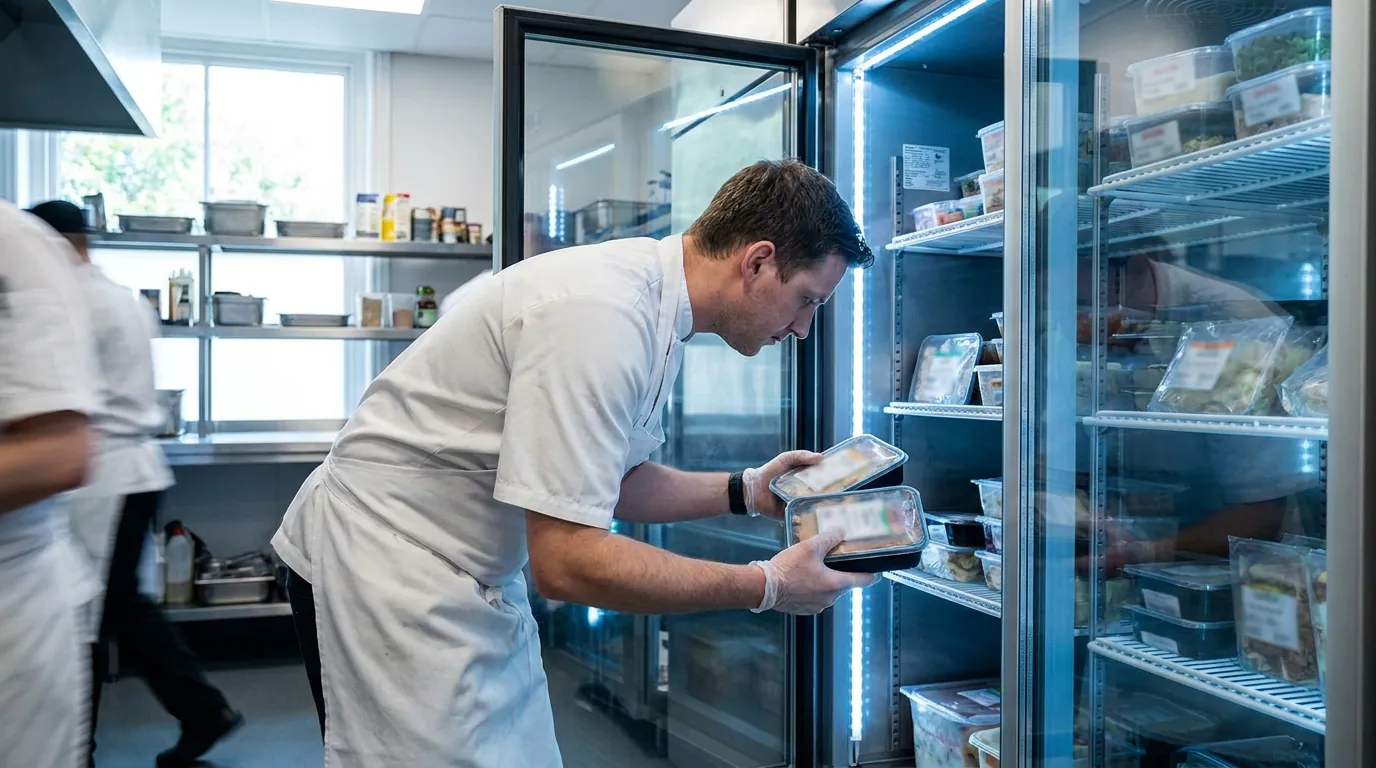
The FSA’s good-practice target is tighter. It recommends fridges run between 0 and 5°C, and in healthcare and social care settings it is good practice to maintain the cold chain for chilled ready-to-eat food at 5°C or below from delivery through to service, monitoring and recording temperatures throughout (FSA chilling guidance; FSA listeriosis guidance). The gap between 5°C and 8°C is your safety margin against Listeria, which grows at fridge temperatures.
CQC Regulation 12 and Regulation 14
Food safety also feeds directly into a care home’s CQC judgement. Regulation 12 (Safe care and treatment) requires care to be provided safely, including assessing and doing all that is reasonably practicable to mitigate risks, and assessing, preventing and controlling the spread of infections (CQC). Food safety failures fall squarely within that “safe” duty.
Regulation 14 (Meeting nutritional and hydration needs) requires suitable, nutritious food and drink served at an appropriate temperature, with nutritional needs assessed and dietary, religious and cultural preferences taken into account (CQC). Temperature control, allergen management and hygiene records are not just food-law boxes — weak ones can undermine a “safe” or “effective” rating.
Safer Food Better Business and the care homes supplement
The FSA’s food safety management system for caterers is Safer Food Better Business (SFBB). For care, there is a dedicated supplement: the SFBB supplement for residential care homes covers three care-specific safe methods — Extra Care: Protecting Food, Mini-kitchens, and Gift food — and is intended for small residential care homes (not nursing homes), used alongside the standard SFBB pack for caterers (FSA). The supplement exists because care settings have risks an ordinary restaurant does not: residents’ rooms with mini-kitchens, and well-meaning gift food brought in by families.
Controlling Listeria in chilled ready-to-eat food
Because Listeria monocytogenes can grow at low refrigeration temperatures and can survive freezing, FSA guidance targets chilled ready-to-eat food specifically (FSA). For a care home, this is the single most important hazard to get right.
Which ready-to-eat foods are high-risk
The FSA identifies these high-risk ready-to-eat foods for Listeria (FSA):
- Cold pre-cooked meats and deli meats
- Pâté
- Smoked and cured fish
- Cooked shellfish
- Soft mould-ripened cheeses
- Unpasteurised (raw) milk
- Pre-prepared sandwiches and salads
- Pre-cut fruit
These are exactly the kinds of “easy” cold items that turn up on a care home tea-time trolley. They deserve the closest attention.
The three FSA control areas
The FSA listeriosis guidance is built around three control areas (FSA):
- Control of contamination — cleaning and disinfection, and supplier controls so contaminated food does not enter the kitchen in the first place.
- Control of growth — the 5°C cold chain and short shelf life, so any Listeria present cannot multiply to dangerous levels.
- Management controls — a HACCP-based food safety management system, with temperature recording and verification. If you are building or reviewing your system, our complete UK guide to HACCP walks through the principles.
It is worth knowing this approach is regarded as effective. In an FSA survey, 77% of health and social care (non-NHS) settings had HACCP-based food safety management systems, and 95% of settings aware of the listeriosis guidance felt it was effective at reducing risk to vulnerable groups (FSA).
Cold chain, use-by dates and short shelf life
Controlling growth comes down to keeping food cold and not keeping it long. The FSA’s good-practice points:
- Chilling food below 5°C stops or significantly slows the growth of bacteria, including Listeria (FSA).
- Ready-to-eat foods should be eaten within 4 hours of removal from the fridge (within 2 hours on a very warm day), and opened foods with no instructions used within two days (FSA).
- Under FSA listeriosis good practice, ready-to-eat sandwiches should have a maximum shelf life of the day of production plus two days (FSA).
Maintaining and recording the cold chain from delivery to the resident’s plate is the practical expression of all of this.
Cooking, reheating and hot-holding temperatures that keep residents safe
Hot food has its own controls, and they are equally non-negotiable in a care setting.
Cook to 70°C for 2 minutes, hot hold at 63°C, reheat once
FSA business guidance is to cook food to a core temperature of 70°C for 2 minutes, with accepted equivalents of 60°C for 45 minutes, 65°C for 10 minutes, 75°C for 30 seconds, or 80°C for 6 seconds (FSA).
Hot food must be held at 63°C or above. It may be held below 63°C for a maximum of two hours, once, before being cooled to 8°C or thrown away. Reheated food must be steaming hot throughout and only reheated once (FSA).
Cooling and the danger zone
The bacterial danger zone is between 8°C and 63°C — the range where pathogens multiply fastest. To get food through it quickly, the FSA recommends cooked food be cooled and refrigerated within one to two hours, and that defrosted food be used within 24 hours (FSA chilling guidance). Cooling cooked food fast, then holding it at 5°C, is how you keep a prepared dish out of that danger zone.
Allergens and modified-texture diets for vulnerable residents
Two further controls are specific to feeding a resident population: getting allergens right, and getting texture right.
The 14 allergens and Natasha’s Law in a care setting
UK law requires 14 allergens to be declared: celery, cereals containing gluten, crustaceans, eggs, fish, lupin, milk, molluscs, mustard, peanuts, sesame, soybeans, sulphur dioxide/sulphites, and tree nuts (FSA). Care home kitchens must provide accurate information on all 14 for the food and drink they serve.
Where a care home prepacks food for direct sale — for example, sandwiches or snacks made and wrapped on site before a resident or visitor selects them — Natasha’s Law applies. Since 1 October 2021, prepacked for direct sale (PPDS) food must carry the name of the food and a full ingredients list with the 14 allergens emphasised within it (FSA). Our Natasha’s Law guide for UK food businesses covers exactly what counts as PPDS and how to label it, and our allergen matrix guide sets out how to map every dish against the 14 allergens so the information behind each meal is accurate and traceable.
IDDSI texture levels and dysphagia
Many residents have dysphagia (difficulty swallowing), which makes texture itself a safety control. The IDDSI framework (International Dysphagia Diet Standardisation Initiative) has 8 levels (0–7): drinks run from Level 0 (thin) to Level 4 (extremely thick) and foods from Level 3 (liquidised) to Level 7 (regular/easy to chew), standardising texture-modified diets to reduce choking incidents (RCSLT). Serving the exact prescribed level is not a presentation preference — getting it wrong risks choking or aspiration.
Joining it up: allergen-accurate, correctly-textured, individualised meals
The hard part in a care home is that these controls combine per resident. A single meal may need to be the right IDDSI level and free of a specific allergen and suited to a resident’s dietary, religious or cultural needs under Regulation 14. A texture-modified meal still has to carry correct allergen information. Keeping a clear, current record of each resident’s requirements — and matching every plate to it — is where the safety actually lives.
The records that prove it
A control you cannot evidence is a control an inspector cannot credit. Care homes should operate an SFBB system (the caterers pack plus the residential care homes supplement) and keep the records that show it is working in practice.
What EHOs and CQC inspectors expect to see
Environmental Health Officers and CQC inspectors look for documentation that ties together, including:
- Fridge, freezer and cold-chain temperatures — recorded from delivery through to service
- Cooking, reheating and hot-holding checks
- Cleaning schedules
- Supplier and delivery checks
- Allergen information for every dish served
Together these demonstrate due diligence to an EHO and evidence CQC-safe care under Regulations 12 and 14 (FSA SFBB care homes supplement). The common failure is not the absence of procedures but the absence of contemporaneous proof — logs written up after the fact, or allergen sheets a menu version out of date. Digital records that capture each check at the point of task, time-stamped and attributed, close that gap; this is the core of what we built Forkto for care homes to do.
A practical care home food safety checklist
Use this as a quick self-audit against the FSA and CQC expectations above:
- Are chilled ready-to-eat foods held at 5°C or below from delivery to service, with temperatures monitored and recorded?
- Is every fridge running between 0 and 5°C, and is nothing held above the 8°C legal limit?
- Are high-risk Listeria foods (pâté, cold meats, smoked fish, soft cheeses, pre-made sandwiches and salads, pre-cut fruit) identified and given the shortest practical shelf life — sandwiches at day of production plus two days?
- Are ready-to-eat foods used within 4 hours of leaving the fridge (2 hours on a very warm day)?
- Do you cook to 70°C for 2 minutes (or an equivalent), hot hold at 63°C or above, and reheat steaming hot, only once?
- Is cooked food cooled and refrigerated within one to two hours to get it out of the 8–63°C danger zone?
- Is accurate 14-allergen information available for every dish, with PPDS items labelled to Natasha’s Law where they apply?
- Is each resident’s prescribed IDDSI level and dietary need recorded and matched to every meal?
- Do you run an SFBB system with the residential care homes supplement, and keep the temperature, cleaning, supplier and allergen records to prove it?
FAQ
Why are care homes higher-risk for food poisoning than other catering settings? Residents are disproportionately older or immunocompromised — the groups most susceptible to severe foodborne illness. Listeriosis in particular has a high hospitalisation and fatality rate compared with other bacteria, and in 2024 incidence was highest in people aged 80 and over. A foodborne infection that would be mild in a healthy adult can be life-threatening for a resident.
What temperature should a care home fridge be? FSA good practice is a fridge running between 0 and 5°C, with the cold chain for chilled ready-to-eat food held at 5°C or below from delivery to service. The legal maximum is 8°C, so 5°C gives a margin against Listeria, which grows at fridge temperatures.
What does the FSA Listeria guidance mean for care homes? It focuses on chilled ready-to-eat foods and three control areas: controlling contamination (cleaning, supplier controls), controlling growth (5°C cold chain, short shelf life such as sandwiches at day of production plus two days), and management controls (HACCP-based systems, temperature recording and verification).
Do care homes have to follow Natasha’s Law and allergen rules? Yes. Care kitchens must provide accurate information on the 14 regulated allergens for all food served. If food is prepacked for direct sale (made and wrapped on site before selection), Natasha’s Law — in force since 1 October 2021 — requires a label showing the food name and a full ingredients list with the 14 allergens emphasised.
What is IDDSI and why does it matter for care home food safety? IDDSI is an 8-level (0–7) framework describing drink thickness (levels 0–4) and food texture (levels 3–7). Many residents have dysphagia, so serving the exact prescribed texture is a safety control: getting it wrong risks choking or aspiration. Texture-modified meals must also still carry correct allergen information.
How does food safety affect a care home’s CQC rating? Food safety sits within CQC’s “safe” and “effective” assessments. Regulation 12 covers preventing and controlling the spread of infection, and Regulation 14 requires suitable, nutritious food served at the right temperature with dietary needs met. Poor temperature control, allergen management or hygiene records can directly undermine a “safe” judgement.
What food safety records should a care home keep? Operate an SFBB system (the caterers pack plus the residential care homes supplement covering Extra Care, mini-kitchens and gift food) and keep records evidencing it: fridge/freezer and cold-chain temperatures, cooking/reheating and hot-holding checks, cleaning schedules, supplier and delivery checks, and allergen information.
What core cooking, reheating and hot-holding temperatures apply? Cook to a core temperature of 70°C for 2 minutes (or equivalents such as 75°C for 30 seconds or 80°C for 6 seconds), hold hot food at 63°C or above, reheat until steaming hot throughout and only once, and chill cooked food into the fridge within one to two hours.
This guide reflects FSA, UKHSA, CQC and UK legislation guidance as cited above, current as at June 2026. It is general information, not legal advice — always check the source guidance and your local authority’s requirements for your specific setting.
Related Forkto software
Frequently asked questions
Why are care homes higher-risk for food poisoning than other catering settings?
Residents are disproportionately older or immunocompromised, the groups most susceptible to severe foodborne illness. Listeriosis especially has a high hospitalisation and fatality rate compared with other bacteria, and in 2024 incidence was highest in people aged 80 and over. A foodborne infection that would be mild in a healthy adult can be life-threatening for a care home resident (source: FSA listeriosis guidance introduction; UKHSA 2024 surveillance).
What temperature should a care home fridge be?
FSA good practice is a fridge running between 0 and 5°C, and the cold chain for chilled ready-to-eat food should be held at 5°C or below from delivery to service. The legal maximum under the Food Safety and Hygiene (England) Regulations 2013 is 8°C, so 5°C gives a safety margin against Listeria, which grows at fridge temperatures (source: food.gov.uk chilling guidance; legislation.gov.uk uksi/2013/2996).
What does the FSA Listeria guidance mean for care homes?
The FSA guidance on reducing the risk of vulnerable groups contracting listeriosis focuses on chilled ready-to-eat foods and three control areas: controlling contamination (cleaning, supplier controls), controlling growth (5°C cold chain, short shelf life such as sandwiches at day of production plus two days), and management controls (HACCP-based systems, temperature recording and verification) (source: FSA listeriosis guidance implementation, chapter 5).
Do care homes have to follow Natasha's Law and allergen rules?
Yes. Care kitchens must provide accurate information on the 14 regulated allergens for all food served. If food is prepacked for direct sale (made and wrapped on site before selection), Natasha's Law (in force since 1 October 2021) requires a label showing the food name and full ingredients list with the 14 allergens emphasised (source: food.gov.uk PPDS allergen labelling and food allergy guidance).
What is IDDSI and why does it matter for care home food safety?
IDDSI is the International Dysphagia Diet Standardisation Initiative, an 8-level (0-7) framework describing drink thickness (levels 0-4) and food texture (levels 3-7). Many residents have dysphagia, so serving the exact prescribed texture is a safety control: getting it wrong risks choking or aspiration. Texture-modified meals must also still carry correct allergen information (source: RCSLT IDDSI framework).
How does food safety affect a care home's CQC rating?
Food safety sits within CQC's 'safe' and 'effective' assessments. Regulation 12 (Safe care and treatment) covers preventing and controlling the spread of infection, and Regulation 14 requires suitable nutritious food served at the right temperature with dietary needs met. Poor temperature control, allergen management or hygiene records can directly undermine a 'safe' judgement (source: CQC Regulations 12 and 14).
What food safety records should a care home keep?
Care homes should operate an FSA Safer Food Better Business system (the caterers pack plus the residential care homes supplement covering Extra Care, mini-kitchens and gift food) and keep records evidencing it: fridge/freezer and cold-chain temperatures, cooking/reheating and hot-holding checks, cleaning schedules, supplier/delivery checks, and allergen information. These records demonstrate due diligence to EHOs and evidence CQC-safe care (source: FSA SFBB residential care homes supplement).
What core cooking, reheating and hot-holding temperatures apply?
FSA business guidance is to cook to a core temperature of 70°C for 2 minutes (or equivalents such as 75°C for 30 seconds or 80°C for 6 seconds), hold hot food at 63°C or above, reheat until steaming hot throughout and only once, and chill cooked food into the fridge within one to two hours (source: food.gov.uk cooking safely in your business; chilling guidance).
Safe hands, clear records
Stop running food safety on paper
Forkto turns daily checks, temperature logs, HACCP and audits into a few taps on a phone. Your team stays consistent and you're always ready for the EHO.
14-day free trial · No card required