Food safety guide
Food Waste Separation Law: What Food Businesses Must Do in England
England's food waste separation law is already in force for most workplaces. What food businesses must separate, record and prove before collection.
26 July 2026
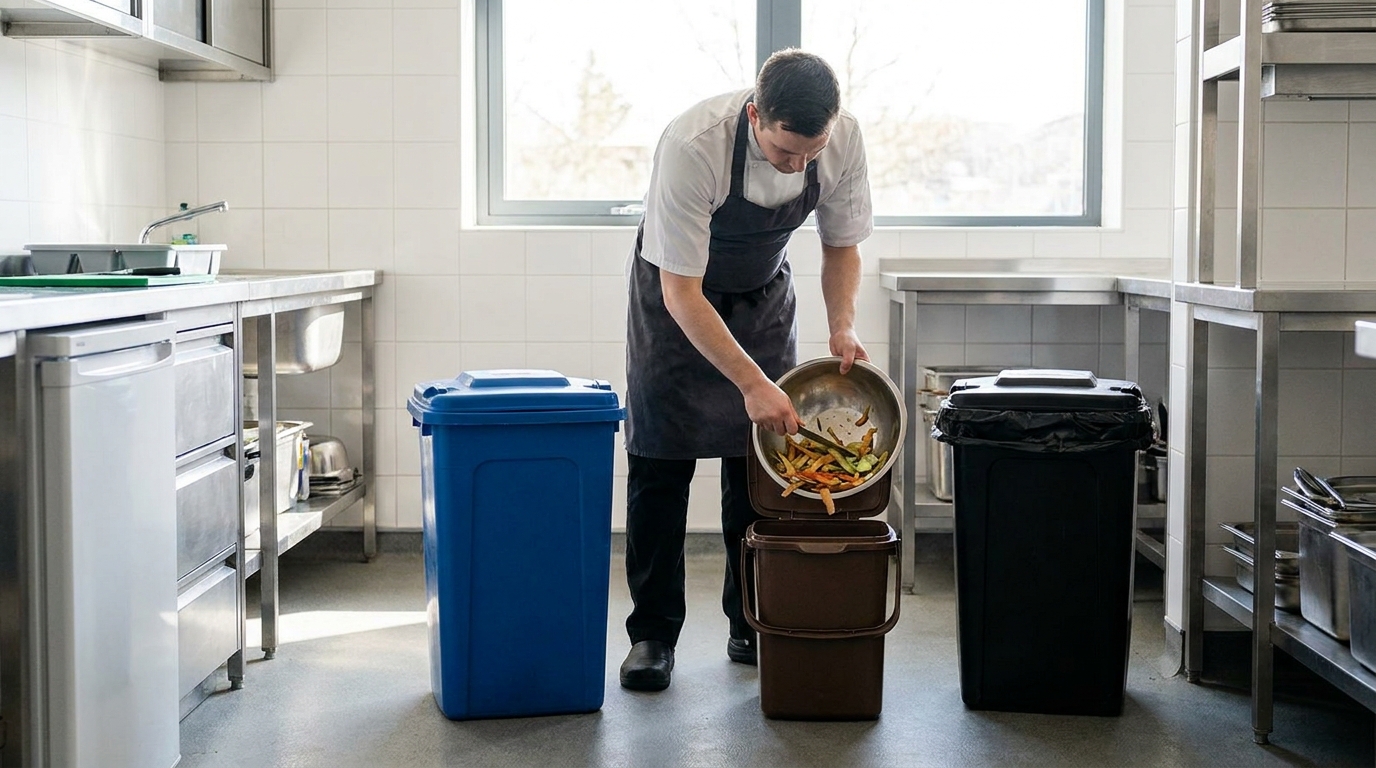
England’s food waste separation law is no longer a future change. Since 31 March 2025, most workplaces in England have had to separate food waste, dry recyclable waste and non-recyclable waste before collection (GOV.UK, Simpler recycling: workplace recycling in England). Micro-firms with fewer than 10 full-time equivalent employees have until 31 March 2027.
For food businesses, this is easy to misread as a bin-store issue. It is not. A cafe, restaurant, bakery, care home kitchen or takeaway now needs a system that tells staff what goes where, keeps food waste out of general waste, prevents contamination, controls pests and leaves a record trail under the wider waste duty of care. That record trail sits close to the same operational disciplines environmental health officers already care about: stock rotation, use-by dates, pest control, cleaning and proof that the business is managed consistently.
This guide explains who must comply, what counts as food waste, what records to keep, how enforcement works and how to turn the new rules into a food safety management process rather than another folder of paperwork.
The short version
| Question | Answer |
|---|---|
| What changed? | Workplaces in England must separate food waste, dry recyclables and non-recyclable waste before collection. |
| When did it start? | 31 March 2025 for most workplaces. |
| Who gets longer? | Micro-firms with fewer than 10 full-time equivalent employees have until 31 March 2027. |
| Does it apply to restaurants and cafes? | Yes. GOV.UK specifically lists hospitality, including cafes, restaurants, pubs, takeaways and hotels. |
| Is there a minimum food waste threshold? | No. The rule applies no matter how little food waste you produce. |
| Can food waste stay in general waste? | No, not if your business is in scope. It must be separated before collection. |
| Can compostable packaging go in food waste? | Usually no. GOV.UK says compostable or biodegradable packaging cannot be recycled with food waste unless you arrange a dedicated collection. |
| Who enforces it? | The Environment Agency can issue compliance notices where workplaces do not comply. |
| What records matter? | Waste transfer notes, registered waste carrier checks, collection schedules and staff instructions. |
Who must follow the rules?
The England rules apply to all businesses, charities and public sector organisations that produce workplace waste. GOV.UK lists the obvious food business categories: cafes, restaurants, pubs, takeaways, hotels, supermarkets, convenience stores, schools, hospitals, care homes, markets and temporary event venues. The list is not limited to traditional restaurants. If your workplace produces waste similar to household waste, you should assume the rules apply unless you have a specific exemption.
The main timing distinction is business size:
| Business size | Deadline |
|---|---|
| 10 or more full-time equivalent employees | Already in force since 31 March 2025 |
| Fewer than 10 full-time equivalent employees | Must comply by 31 March 2027 |
The micro-firm test is based on full-time equivalent employees, not simply the number of people on the rota. Part-time hours are converted into full-time equivalents, and the count is across the whole business, not each site in isolation. A group with three small cafes can therefore fall outside the micro-firm exemption even if each individual site has fewer than 10 people.
Volunteers, contractors and self-employed workers do not count toward the employee total in the GOV.UK guidance. But the practical point is simple: if you are close to the threshold, work it out carefully and document the decision. A business relying on the 2027 deadline should be able to explain why.
What must be separated?
Workplaces must keep three waste streams separate before collection:
- Dry recyclable waste: plastic, metal, glass, paper and card.
- Food waste: leftovers, food preparation waste and other food-derived material.
- Non-recyclable waste: residual waste that cannot go into the other streams.
Waste collectors have their own rules on whether certain dry recyclables can be collected together, but food waste must stay separate from dry recycling and residual waste. Do not build your process around a single “mixed waste” bin and hope the carrier sorts it later. The legal duty starts before collection.
What counts as food waste?
The legal definition is broad. For a food business, the practical categories look like this:
| Item | Food waste? | Notes |
|---|---|---|
| Plate scrapings and leftovers | Yes | Includes customer meals and staff meals. |
| Preparation waste | Yes | Onion skins, peelings, offcuts and similar kitchen prep waste. |
| Fruit skins and cores | Yes | Banana skins, apple cores and vegetable peelings are included in GOV.UK examples. |
| Coffee grounds and tea bags | Yes | Both are specifically named in the guidance. |
| Bones and eggshells | Yes | Treat as food waste unless your collector gives a different instruction. |
| Caddy liners | Yes | GOV.UK says caddy liners, including compostable liners, can be collected with food waste. |
| Small amounts of fats, oils and greases | Sometimes | Follow your collector’s instructions. Larger quantities should use a dedicated used cooking oil collection. Never pour cooking oil down the drain. |
| Compostable or biodegradable packaging | No | Treat it as non-recyclable waste or arrange a dedicated collection. |
| Heavily food-contaminated packaging | Usually no | If it cannot be recycled cleanly, it belongs in residual waste unless your collector accepts it separately. |
The part that catches food businesses out is the zero minimum threshold. England does not say “only if you produce 5kg a week”. GOV.UK says workplaces must collect food waste even if they do not serve food or have a kitchen, and even where the amount is small.
That matters for coffee shops, office canteens, small retail sites with staff rooms and mobile or event-based food operators. A business that produces only coffee grounds, staff lunch waste and a small amount of prep waste still needs a compliant answer.
What food businesses need to do in practice
The rules do not prescribe one exact bin layout. You can decide the size of containers and frequency of collection based on the waste you produce. What matters is that your system actually separates waste before collection and can be understood by staff, customers and waste contractors.
1. Map where food waste is produced
Start with the process, not the bins. Walk through a normal trading day and mark every point where food waste appears:
- goods-in rejections and damaged produce
- veg prep, meat prep and bakery trim
- date-expired stock
- buffet or hot-hold leftovers
- plate waste
- staff food
- coffee grounds and tea bags
- returns and customer complaints
Most kitchens discover that one kitchen caddy is not enough. Food waste is created at several points, and if the correct bin is too far away, staff will use the nearest general waste bin during a busy service.
2. Arrange separate collection with a registered carrier
GOV.UK says workplaces should arrange separate dry recycling, food waste and non-recyclable waste collections, using either a private company or local authority service. You must make sure the company is registered on the Environment Agency public register of waste carriers, brokers and dealers.
Keep the carrier’s registration number with your waste documents. This is not admin trivia. Under the wider waste duty of care, businesses must take reasonable steps to make sure their waste is handled safely, legally and by authorised people.
3. Choose bin locations that match behaviour
The best food waste bin is the one staff can reach without thinking. Put caddies or bins where waste actually arises:
- next to prep benches
- near pot wash
- near coffee stations
- in staff rooms
- near plate-scrape areas
- in bin stores for sealed external collection
For customer-facing waste, GOV.UK says waste from customers and visitors is covered too. Where customers clear their own trays, separate bins and clear signage matter because contamination is otherwise almost guaranteed.
4. Label the bins clearly
Signage is not just about looking tidy. It stops contamination, reduces staff uncertainty and gives you evidence that the business tried to implement the rules properly. WRAP’s Business of Recycling site provides sector guidance and free signage.
For food businesses, the signs should be more specific than “food”. A practical sign might say:
- Food waste: leftovers, plate scrapings, peelings, coffee grounds, tea bags.
- Not food waste: packaging, cling film, gloves, blue roll, foil trays, compostable cups unless collected separately.
If your waste carrier has a different acceptance list, use that. A sign that contradicts your collector’s rules will cause rejected collections.
5. Control odour, pests and bin hygiene
GOV.UK recommends weekly or fortnightly food waste collection and says it is not recommended to store food waste for more than two weeks. In a food business, the right frequency is often weekly or more often, because the food safety risk is not only legal separation. It is odour, flies, rodents, leaking bags and dirty bin areas.
This is where waste separation joins ordinary food hygiene. The Food Standards Agency’s guidance for starting a food business says food businesses must dispose of waste securely and properly, and its Safer Food Better Business materials include pest control, cleaning and management as part of food safety procedures (FSA, starting a food business, SFBB). Your food waste controls should therefore sit with your cleaning schedule and pest checks, not in a separate sustainability folder nobody opens.
At minimum:
- use lidded internal and external containers
- keep external bins closed
- clean caddies and bin areas on a defined schedule
- do not let food waste build up in prep areas
- keep bin stores away from open food and clean equipment
- record pest activity and corrective actions
For the food hygiene side of this, see our pest control guide and commercial kitchen cleaning schedule guide.
6. Keep waste transfer notes for two years
Every transfer of business waste needs a proper record. For non-hazardous waste, that is normally a waste transfer note or equivalent documentation. GOV.UK provides a waste transfer note template, and the duty of care code explains that anyone who produces or controls waste must keep it safe and pass it only to authorised operators.
For a food waste collection, your records should show:
- what waste was collected
- the quantity or container size
- when and where it was collected
- who collected it
- the carrier registration details
- where the waste is going, where available
- the correct waste description
Keep waste transfer notes for at least two years. If your carrier uses an annual “season ticket” waste transfer note for repeated collections, keep the annual note and the collection schedule or invoices that prove the individual lifts happened.
7. Train staff and review contamination
Staff training under these waste rules is practical, not academic. Every team member who handles waste should know:
- which bin food waste goes into
- what must not go into food waste
- what to do when a bin is contaminated
- where external bins are
- how often caddies are emptied
- who to tell if a collection is missed
Record the briefing. It can be a toolbox talk, induction item or short refresher in your staff training system. The point is to prove the business did more than buy a brown bin and hope.
What happens if you do not comply?
The Simpler Recycling separation requirements are enforced by the Environment Agency. GOV.UK says that if workplaces do not comply by the relevant deadline, they are at risk of a compliance notice from the Environment Agency.
The Environment Agency’s charging response says it has already been giving advice and guidance where there is suspected non-compliance. Once the charging scheme is in place, if advice is ignored, the EA can issue a compliance notice to the waste collector or producer and charge for regulatory time where non-compliance is found (Environment Agency charge proposals for Simpler Recycling).
Two points are worth separating:
- The workplace separation rule is about whether you separate food waste, dry recycling and residual waste before collection.
- The waste duty of care is the older, wider obligation to handle waste safely, store it securely, use authorised carriers and keep proper transfer records.
Many scary headlines mix household bin penalties, business waste offences and duty-of-care penalties into one number. Do not rely on that. The practical risk for a food business is simpler: if you cannot show a separate food waste collection, registered carrier and waste records, you are exposed on both the new separation duty and the older duty-of-care record trail.
How this connects to EHO inspections
An environmental health officer is not the main enforcer of the England workplace recycling rules. But waste still affects food hygiene inspections because poor waste management is a route into contamination, pests and weak management control.
Food waste is relevant to an EHO in at least four ways:
- Pest attraction. Food waste left open, overflowing or stored too long attracts flies and rodents.
- Cleaning standards. Dirty caddies, leaking sacks and bin-store residue are part of the hygiene picture.
- Stock control. Repeated waste from expired food points to poor FIFO, poor date labelling or over-ordering.
- Management evidence. A business that records waste reasons and corrective actions can show it notices problems and acts on them.
This is why the best food waste system is not just a collection contract. It is a loop:
- Separate waste correctly.
- Record what was wasted and why.
- Review the pattern.
- Fix the process that caused avoidable waste.
- Keep the evidence.
If food is being disposed of because of a fridge failure, for example, the waste record should tie back to the temperature log and the corrective action. If food is being thrown away because it passed its use-by date, it should tie back to stock rotation and date labelling. For more on those controls, see our guides to stock rotation and FIFO, use-by vs best-before dates and food temperature checks.
The cost case: separation is not just compliance
Food waste is expensive before it ever reaches the bin. WRAP says the UK hospitality and food service sector throws away 1.1 million tonnes of food each year, and that 75% of it could have been eaten, costing businesses and organisations GBP3.2 billion (WRAP, hospitality food waste press release).
The House of Commons Library briefing on food waste summarises WRAP data showing that, in hospitality and food service, 18% of food purchased is thrown away. It also breaks the source down as 45% preparation waste, 34% plate waste and 21% spoilage (House of Commons Library, Food waste in the UK).
Those numbers change how you should view the new law. Separate collection is the compliance baseline. Tracking why the waste happened is where the margin improvement is.
Preparation waste might mean over-trimming, poor yield or recipes that do not use the whole ingredient. Plate waste might mean portion sizes are wrong. Spoilage might mean poor ordering, weak stock rotation or date labels that are not visible until it is too late. A food waste bin tells you the waste exists. A waste log tells you where the money is leaking.
Our free kitchen waste log is a simple starting point if you still work on paper. Digital wastage tracking goes further by logging product, quantity, reason and cost in a searchable record, so waste can be reviewed by site, item or cause rather than guessed at from the bin store.
Food waste and digital waste tracking
The UK is also rolling out a mandatory digital waste tracking service. This is separate from the food waste separation duty, but it is part of the same direction of travel: less paper, better traceability and more visible waste movements.
The current GOV.UK timeline says:
| Date | Digital waste tracking milestone |
|---|---|
| 28 April 2026 | Public beta available for permitted and licensed waste receiving sites. |
| October 2026 | Mandatory for waste receiving site operators in England, Wales and Northern Ireland. |
| January 2027 | Mandatory for waste receiving site operators in Scotland. |
| Spring 2027 | Public beta planned for waste collectors. |
| October 2027 | Mandatory for waste collectors, carriers, brokers and dealers. |
For an ordinary cafe or restaurant, this does not mean you personally need to start using the service in October 2026 unless you operate a permitted waste receiving site. But it does mean the waste chain around you is becoming more digital. Carriers and receiving sites will increasingly expect cleaner data, clearer waste descriptions and better records from producers. Paper waste transfer notes are not the future.
A 30-day compliance checklist
Use this if you need to get your food waste system under control quickly.
Week 1: Confirm scope
- Work out whether the business is over or under 10 full-time equivalent employees.
- Check whether the count is across multiple sites.
- Confirm the relevant deadline: 31 March 2025 or 31 March 2027.
- Identify every site, kiosk, market stall or temporary venue that produces workplace waste.
Week 2: Set up collection
- Contact your current waste provider about separate food waste collection.
- Check the carrier registration on the Environment Agency public register.
- Ask what food waste they accept and what they reject.
- Agree container sizes and collection frequency.
- Store carrier details with your waste documents.
Week 3: Build the site process
- Put caddies where food waste is actually produced.
- Label food waste, recycling and residual bins clearly.
- Set a cleaning schedule for caddies and the bin store.
- Decide who empties internal caddies and when.
- Add missed collections, leaking bins and contamination to your issue process.
Week 4: Train and evidence
- Brief staff on what goes in each bin.
- Record the training.
- Start keeping waste transfer notes in one place.
- Start a simple food waste log by item, quantity and reason.
- Review the first week’s entries and fix the biggest avoidable cause.
The better way to think about it
The legal minimum is to separate food waste before collection. The operational win is to understand why that food became waste in the first place.
A compliant food business should be able to answer four questions:
- Where does our food waste go? Separate collection, registered carrier, clear waste stream.
- What did we throw away? Product or category, not just “one full bin”.
- Why did we throw it away? Spoilage, overproduction, prep waste, plate waste, date expiry, temperature breach.
- What changed because of it? Smaller prep batch, supplier issue raised, fridge repaired, portion size adjusted, stock process fixed.
That is the difference between a bin system and a management system. The new law forces the first. Good operators use it to build the second.
Frequently asked questions
Do restaurants in England need a separate food waste bin?
Yes, unless the business is still covered by the temporary micro-firm exemption. Workplaces in England must separate food waste from dry recycling and non-recyclable waste before collection. Micro-firms with fewer than 10 full-time equivalent employees have until 31 March 2027.
Is there a minimum amount of food waste before the law applies?
No. GOV.UK guidance says workplaces must collect food waste no matter how little they produce, even if they do not serve food or have a kitchen.
What counts as food waste under the rules?
Food leftovers, plate scrapings, preparation waste, fruit and vegetable peelings, coffee grounds and tea bags all count. Caddy liners can go with food waste, but compostable packaging cannot normally be recycled with food waste unless you arrange a dedicated collection.
Who enforces the food waste separation rules in England?
The Environment Agency enforces the Simpler Recycling separation requirements. Food hygiene officers may still look at waste storage, pest control and food safety records during hygiene inspections, but the separation regime itself is enforced by the Environment Agency.
How long should food waste records be kept?
Waste transfer notes and equivalent duty-of-care records should be kept for at least two years. You must also check that your waste carrier is registered to take the waste.
Do micro-businesses need to do anything before 31 March 2027?
Micro-firms have a later legal deadline, but they should still prepare early: check their full-time equivalent employee count across the whole business, speak to their waste carrier, choose bin locations and start training staff before the exemption ends.
Related Forkto software
Frequently asked questions
Do restaurants in England need a separate food waste bin?
Yes, unless the business is still covered by the temporary micro-firm exemption. Workplaces in England must separate food waste from dry recycling and non-recyclable waste before collection. Micro-firms with fewer than 10 full-time equivalent employees have until 31 March 2027.
Is there a minimum amount of food waste before the law applies?
No. GOV.UK guidance says workplaces must collect food waste no matter how little they produce, even if they do not serve food or have a kitchen.
What counts as food waste under the rules?
Food leftovers, plate scrapings, preparation waste, fruit and vegetable peelings, coffee grounds and tea bags all count. Caddy liners can go with food waste, but compostable packaging cannot normally be recycled with food waste unless you arrange a dedicated collection.
Who enforces the food waste separation rules in England?
The Environment Agency enforces the Simpler Recycling separation requirements. Food hygiene officers may still look at waste storage, pest control and food safety records during hygiene inspections, but the separation regime itself is enforced by the Environment Agency.
How long should food waste records be kept?
Waste transfer notes and equivalent duty-of-care records should be kept for at least two years. You must also check that your waste carrier is registered to take the waste.
Do micro-businesses need to do anything before 31 March 2027?
Micro-firms have a later legal deadline, but they should still prepare early: check their full-time equivalent employee count across the whole business, speak to their waste carrier, choose bin locations and start training staff before the exemption ends.
Safe hands, clear records
Stop running food safety on paper
Forkto turns daily checks, temperature logs, HACCP and audits into a few taps on a phone. Your team stays consistent and you're always ready for the EHO.
14-day free trial · No card required