Food safety guide
Use By vs Best Before: The UK Difference Explained
Use by is about safety; best before is about quality. Learn the legal difference, freezing rules and how UK kitchens should manage each date.
17 July 2026
The difference is simple and safety-critical: a use-by date is about safety and a best before date is about quality. You must never eat, sell or use food after its use-by date — even if it looks and smells perfectly fine — because harmful bacteria may have grown that you cannot see, taste or smell. Food past its best before date is a different matter: it is usually still safe to eat, it just may not be at its best (FSA, Best before and use-by dates).
For a food business that distinction is not academic. One date is a hard legal line you can be prosecuted for crossing; the other is a quality judgement you are allowed to make. This guide explains exactly what each date means in law, whether food is safe after it, the freezing rule, the egg nuance, and how to run date checks in a kitchen so nothing slips past the line that matters.
Use by vs best before at a glance
| Use by | Best before | |
|---|---|---|
| What it’s about | Safety | Quality |
| Can a business sell/use food after it? | No — criminal offence | Yes, if still safe and of expected quality |
| Can you eat food after it? | No | Usually yes, use judgement |
| Typical foods | Raw meat, fish, dairy, cooked/ready-to-eat chilled food, prepared meals | Tinned, dried, frozen and ambient foods |
| What to watch | The date passing — bin it | Deterioration in flavour, texture or appearance |
The single most important thing to take from this table: you cannot judge a use-by date by looking, smelling or tasting. The whole point of a use-by date is that unsafe food can look completely normal.
Use-by dates: the legal safety cut-off
A use-by date marks the point beyond which a food is no longer safe to eat. It appears on perishable, higher-risk foods — raw meat and fish, dairy, cooked and ready-to-eat chilled products, prepared meals — where dangerous bacteria such as Listeria can grow to harmful levels without any visible change to the food.
For a food business, the use-by date is a hard legal limit. It is a criminal offence to sell or use food after its use-by date, and there is no “it seemed fine” defence — the offence stands regardless of the food’s apparent condition (Food Safety Act 1990; FSA). When a use-by date passes, the food must be discarded. Full stop.
Two practical points kitchens get wrong:
- Storage instructions are part of the date. A use-by date only holds if the food has been kept as the label says — typically chilled. Leave a use-by product out of temperature control and the date is no longer reliable, even before it is reached.
- Opening changes everything. The printed use-by date assumes an unopened pack. Once opened, the safe life usually shortens sharply. Follow any “use within X days of opening” instruction and apply your own internal label — a container of cream dated Thursday is not safe until Thursday once it has been opened, portioned and returned to the fridge.
Best before dates: quality, not safety
A best before date (sometimes shown as “best before end” or BBE) marks the point beyond which a food may start to lose quality — flavour, texture, appearance — rather than become unsafe. It appears on lower-risk, longer-life foods: tinned goods, dried pasta and pulses, frozen items, biscuits and many ambient products.
Can you eat food past its best before date? Usually, yes. After the best before date the food is generally still safe to eat if it has been stored properly; it may simply not be at its peak. For a food business it is not illegal to sell food past its best before date, provided the food is still safe and of the quality customers would reasonably expect.
There is a caveat. “Not illegal” does not mean “no responsibility”. If a best-before product has genuinely deteriorated — a rusty tin, rancid oil, mouldy bread — using it is a food safety problem regardless of what the label says. And a storeroom full of long-expired best before stock is a clear signal to an Environmental Health Officer that your rotation is weak.
The freezing rule
Freezing is the one move that legitimately extends the life of a use-by product — and it is widely misunderstood. The rule the FSA sets out is straightforward:
- You can freeze food right up to and including the use-by date. Freezing effectively pauses the clock while the food is frozen.
- Once you defrost it, treat it as ready to use and eat it within 24 hours (FSA).
- Do not refreeze raw food that has been thawed. You can refreeze cooked food once, if it was cooled quickly after cooking.
For a kitchen, this means the freezer is a valid tool for cutting waste — but only if freezing and defrosting are labelled and dated. Product frozen on its use-by date and product frozen weeks earlier are not interchangeable, and an unlabelled freezer is one of the first places an EHO loses confidence in your system.
The egg nuance
Eggs are the classic exception people cite, so it is worth being precise. In the UK, boxed eggs carry a best before date, not a use-by date — typically around 28 days from laying. That reflects quality, but with eggs the safety dimension does not disappear at the date: the Salmonella risk rises as eggs age, so eggs are best used well within their best before date, cooked thoroughly for vulnerable groups, and stored chilled and consistently. British Lion eggs are vaccinated against Salmonella, which is why FSA advice on runny and raw egg dishes is more relaxed for them. The takeaway for a kitchen: treat eggs as a best-before product for the label, but manage them with use-by discipline in practice.
How to run date checks in a kitchen
Understanding the two dates is one thing; making sure nothing crosses the use-by line across every shift is another. A reliable system rests on a few habits:
- Check dates at delivery. Refuse short-dated stock you cannot realistically use in time — accepting it just imports a problem. This is where date control starts. See goods-in delivery checks.
- Run FIFO — First-In, First-Out. New stock goes behind old in every fridge, freezer and dry store, so the oldest is always used first and nothing reaches its use-by date at the back of a shelf. Our FIFO stock rotation guide covers the full system.
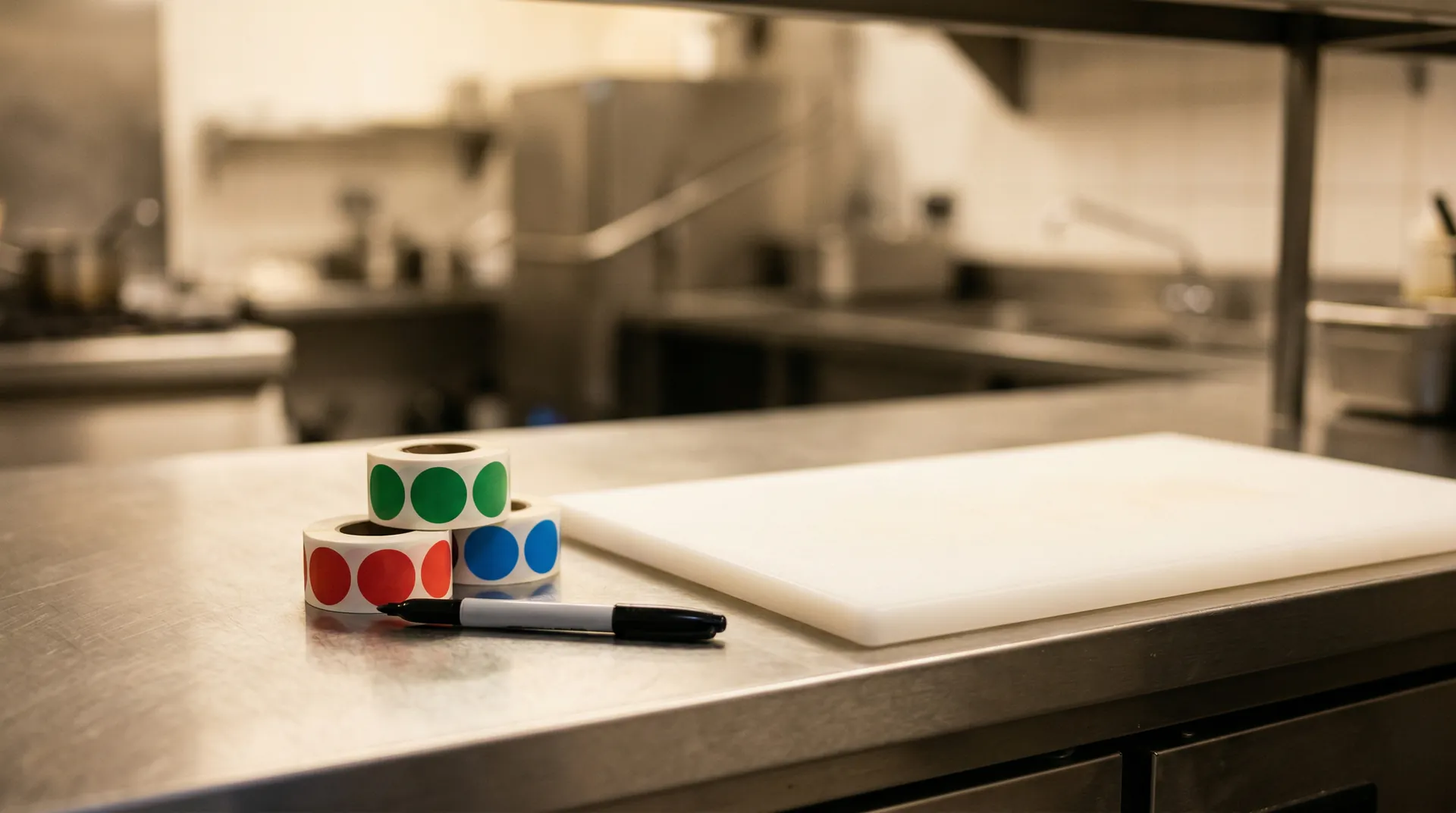
- Use day dots and internal labels. The moment food is opened, decanted, cooked or prepared, the manufacturer’s date no longer applies — you apply your own, showing what it is, when it was prepared, and a new use-by date from your HACCP plan. Our date labelling guide goes deeper on getting this right.
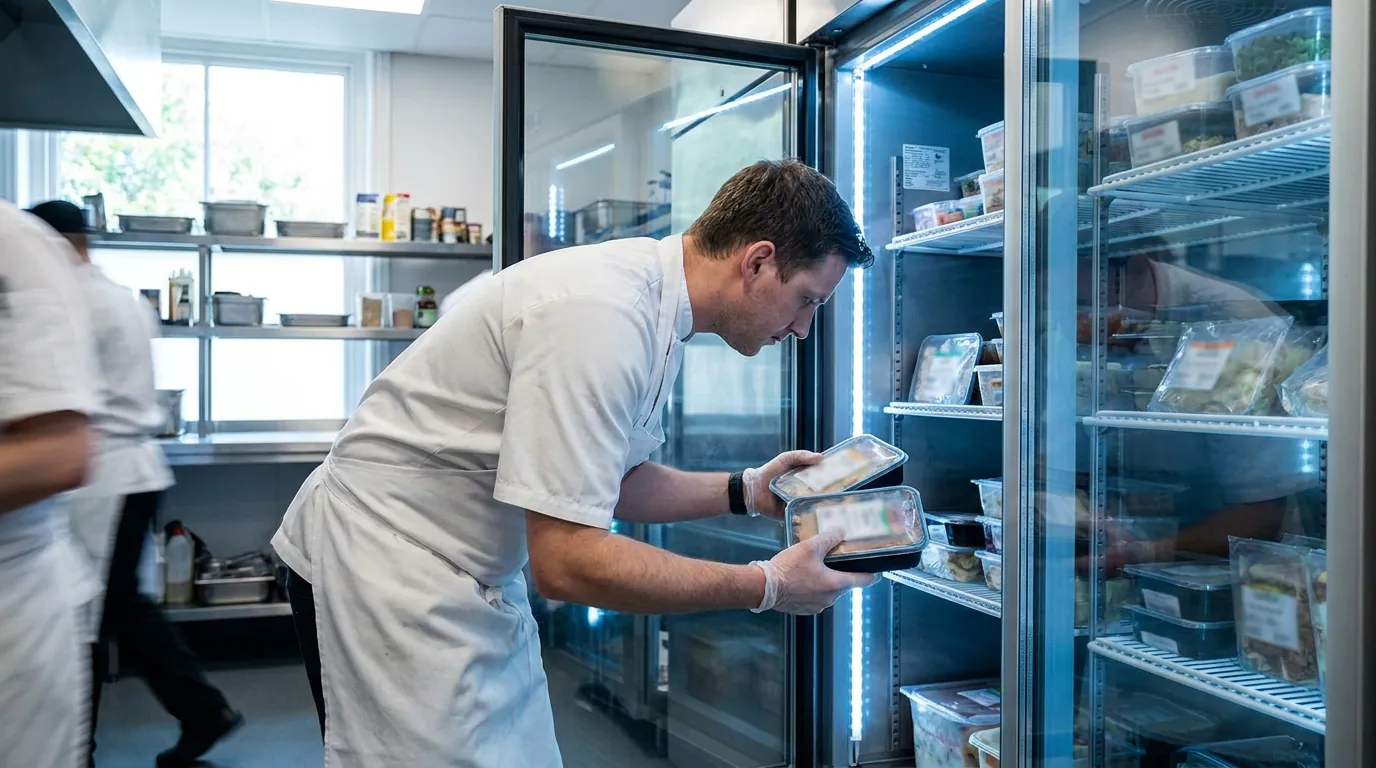
- Sweep at opening. Build a check of fridge and freezer dates into your opening routine, so anything at or past its use-by date is caught and removed before service — not discovered mid-shift.
What an EHO looks for on dates
During an inspection an Environmental Health Officer will open your fridges, freezers and dry stores and look, specifically, for anything past its use-by date — the fastest way to demonstrate a live food safety failure. They will also check that opened, decanted and prepared items carry clear internal labels with a use-by date, that a rotation system like FIFO is genuinely being followed, and that staff can explain how it all works.
Out-of-date food in storage is not a paperwork slip; it feeds directly into your hygiene score and the inspector’s confidence in management, both of which shape your Food Hygiene Rating. One in-date, well-labelled walk-in tells a very different story from a shelf of ambiguous “Tuesday” labels.
The waste angle: best before is an opportunity, not a bin
Here is where the two dates diverge commercially. Because best before is about quality, food that has just passed it is very often perfectly usable — which makes it a waste-reduction and cost opportunity, not automatic bin fodder. Ambient and dried stock a little past best before can frequently still be used safely or donated to redistribution charities, whereas use-by food cannot be donated or used at all once the date passes.
The practical discipline is to separate the two mentally: use-by food is a hard stop; best before food is a judgement call you should make deliberately rather than by default. Tracking what you throw away — and why — tells you whether you are over-ordering, rotating poorly, or binning best-before stock that could have been used. Digital wastage tracking turns those disposals into a pattern you can act on, and stock management surfaces what is coming up to date before it is lost.
The bottom line
Get one thing right and the rest follows: use by is a safety deadline you cannot cross; best before is a quality guide you can. Treat use-by dates as hard limits, label everything you open or prepare with your own date, run FIFO so nothing hides past its use-by date, and make a deliberate call on best-before stock rather than throwing it out by reflex. A digital labelling system keeps every internal date accurate and legible — so the line that matters is never crossed by accident, and the food that is still good never ends up in the bin.
Frequently asked questions
What is the difference between use by and best before?
A use-by date is about safety — food should not be eaten, sold or used after it, even if it looks and smells fine, because harmful bacteria may have grown. A best before date is about quality — after it the food is usually still safe to eat but may have lost flavour, texture or appearance. Use by is a hard legal limit; best before is a guide.
Can you eat food past its best before date?
Usually, yes. Best before is a quality date, not a safety one, so food is generally still safe to eat afterwards if it has been stored correctly — though it may not be at its best. Use your judgement with dried, tinned and frozen foods. You must never do the same with a use-by date.
Is it illegal to sell food past its use-by date?
Yes. It is a criminal offence for a food business to sell or use food after its use-by date, even if the food appears perfectly fine. Selling food past its best before date is not illegal, provided the food is still safe and of the quality expected.
Can you freeze food on its use-by date?
Yes. You can freeze food right up to and including the use-by date. Freezing pauses the clock. Once defrosted, treat it as ready to use and eat it within 24 hours — do not refreeze raw food that has been thawed.
What does a use-by date apply to?
Use-by dates appear on higher-risk, perishable foods — raw meat and fish, dairy, cooked and ready-to-eat chilled products, prepared meals. Best before dates appear on lower-risk, longer-life foods such as tinned, dried, frozen and ambient goods.
Does the use-by date still apply once a product is opened?
No — opening usually shortens the safe life. The printed use-by date assumes the pack is unopened. Once opened, follow any “use within X days of opening” instruction, and apply your own internal label with a new, shorter use-by date based on your HACCP plan.
Related Forkto software
Frequently asked questions
What is the difference between use by and best before?
A use-by date is about safety — food should not be eaten, sold or used after it, even if it looks and smells fine, because harmful bacteria may have grown. A best before date is about quality — after it the food is usually still safe to eat but may have lost flavour, texture or appearance. Use by is a hard legal limit; best before is a guide.
Can you eat food past its best before date?
Usually, yes. Best before is a quality date, not a safety one, so food is generally still safe to eat afterwards if it has been stored correctly — though it may not be at its best. Use your judgement with dried, tinned and frozen foods. You must never do the same with a use-by date.
Is it illegal to sell food past its use-by date?
Yes. It is a criminal offence for a food business to sell or use food after its use-by date, even if the food appears perfectly fine. Selling food past its best before date is not illegal, provided the food is still safe and of the quality expected.
Can you freeze food on its use-by date?
Yes. You can freeze food right up to and including the use-by date. Freezing pauses the clock. Once defrosted, treat it as ready to use and eat it within 24 hours — do not refreeze raw food that has been thawed.
What does a use-by date apply to?
Use-by dates appear on higher-risk, perishable foods — raw meat and fish, dairy, cooked and ready-to-eat chilled products, prepared meals. Best before dates appear on lower-risk, longer-life foods such as tinned, dried, frozen and ambient goods.
Does the use-by date still apply once a product is opened?
No — opening usually shortens the safe life. The printed use-by date assumes the pack is unopened. Once opened, follow any 'use within X days of opening' instruction, and apply your own internal label with a new, shorter use-by date based on your HACCP plan.
Safe hands, clear records
Stop running food safety on paper
Forkto turns daily checks, temperature logs, HACCP and audits into a few taps on a phone. Your team stays consistent and you're always ready for the EHO.
14-day free trial · No card required