HACCP Plan Template
A free printable HACCP plan template for UK food businesses. A blank hazard analysis chart to work through your process, controls, critical limits and monitoring, step by step.
Download resource
Download PDFEvery food business in the UK is legally required to have permanent procedures based on HACCP principles — but “HACCP” can feel like a wall of jargon when you just need to write your plan down. This free, printable HACCP plan template turns the seven principles into a single working chart. You fill in each step of your process, the hazards, your controls and critical limits, and how you monitor and correct them, and the result is the documented backbone of your food safety management system.
Why a HACCP Plan Matters
Under Regulation (EC) 852/2004 Article 5, retained in UK law, food business operators must put in place and maintain permanent procedures based on HACCP principles. It is not optional, and “we know what we’re doing” is not a plan an inspector can assess. A written plan is what makes your thinking visible: it shows an Environmental Health Officer that you have identified where your process can go wrong and decided, in advance, how you keep it safe.
Beyond compliance, the exercise of writing the plan is where the value sits. Walking your process from delivery to service and asking “what could go wrong here?” at each step routinely surfaces gaps nobody had noticed — the reheat that was never timed, the delivery temperature nobody checks. A HACCP plan that reflects your real kitchen, kept up to date, is also central evidence in a due diligence defence should anything ever go wrong.
For the full method, work through our long-form guide on how to write a HACCP plan.
What the Template Tracks
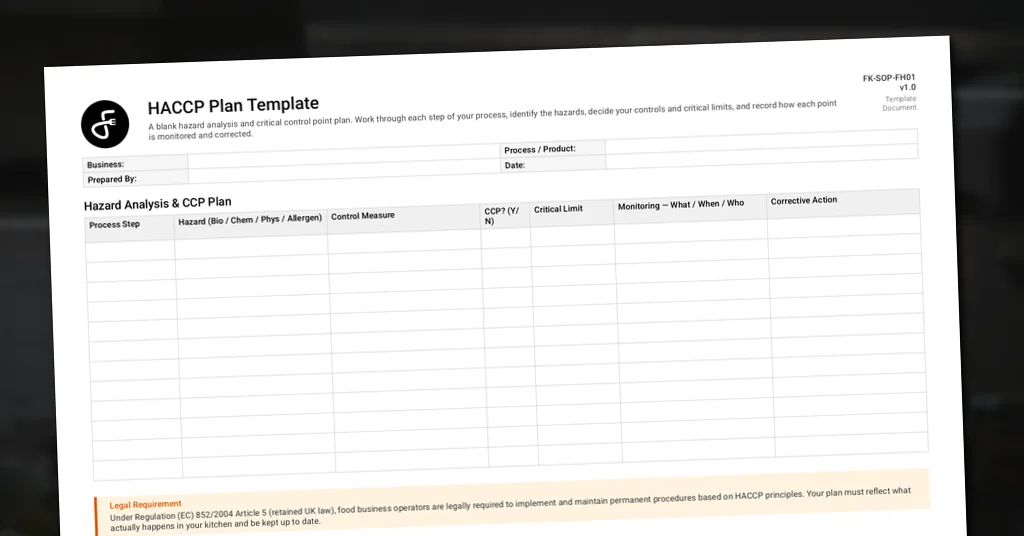
The core of the template is a landscape hazard-analysis chart with a header block for the business, the process or product, who prepared it and the date. Each of its rows works across seven columns:
- Process Step — a stage of your process, from delivery through to service
- Hazard — what could go wrong, categorised as biological, chemical, physical or allergen
- Control Measure — how you prevent, eliminate or reduce that hazard
- CCP? — whether this step is a critical control point
- Critical Limit — the measurable value that keeps it safe, such as 75°C core or 8°C maximum chilled storage
- Monitoring — what is checked, how often, and by whom
- Corrective Action — what happens if the critical limit is breached
Beneath the chart, the template sets out the seven HACCP principles in order, a verification and review notes section, and a sign-off, so the finished document is a complete, controlled record rather than a loose worksheet.
How to Use It
-
Map your process first. List every step your food passes through, from goods-in to service. The chart is only as good as the process it describes, so be specific to your kitchen.
-
Identify the hazards at each step. For every step, ask what biological, chemical, physical or allergen hazard could arise. Our hazard analysis guide walks through how to spot them.
-
Decide your controls and find the CCPs. A critical control point is a step where control is essential to keep food safe — typically cooking, chilling or hot holding. Mark these clearly; they are where monitoring matters most.
-
Set measurable critical limits. Give each CCP a number you can check, such as a 75°C core cooking temperature or an 8°C chilled-storage maximum. “Cooked properly” is not a critical limit; “75°C core” is.
-
Define monitoring and corrective action. State what is checked, when and by whom, and exactly what happens when a limit is breached — continue cooking, discard, or adjust the equipment.
-
Verify, review and re-date. Check your records against what actually happens, and update the plan whenever your menu, equipment or process changes. A HACCP plan is a living document, not a one-off.
Part of a Complete Food Safety System
The plan is the top layer of your food safety management system; your daily records are the proof it runs. Build on it with:
- How to write a HACCP plan — the full step-by-step method behind this template
- What is HACCP? Complete guide — the principles, the law and the due-diligence context
- Hazard analysis 101 — how to identify the risks that feed into your plan
If maintaining a HACCP plan and its daily records on paper feels like more than it should be, Forkto’s HACCP software keeps your plan, monitoring and corrective actions in one connected, always-current system, with the daily food records that prove it works ready for inspection at any moment.
Frequently asked questions
What is a HACCP plan?
A HACCP plan is a written food safety plan built on the seven HACCP principles. You work through each step of your process, identify the hazards, decide the controls and critical limits, and set out how each critical point is monitored and corrected. It is the documented core of your food safety management system.
Is a HACCP plan a legal requirement in the UK?
Yes. Regulation (EC) 852/2004 Article 5, retained in UK law, requires food business operators to put in place and maintain permanent procedures based on HACCP principles. Small businesses can use a simplified approach such as Safer Food Better Business, but the underlying HACCP logic still applies.
What are the seven principles of HACCP?
Conduct a hazard analysis; determine the critical control points; establish critical limits; establish monitoring; establish corrective actions; verify the system works; and keep documentation. This template is laid out to work through all seven in order.
What is a critical control point?
A critical control point (CCP) is a step in your process where control is essential to prevent, eliminate or reduce a food safety hazard to a safe level — for example cooking, chilling, or a metal-detection step. At each CCP you set a measurable critical limit, such as 75°C core temperature, and monitor it.
Tired of paper checklists?
Run this checklist digitally with Forkto
Assign checks to staff, get reminders, capture photos and timestamps, and keep a tamper-proof record for the EHO — no more lost paper or missed checks.
14-day free trial · No card required