Food safety guide
How Often Should You Clean a Commercial Kitchen? (UK Cleaning Schedule)
How often should you clean a commercial kitchen? UK law, the FSA two-stage method, and a daily, weekly and deep-clean schedule for compliant kitchens.
24 June 2026
We work with UK food businesses every day, and “how often should we clean?” is one of the questions that comes up most — usually a few days before an inspection. The honest answer is that UK law never hands you a single number. It sets a standard, and it leaves the frequency to you.
Key facts
- UK law sets no single cleaning frequency. Regulation (EC) 852/2004 requires food premises to be “kept clean and maintained in good repair and condition”, and food-contact equipment to be “effectively cleaned and, where necessary, disinfected”.
- In practice that means four layers: clean as you go, clean and disinfect contact surfaces between tasks (especially after raw food), a daily / every-shift kitchen clean, and weekly or periodic deep cleans.
- The frequency for each item is your risk-based decision, written into a cleaning schedule and backed by records — because Article 5 of 852/2004 requires documented, HACCP-based procedures.
- Cleaning is one of the FSA’s ‘4 Cs’ of food hygiene (cross-contamination, cleaning, chilling and cooking), and the method is always two stages: clean, then disinfect.
How often should you clean a commercial kitchen?
There is no single legal frequency. UK law requires your premises to be kept clean and your food-contact equipment to be effectively cleaned and disinfected often enough to avoid contamination — but it deliberately stops short of a fixed timetable. In a working kitchen that translates into four overlapping layers of cleaning:
- Clean as you go — deal with spills, clutter and used equipment continuously, and wash work surfaces between tasks.
- Between tasks — clean and disinfect food-contact surfaces and equipment between different jobs, especially after raw food.
- Daily / every shift — a structured clean-down of surfaces, equipment, sinks, floors and high-touch points.
- Weekly and periodic deep cleans — fridges, freezers, storage, and longer-cycle items such as ovens and extraction.
Everything below explains what the law actually says, the method the FSA expects, and how to turn it into a schedule an inspector will be happy with. If you want the room-by-room version, our complete guide to FOH and BOH cleaning schedules for restaurants is the companion piece to this article.
What does UK law actually say about cleaning frequency?
Regulation (EC) 852/2004 — ‘kept clean’ and ‘effectively cleaned’
The core legal duty sits in Regulation (EC) No 852/2004, Annex II. Three points matter:
- Chapter I, point 1 — food premises must be “kept clean and maintained in good repair and condition”. This sets the standard (“clean”) without prescribing how often.
- Chapter V, point 1(a) — all articles, fittings and equipment that food comes into contact with must be “effectively cleaned and, where necessary, disinfected” frequently enough to avoid any risk of contamination.
- Chapter II, point 1(f) — surfaces in food-handling areas, particularly food-contact surfaces, must be kept in sound condition and be easy to clean and, where necessary, to disinfect.
Notice the wording: “kept clean”, “effectively cleaned”, “frequently enough”. The law describes an outcome, not a schedule.
Why there’s no fixed legal timetable
The reason the law gives no timetable is that it pushes the decision onto you. Under Article 5 of Regulation 852/2004, food business operators must put in place, implement and maintain permanent procedures based on HACCP principles, and keep documents and records — proportionate to the business — demonstrating that those measures work.
In plain terms: you decide how often each item is cleaned, based on the risk it carries, and you write that decision down. A high-risk raw-meat board is cleaned and disinfected after every use; a storeroom shelf is on a much longer cycle. Both are legitimate, provided your reasoning is documented and your records show it actually happens. That is why a written, risk-based cleaning schedule and completed cleaning records are expected — not because a regulation names a frequency, but because Article 5 requires you to demonstrate your system.
The FSA two-stage clean and disinfect method (and why it’s two stages)
Frequency is only half the picture. How you clean matters just as much, and the FSA is specific about the two-stage method.
Stage 1: clean. Stage 2: disinfect
- Clean — use hot soapy water or a cleaning product to remove visible dirt, grease and debris, then wipe or rinse it off.
- Disinfect — apply a disinfectant or sanitiser to the now visibly clean surface and leave it for the required contact time before wiping or rinsing.
The order is not optional. As the FSA explains, detergents clean and remove grease but do not kill bacteria and viruses; disinfectants kill bacteria and viruses but only work on a visibly clean surface — they do not work if it is covered in grease or dirt. Spraying sanitiser onto a greasy bench achieves very little.
Detergent vs disinfectant vs sanitiser — and the British Standard
A detergent cleans, a disinfectant kills microorganisms, and a sanitiser does both in one product. Whichever you use, the disinfectants and sanitisers in a food business should meet British Standard BS EN 1276 or BS EN 13697. Check the label — a reputable food-grade product will state which standard it meets.
Rinsing and following dilution and contact times
Two details catch people out. First, after disinfecting, food-contact surfaces should be washed down with water to prevent chemical contamination of food. Second, you must follow the manufacturer’s dilution rate and contact time for the product to work — a sanitiser wiped off after two seconds when it needs five minutes has done nothing. These details belong on your cleaning schedule against each product.
Commercial kitchen cleaning frequency breakdown (the schedule)
Here is how the four layers translate into a working timetable. Treat the cadences below as a sensible default — the actual frequency for each item is yours to set by risk, and the FSA’s example schedule shows it varies by item: after use, every shift, daily, weekly or other.
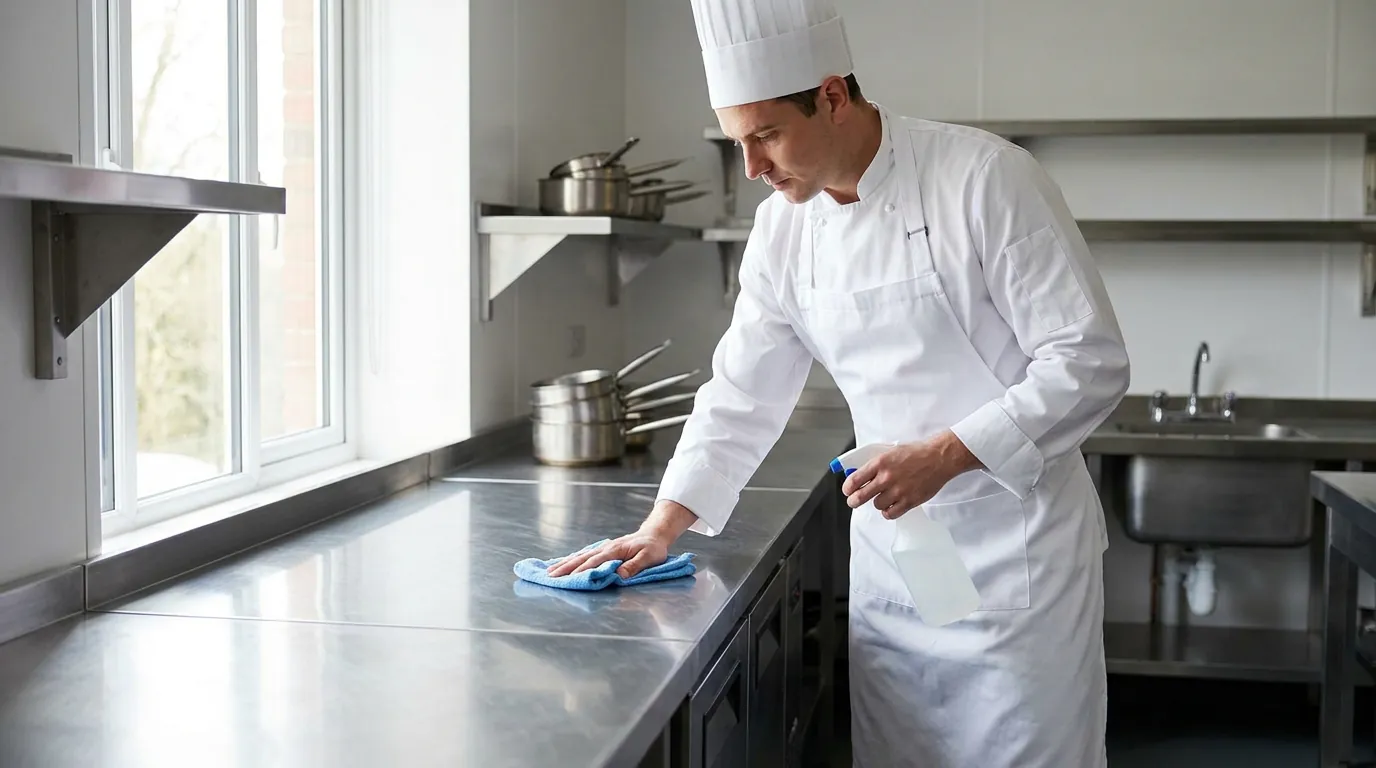
Clean as you go — spills, clutter and between every task
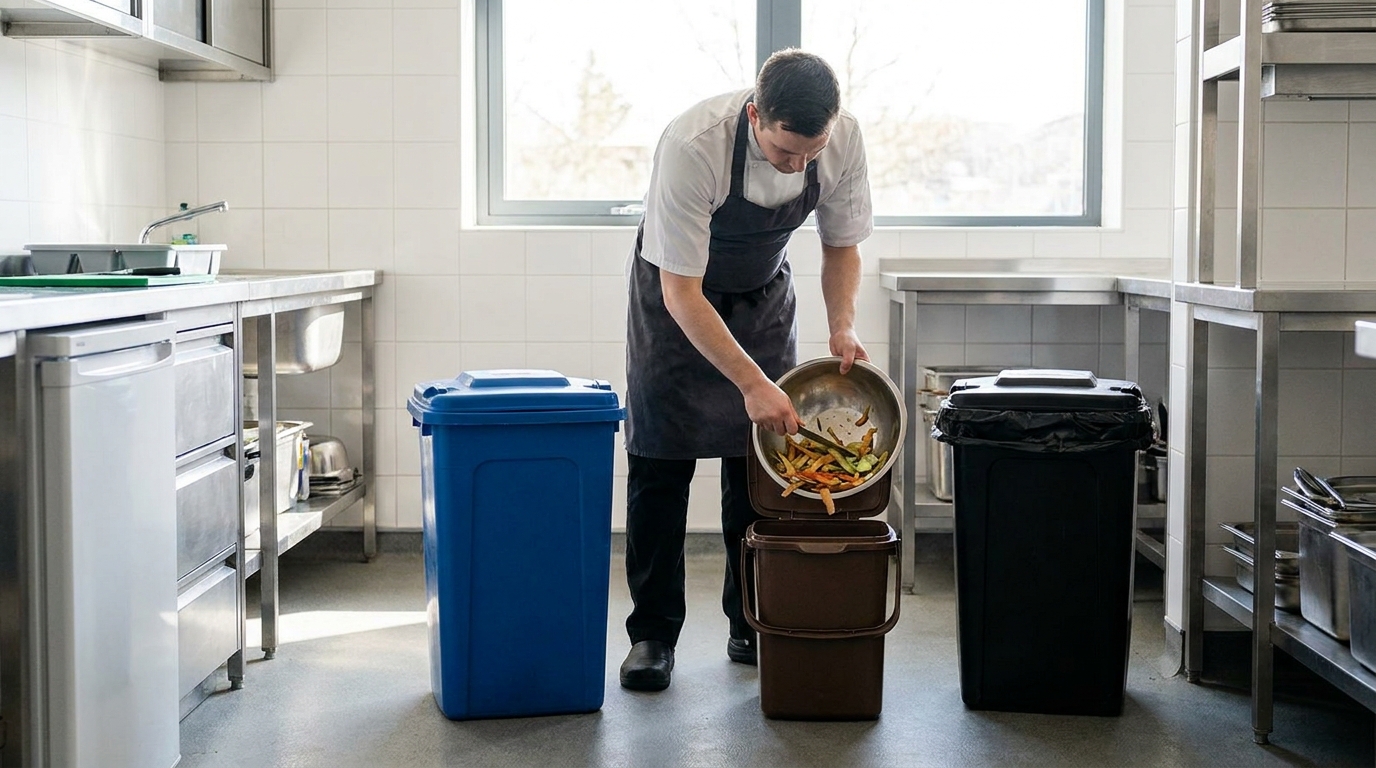
“Clear and clean as you go” is continuous, not a job at the end of service. It means washing or wiping spills as soon as they happen, clearing away clutter and used equipment, and washing work surfaces thoroughly between tasks — using a new or freshly disinfected cloth before preparing ready-to-eat food. It also means food waste: it should be stored in a specific place away from food preparation before collection, and that area cleaned and disinfected regularly.
Daily / every shift — surfaces, equipment, sinks, floors, high-touch points
A structured end-of-shift or daily clean covers work surfaces, chopping boards, the equipment in use, sinks, floors and frequently touched points. The FSA’s Safer Food Better Business example schedule shows work surfaces and chopping boards cleaned and disinfected “after use” — so for contact surfaces, “daily” really means “between tasks and at the end of each shift”, not once at close. This is the layer most kitchens think of as “the clean”, and it is the one a front-of-house cleaning schedule and a back-of-house cleaning schedule are built around.
Weekly — fridges, freezers, storage and behind equipment
Some items are lower-frequency but easy to forget. The SFBB example schedule shows fridges cleaned weekly, and the same weekly-ish rhythm suits freezers, dry and chilled storage, and the spaces behind and under equipment where debris collects out of sight.
Monthly and periodic — the deep clean
Longer-cycle items make up the deep clean: extraction canopies and ducting, walls and ceilings, drains, and specialist equipment. There is no legal monthly rule — the interval is set by your risk assessment and how heavily the item is used. Grease-laden extraction in a busy fry kitchen needs attention far sooner than the same canopy over a sandwich bench. Put these on a recurring cycle so they never slip; our weekly deep-clean checklist is a starting framework you can stretch to monthly or quarterly per item.
Contact surfaces and equipment — clean and disinfect between raw and ready-to-eat
The highest-risk moment in any kitchen is the switch from raw to ready-to-eat. The FSA is explicit: clean and disinfect food areas and equipment between different tasks, especially after handling raw food, to prevent cross-contamination.
Complex equipment and the raw / ready-to-eat rule
Some equipment cannot be made safe by cleaning between uses within a single day. The FSA’s E. coli cross-contamination guidance states that complex equipment such as vacuum packing machines, slicers and mincers should not be used for both raw and ready-to-eat food during a normal business day, because the cross-contamination risk is too high. The practical answer is dedicated equipment, or strict time separation with a full strip-down clean.
Cloths — disposable vs reusable
Cloths move bacteria around a kitchen if you let them. The FSA’s guidance is that reusable cloths should be washed, disinfected and dried between tasks — ideally machine-washed on a very hot cycle (for example 90°C) — disposable cloths thrown away after each task, and bleach is not a suitable disinfectant for cloths. A fresh or freshly disinfected cloth before any ready-to-eat work is the rule.
How to build a compliant cleaning schedule (what / how / with what / how often / who)
A cleaning schedule is the document that turns “kept clean” into something an inspector can check. The FSA cleaning schedule template records, for each item: how you clean it, what chemicals and equipment you use and how (including dilution rate and contact time), and how often you clean it. Add who is responsible and you have a complete, workable schedule.
What to disinfect vs just clean
You do not need to disinfect everything. The FSA advises concentrating disinfection on items that come into contact with food and on frequently touched items — door and appliance handles, taps, switches and probe thermometers. Floors and walls, for instance, generally need cleaning rather than the full two-stage treatment, which keeps your schedule focused on the points that actually carry risk.
Recording, training staff and supervising cleaning
A schedule on a shelf changes nothing. The FSA recommends putting your cleaning schedule on the wall, training staff on it so they know what to clean and when, and supervising cleaning. Completed records are the proof: under Article 5 you need to be able to show not just the plan but that the cleaning happened. Many kitchens now capture those sign-offs with digital daily checks so the record is time-stamped and attributed to a person, rather than a paper sheet ticked in a batch at the end of the week. Whether you go digital or stay on paper, the principle is the same — the record should reflect what actually happened, when.
How an EHO checks your cleaning at inspection (and the FHRS 0–5 rating)
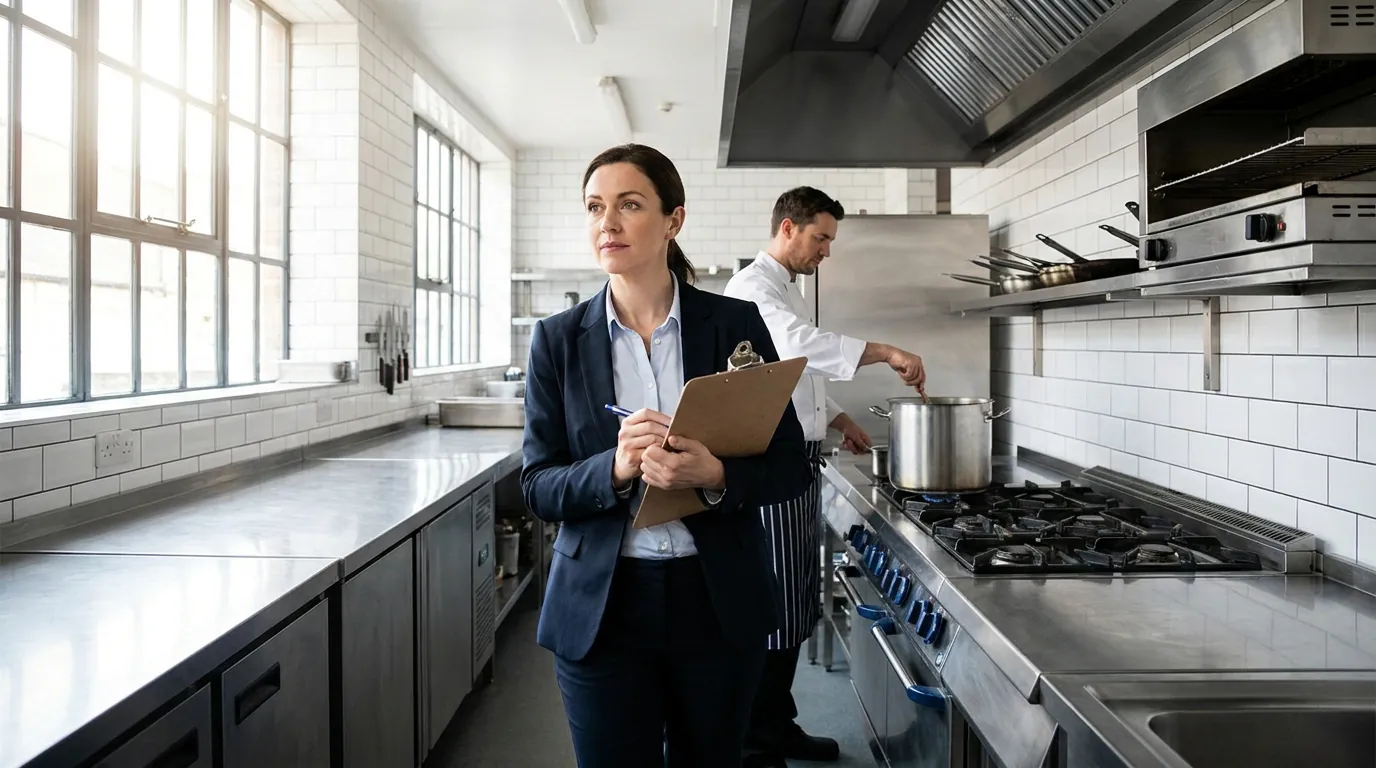
When a local authority food safety officer inspects, they assess three things: how hygienically food is handled, the physical condition of the premises (including cleanliness), and how the business manages food safety through its processes, training and systems. Your cleaning schedule and completed records sit squarely in that third area — and visible cleanliness feeds the second.
Those three areas combine into your Food Hygiene Rating, which runs from 5 (very good) down to 0 (urgent improvement necessary). The rating is a snapshot of the standards found on the day, so consistent everyday cleaning — not a frantic pre-inspection blitz — is what protects it.
Common kitchen cleaning mistakes that lose hygiene-rating points
From what we see working with UK kitchens, the recurring failures are predictable:
- Disinfecting a dirty surface. Skipping stage one means stage two does nothing, because disinfectants only work on a visibly clean surface.
- Ignoring contact times and dilution. Wiping sanitiser straight off, or mixing it too weak, defeats it — follow the manufacturer’s instructions.
- Not rinsing food-contact surfaces after disinfecting, risking chemical contamination of food.
- Treating “after use” as “end of day”. Contact surfaces and boards need cleaning and disinfecting between tasks, especially after raw food.
- Using one slicer or mincer for raw and ready-to-eat in the same day — a documented high-risk practice.
- Reusing tired cloths. Reusable cloths need hot washing and disinfecting between tasks; bleach is not suitable for them.
- A schedule no one follows. A plan that isn’t on the wall, isn’t trained out, and has no completed records is the gap an EHO finds first.
Frequently asked questions
How often should you clean a commercial kitchen? There is no single legally fixed frequency. UK law (Regulation (EC) 852/2004) requires premises to be “kept clean” and contact equipment “effectively cleaned and, where necessary, disinfected”. In practice: clean as you go and clean/disinfect contact surfaces between tasks (especially after raw food), a daily kitchen clean each shift, and weekly or periodic deep cleans for items like fridges, ovens and extraction — all set in a risk-based cleaning schedule.
What is the FSA two-stage cleaning method? Cleaning and disinfection must be done in two stages: first clean with hot soapy water or a cleaning product to remove visible dirt and grease, then apply a disinfectant or sanitiser to the now visibly clean surface and leave it for the required contact time before rinsing. Disinfectants only work on already-clean surfaces.
How often should food contact surfaces be cleaned and disinfected? Clean and disinfect food areas and equipment between different tasks, especially after handling raw food. The FSA Safer Food Better Business example schedule shows work surfaces and chopping boards cleaned and disinfected “after use”, so the practical frequency for contact surfaces is between every task, not just at the end of the day.
Do you legally need a written cleaning schedule? You must keep documented HACCP-based procedures and records proportionate to your business (Article 5 of Regulation 852/2004). The FSA’s Safer Food Better Business pack provides a cleaning schedule template that records what is cleaned, how, with what, and how often — and an EHO will expect to see it and your completed records at inspection.
What standard should commercial kitchen disinfectant meet? Disinfectants and sanitisers used in a food business should meet British Standard BS EN 1276 or BS EN 13697, and must be diluted and left on for the contact time stated in the manufacturer’s instructions to be effective.
What does ‘clean as you go’ mean in a kitchen? “Clear and clean as you go” means keeping the kitchen free of clutter and rubbish, washing or wiping spills as soon as they happen, clearing away used equipment, and washing work surfaces thoroughly between tasks — using a fresh or disinfected cloth before preparing ready-to-eat food.
How does an EHO check your cleaning at an inspection? A local authority food safety officer (EHO) assesses three things: how hygienically food is handled, the physical condition and cleanliness of the premises, and how you manage food safety — including your cleaning schedule, the chemicals you use, staff training and completed cleaning records. This feeds your Food Hygiene Rating (0 to 5).
The bottom line
The question “how often should you clean a commercial kitchen?” has no single legal answer, and that is the point. UK law sets the standard — kept clean, effectively cleaned and disinfected — and leaves the frequency to a risk-based schedule you write, follow and record. Get the layers right (clean as you go, between tasks, daily, and periodic deep cleans), use the two-stage method properly, focus disinfection where it counts, and keep honest records. Do that consistently and the inspection looks after itself, because the standard is already being met every day rather than rebuilt the night before.
Related Forkto software
Frequently asked questions
How often should you clean a commercial kitchen?
There is no single legally fixed frequency. UK law (Regulation (EC) 852/2004) requires premises to be 'kept clean' and contact equipment 'effectively cleaned and, where necessary, disinfected'. In practice this means: clean as you go and clean/disinfect contact surfaces between tasks (especially after raw food), a daily kitchen clean each shift, and weekly or periodic deep cleans for items like fridges, ovens and extraction — all set in a risk-based cleaning schedule.
What is the FSA two-stage cleaning method?
Cleaning and disinfection must be done in two stages: first clean with hot soapy water or a cleaning product to remove visible dirt and grease, then apply a disinfectant or sanitiser to the now visibly clean surface and leave it for the required contact time before rinsing. Disinfectants only work on already-clean surfaces.
How often should food contact surfaces be cleaned and disinfected?
Clean and disinfect food areas and equipment between different tasks, especially after handling raw food. The FSA Safer Food Better Business example schedule shows work surfaces and chopping boards cleaned and disinfected 'after use', so the practical frequency for contact surfaces is between every task, not just at the end of the day.
Do you legally need a written cleaning schedule?
You must keep documented HACCP-based procedures and records proportionate to your business (Article 5 of Regulation 852/2004). The FSA's Safer Food Better Business pack provides a cleaning schedule template that records what is cleaned, how, with what, and how often — and an EHO will expect to see it and your completed records at inspection.
What standard should commercial kitchen disinfectant meet?
Disinfectants and sanitisers used in a food business should meet British Standard BS EN 1276 or BS EN 13697, and must be diluted and left on for the contact time stated in the manufacturer's instructions to be effective.
What does 'clean as you go' mean in a kitchen?
'Clear and clean as you go' means keeping the kitchen free of clutter and rubbish, washing or wiping spills as soon as they happen, clearing away used equipment, and washing work surfaces thoroughly between tasks — using a fresh or disinfected cloth before preparing ready-to-eat food.
How does an EHO check your cleaning at an inspection?
A local authority food safety officer (EHO) assesses three things: how hygienically food is handled, the physical condition and cleanliness of the premises, and how you manage food safety — including your cleaning schedule, the chemicals you use, staff training and completed cleaning records. This feeds your Food Hygiene Rating (0 to 5).
Safe hands, clear records
Stop running food safety on paper
Forkto turns daily checks, temperature logs, HACCP and audits into a few taps on a phone. Your team stays consistent and you're always ready for the EHO.
14-day free trial · No card required