Kitchen Waste Log
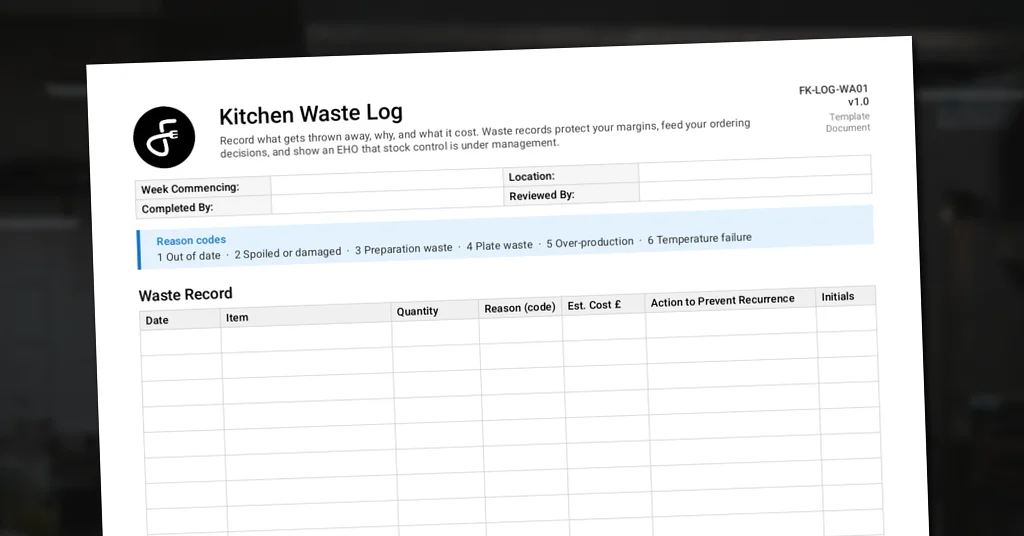
A free printable kitchen waste log for commercial kitchens. Record what you throw away, why, and what it cost — protect your margins and show EHOs that stock control is managed.
Download resource
Download PDFMost food safety records are pure cost — necessary, but they only ever take time. A waste log is the exception: it is the rare record that pays for itself. This free Kitchen Waste Log helps you record what gets thrown away, why, and what it cost, so the same sheet that protects your margins also shows an Environmental Health Officer that stock control is under management.
Why Track Waste
Every item in the bin was bought, delivered, stored and often prepped before it was thrown out — so waste is money you have already spent, gone. Without a record you can feel that food is being wasted, but you cannot see which items, how often, or why. A log turns a vague sense of loss into a short list you can actually act on.
There is a compliance dividend too. Recording waste — especially items binned because they were out of date or spoiled — is direct evidence that stock rotation and date control are being managed. An inspector assessing confidence in management wants to see that expired stock is caught and removed on a system, not discovered by chance. A waste log shows exactly that.
What the Log Tracks
Each row records a single instance of waste:
- Date — when the item was thrown away
- Item — what was wasted
- Quantity — how much
- Reason (code) — why, using the reason codes below
- Est. cost — a rough value for the wasted item, so losses add up to a number
- Action to prevent recurrence — what will stop it happening again
- Initials — who recorded it
The sheet also carries Week Commencing, Location, Completed By and Reviewed By fields and a sign-off (ref: FK-LOG-WA01).
The Reason Codes
Every entry is coded so you can see where losses cluster:
- Out of date — passed its use-by or best-before
- Spoiled or damaged — no longer usable
- Preparation waste — trimmings and offcuts from prep
- Plate waste — returned or uneaten by customers
- Over-production — cooked more than was sold
- Temperature failure — lost to a cold-chain or hot-holding failure
The codes are the point. Ten entries all coded 5 tell you to make smaller batches; a run of code 1 tells you to order less or rotate stock better; repeated code 6 points at a fridge, a freezer or a delivery that needs attention.
How to Use It
-
Keep the log by the bin. Waste recorded at the moment it happens is accurate; waste reconstructed at the end of the week is a guess.
-
Code every entry. The reason code is what turns a list into a diagnosis — without it you know you are wasting food but not why.
-
Estimate the cost. It does not need to be exact. A rough figure per line makes the weekly total real and turns waste into a business case for change.
-
Fill in the action column. A recorded loss with no action is just an accountancy note. “Reduce Friday soup batch by half” is what actually saves money next week.
-
Review weekly. Total the cost, look at which reason codes dominate, and adjust ordering, prep and portioning accordingly.
Part of a Complete System
Waste tracking connects the records either side of it:
- Goods-In Delivery Record — reducing waste starts by rejecting substandard deliveries before they reach the shelf
- Fridge & Freezer Temperature Log — catches the temperature failures behind reason code 6
- Stock Rotation Guide — the first-in, first-out discipline that cuts out-of-date waste
Go Digital
A paper waste log tells you what happened; it does not add up the cost or show you the trend. With Forkto, waste becomes a live wastage-tracking record that totals cost by reason and item automatically and feeds your stock management — so the pattern behind your losses is obvious, and the case for ordering or prepping differently makes itself.
Frequently asked questions
Why should a commercial kitchen keep a food waste log?
A waste log is one of the few records that pays for itself. Recording what you throw away, why, and what it cost reveals where money is leaving the kitchen — over-ordering, over-production, spoilage — so you can act on it. It also shows an Environmental Health Officer that stock rotation and date control are actively managed, not left to chance.
What should a food waste log record?
For each entry, record the date, the item, the quantity, a reason code, the estimated cost, and an action to prevent it happening again. The cost column turns waste from an abstract problem into a number, and the action column turns a record into an improvement.
What are the main reasons for food waste in a kitchen?
This log uses six reason codes: out of date, spoiled or damaged, preparation waste, plate waste, over-production and temperature failure. Coding every entry lets you see at a glance whether your biggest losses come from ordering too much, prepping too heavily, cooking too much, or a cold-chain problem.
How does tracking waste actually save money?
You cannot cut what you do not measure. A completed log shows which items you throw away most and why, so you can order more tightly, adjust batch and portion sizes, and tighten stock rotation. The reason codes point straight at the fix — repeated over-production means smaller batches; repeated out-of-date means better rotation or smaller orders.
Tired of paper checklists?
Run this checklist digitally with Forkto
Assign checks to staff, get reminders, capture photos and timestamps, and keep a tamper-proof record for the EHO — no more lost paper or missed checks.
14-day free trial · No card required