Food Temperature Log Sheet
A free printable food temperature log sheet for UK kitchens. Record cooking, cooling, reheating and hot holding checks in one place, with target temperatures and corrective actions.
Download resource
Download PDFA fridge log tells you your storage is cold, but it says nothing about the food you actually cook, cool, reheat and hold for service — the stages where pathogens are killed or allowed to multiply. A food temperature log sheet closes that gap. This free, printable log records all four high-risk processes on one line-per-check sheet, with the target temperature, the actual probe reading, and any corrective action taken, so you can prove every batch was handled safely.
Why a Food Temperature Log Matters
The most dangerous moments in a kitchen are not in the fridge — they are at the stove, the hot-hold counter, and the cooling rack. Undercooked food, food reheated only once too gently, or a curry left to cool slowly overnight are classic causes of foodborne illness. A temperature log is how you show these steps were checked and controlled, not left to chance.
Recording temperatures is also central to your food hygiene rating. An Environmental Health Officer assessing your confidence in management will look for cooking, reheating, hot-holding and cooling records as evidence that your food safety management system runs in practice, not just on paper. A complete log is one of the simplest, strongest pieces of due-diligence evidence you can keep.
Every reading you record is only as trustworthy as the probe you take it with, so pair this log with a calibrated thermometer — our probe thermometer calibration guide explains how.
What the Log Tracks
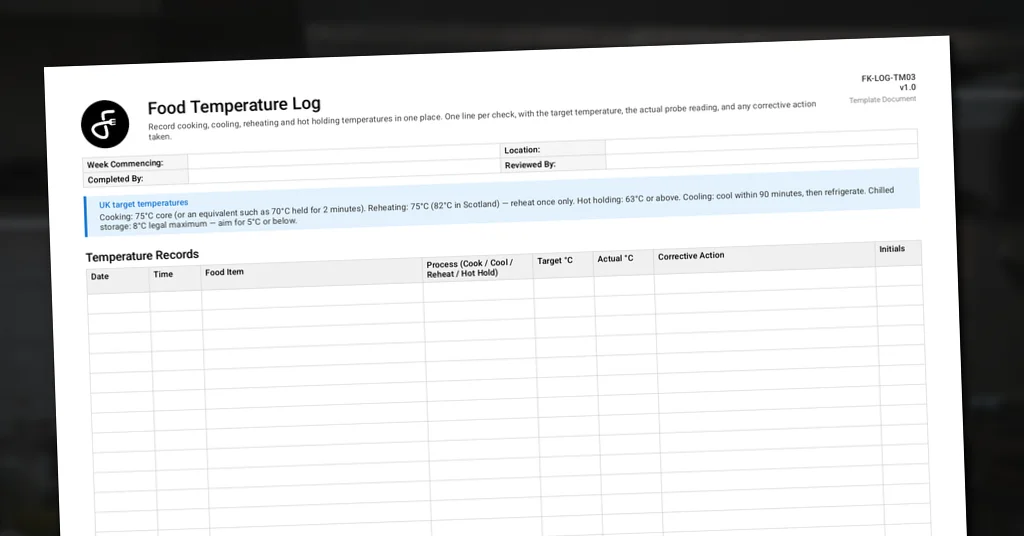
The sheet is a landscape record with a header block for the week commencing, location, who completed it and who reviewed it. Each of its 18 rows captures a single temperature check:
- Date and time of the check
- Food item being checked
- Process — cook, cool, reheat or hot hold, so one sheet covers all four
- Target °C — the temperature the process should reach
- Actual °C — the reading taken with your probe
- Corrective action — what was done if the target was missed
- Initials — who carried out the check
Printed on the sheet is an at-a-glance guide to the UK target temperatures: cook to 75°C core (or an equivalent such as 70°C held for two minutes); reheat to 75°C (82°C in Scotland), and reheat once only; hot hold at 63°C or above; cool within 90 minutes then refrigerate; and store chilled at an 8°C legal maximum, aiming for 5°C or below.
How to Use It
-
Understand the four processes. Cooking is the kill step for most bacteria (75°C core). Cooling matters because slow cooling lets survivors multiply, so get from hot to chilled within 90 minutes. Reheating must hit 75°C (82°C in Scotland) and happen only once. Hot holding must stay at 63°C or above for the whole service.
-
Probe the thickest part. Take readings in the centre or thickest point of the food, where it is slowest to reach temperature, using a clean, calibrated probe.
-
Record the target and the actual reading. Writing both side by side makes a pass or fail obvious at a glance and shows an inspector you know the standard, not just the number.
-
Act on any miss, and write it down. If cooked food is below 75°C, keep cooking and re-probe. If hot-held food drops below 63°C, use it within the two-hour window, reheat to 75°C, or discard it — and note what you did in the corrective action column.
-
Review and sign off. A manager should check the completed sheet each week, confirm checks were done consistently and any failures were resolved, then file it as part of your due-diligence records.
Part of a Complete Temperature System
This log covers food processes; your other temperature records cover storage and equipment. Together they form a complete picture:
- Fridge & Freezer Temperature Log — daily storage temperature recording
- Thermometer Calibration Log — proof the probe behind every reading is accurate
- Probe thermometer calibration guide — how to calibrate and when
If clipboards and missing sheets are a familiar problem, Forkto’s temperature monitoring feature turns these checks into timestamped digital records tied to the member of staff who took them, and flags an out-of-range reading the moment it is logged.
Frequently asked questions
What temperature should food be cooked to in the UK?
Aim for a core temperature of 75°C, or an equivalent time-and-temperature combination such as 70°C held for two minutes. The same principle applies to reheating: 75°C, or 82°C in Scotland. Always check with a clean, calibrated probe in the thickest part of the food.
What is the correct hot holding temperature?
Hot food held for service must be kept at 63°C or above. Food can be held below 63°C for a single period of up to two hours, after which it must be used, reheated to 75°C, or thrown away. Recording hot-holding checks lets you prove the 63°C limit was met throughout service.
How quickly should cooked food be cooled?
Cool cooked food as fast as possible, ideally within 90 minutes, then move it into refrigerated storage at 8°C or below — aim for 5°C. Speed cooling by dividing food into smaller portions, using shallow trays, or an ice bath or blast chiller, and record the check on your temperature log.
Do I have to record cooking temperatures by law?
The law requires you to keep food safe, and temperature records are the standard way to prove you did. An Environmental Health Officer assessing your confidence in management will expect to see cooking, reheating, hot-holding and cooling records — which is exactly what this log captures in one place.
Tired of paper checklists?
Run this checklist digitally with Forkto
Assign checks to staff, get reminders, capture photos and timestamps, and keep a tamper-proof record for the EHO — no more lost paper or missed checks.
14-day free trial · No card required