Goods-In Delivery Record
A free printable goods-in delivery record for UK kitchens. Log temperature, vehicle, packaging and date-code checks for every delivery, with a clear accept or reject decision.
Download resource
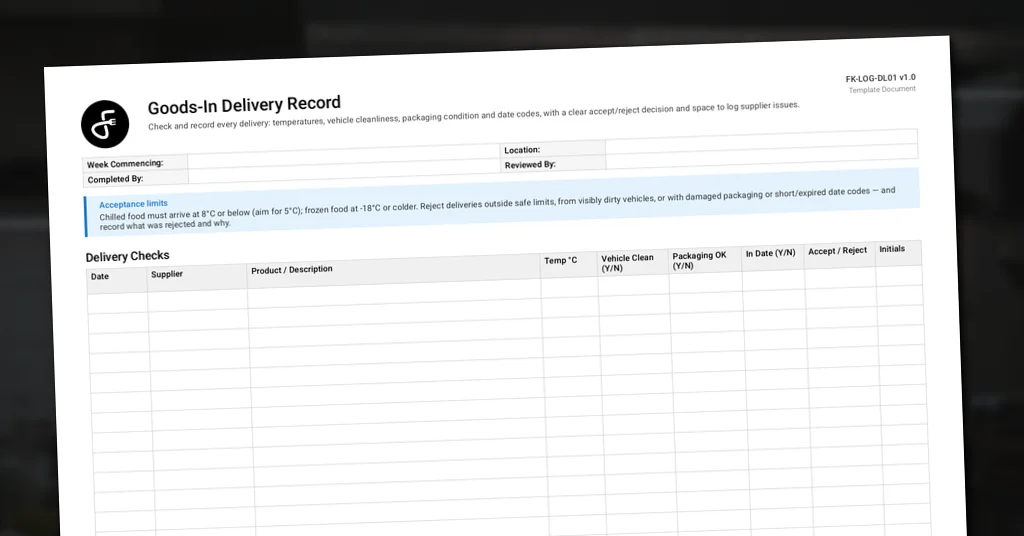
Download PDFEverything in your kitchen starts as a delivery — and a cold chain that has already broken before food reaches your fridge is a problem no amount of careful storage can fix. This free Goods-In Delivery Record gives you a printable sheet to check and record every delivery as it arrives: temperature, vehicle, packaging and date codes, with a clear accept or reject decision.
Why Delivery Checks Matter
The goods-in step is your first and best chance to keep unsafe food out of the building. Once a chilled delivery has been sitting in a warm van, or a case of stock arrives past its date code, the risk is already in your kitchen — checking it in properly is how you stop it going any further.
Keeping the record also protects you. Delivery checks sit within supplier control and the due-diligence defence: a completed log shows an Environmental Health Officer that checks are done consistently and that substandard deliveries are caught, not quietly accepted. It is exactly the kind of documented, working system that earns confidence in management.
For a full walkthrough of what “good” looks like at the back door, read our guide to goods-in and delivery checks. And if the same supplier keeps failing your checks, our guide on how to choose food suppliers covers when to review the relationship.
What the Record Tracks
Each row of the record captures a single delivery and the decision you made about it:
- Date — when the delivery arrived
- Supplier — who it came from, so issues can be traced and patterns spotted
- Product / description — what was delivered
- Temp — the probe reading for chilled and frozen items on arrival
- Vehicle clean (Y/N) — whether the delivery vehicle was clean and fit to carry food
- Packaging OK (Y/N) — whether packaging was intact and undamaged
- In date (Y/N) — whether date codes were correct and not short or expired
- Accept / reject — the decision for that delivery
- Initials — who checked it in, for accountability
Below the main table, a rejections and supplier issues section gives you space to record what was rejected and why. The sheet also carries Week Commencing, Location, Completed By and Reviewed By fields and a sign-off (ref: FK-LOG-DL01).
Acceptance Limits
Use these as your accept-or-reject thresholds:
- Chilled food — 8 degrees C or below on arrival, and aim for 5 degrees C
- Frozen food — minus 18 degrees C or colder
Reject any delivery outside these temperature limits, arriving on a visibly dirty vehicle, with damaged packaging, or carrying short or expired date codes — and record what was rejected and why. A probe reading is only as good as the probe, so check yours against your thermometer calibration log regularly.
How to Use It
-
Keep the record and a probe at the delivery point. Checks that mean walking across the kitchen for a form get skipped.
-
Probe chilled and frozen items before signing for them. Once you have accepted a delivery, a temperature failure becomes your problem, not the supplier’s.
-
Record the reject, not just the accepts. A log that shows a delivery was turned away — with the reason — is stronger evidence your system works than a page of unbroken “accepts”.
-
Use the rejections section. Note the item, the reason and the supplier so repeated problems are visible.
-
Sign off and file weekly. A manager review closes the loop and keeps the record part of your due-diligence file.
Part of a Complete Food Safety System
Delivery records connect to the checks either side of them:
- Fridge & Freezer Temperature Log — where accepted chilled and frozen stock is stored and monitored
- Thermometer Calibration Log — keeps the probe you check deliveries with accurate
- Kitchen Waste Log — catches what gets thrown away when a delivery slips through
Go Digital
Paper delivery notes pile up and are almost impossible to search when you need to trace a problem back to a supplier. With Forkto, your goods-in checks become digital food records — every delivery timestamped, tied to the staff member who checked it in, with rejections and supplier issues logged and searchable. When a supplier keeps sending warm deliveries, the evidence is already there.
Frequently asked questions
What temperature should chilled and frozen food be delivered at?
Chilled food should arrive at 8 degrees C or below — aim for 5 degrees C — and frozen food at minus 18 degrees C or colder. Check the temperature on arrival with a clean probe, and reject anything delivered outside these limits rather than putting it into storage.
What should you check when receiving a food delivery?
Check the temperature of chilled and frozen items, that the delivery vehicle is clean, that packaging is intact and undamaged, and that date codes are correct and not short or expired. Then make a clear accept or reject decision and record it against the supplier and product.
Do food businesses need to keep delivery records?
Keeping goods-in records is not a single named regulation, but it is central to supplier control and to the due-diligence evidence an Environmental Health Officer looks for. A completed delivery record shows checks are done consistently and that substandard deliveries are caught and rejected — strong confidence-in-management evidence.
What should you do if a delivery fails the checks?
Reject the affected items rather than accepting them into storage. Record what was rejected and why in the rejections section, and raise it with the supplier. A pattern of rejections against one supplier is a signal to review whether they are still fit to use.
Tired of paper checklists?
Run this checklist digitally with Forkto
Assign checks to staff, get reminders, capture photos and timestamps, and keep a tamper-proof record for the EHO — no more lost paper or missed checks.
14-day free trial · No card required